

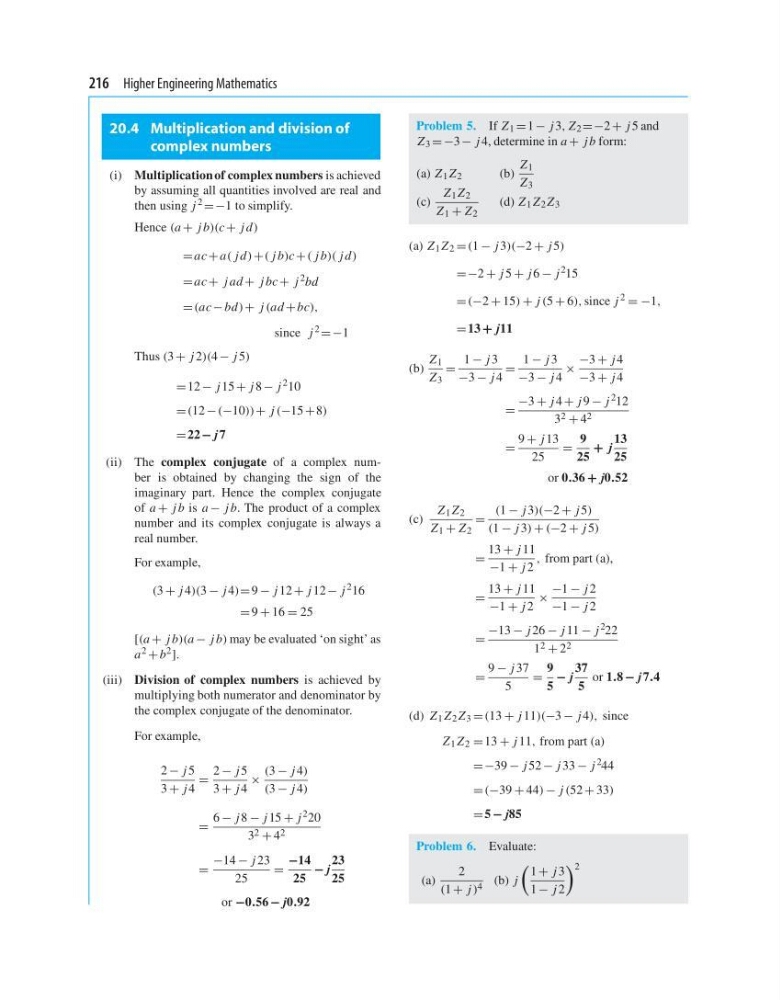
216 Higher Engineering Mathematics
20.4 Multiplication and division of
complex numbers
(i) Multiplication of complex numbers is achieved
by assuming all quantities involved are real and
then using j 2 =−1 to simplify.
Hence (a + j b)(c + j d)
= ac + a( j d) +( j b)c + ( j b)( j d)
= ac + j ad + j bc+ j 2 bd
= (ac − bd) + j (ad + bc),
since j 2 =−1
Thus (3 + j 2)(4 − j 5)
= 12 − j 15 + j 8 − j 2 10
= (12 − (−10)) + j (−15 +8)
= 22 − j 7
(ii) The complex conjugate of a complex number is obtained by changing the sign of the
imaginary part. Hence the complex conjugate
of a + j b is a − j b. The product of a complex
number and its complex conjugate is always a
real number.
For example,
(3 + j 4)(3 − j 4)= 9 − j 12 + j 12 − j 2 16
= 9 + 16 = 25
[(a + j b)(a − j b) may be evaluated ‘on sight’ as
a 2 + b 2 ].
(iii) Division of complex numbers is achieved by
multiplying both numerator and denominator by
the complex conjugate of the denominator.
For example,
2 − j 5
3 + j 4
=
2 − j 5
3 + j 4
×
(3 − j 4)
(3 − j 4)
=
6 − j 8 − j 15 + j 2 20
3 2 + 4 2
=
−14 − j 23
25
=
−14
25
− j
23
25
or −0.56 − j0.92
Problem 5. If Z 1 = 1 − j 3, Z 2 =−2 + j 5 and
Z 3 = −3 − j 4, determine in a + j b form:
(a) Z 1 Z 2
(b)
Z 1
Z 3
(c)
Z 1 Z 2
Z 1 + Z 2
(d) Z 1 Z 2 Z 3
(a) Z 1 Z 2 = (1 − j 3)(−2 + j 5)
=−2 + j 5 + j 6 − j 2 15
= (−2 + 15) + j (5 + 6), since j 2 = −1,
= 13 + j11
(b)
Z 1
Z 3
=
1 − j 3
−3 − j 4
=
1 − j 3
−3 − j 4
×
−3 + j 4
−3 + j 4
=
−3 + j 4 + j 9 − j 2 12
3 2 + 4 2
=
9 + j 13
25
=
9
25
+ j
13
25
or 0.36 + j0.52
(c)
Z 1 Z 2
Z 1 + Z 2
=
(1 − j 3)(−2 + j 5)
(1 − j 3) + (−2 + j 5)
=
13 + j 11
−1 + j 2
, from part (a),
=
13 + j 11
−1 + j 2
×
−1 − j 2
−1 − j 2
=
−13 − j 26 − j 11 − j 2 22
1 2 + 2 2
=
9 − j 37
5
=
9
5
− j
37
5
or 1.8 − j 7.4
(d) Z 1 Z 2 Z 3 = (13 + j 11)(−3 − j 4), since
Z 1 Z 2 = 13 + j 11, from part (a)
=−39 − j 52 − j 33 − j 2 44
= (−39 + 44) − j (52 + 33)
= 5 − j85
Problem 6. Evaluate:
(a)
2
(1 + j ) 4 (b) j
1 + j 3
1 − j 2
2
20.4 Multiplication and division of
complex numbers
(i) Multiplication of complex numbers is achieved
by assuming all quantities involved are real and
then using j 2 =−1 to simplify.
Hence (a + j b)(c + j d)
= ac + a( j d) +( j b)c + ( j b)( j d)
= ac + j ad + j bc+ j 2 bd
= (ac − bd) + j (ad + bc),
since j 2 =−1
Thus (3 + j 2)(4 − j 5)
= 12 − j 15 + j 8 − j 2 10
= (12 − (−10)) + j (−15 +8)
= 22 − j 7
(ii) The complex conjugate of a complex number is obtained by changing the sign of the
imaginary part. Hence the complex conjugate
of a + j b is a − j b. The product of a complex
number and its complex conjugate is always a
real number.
For example,
(3 + j 4)(3 − j 4)= 9 − j 12 + j 12 − j 2 16
= 9 + 16 = 25
[(a + j b)(a − j b) may be evaluated ‘on sight’ as
a 2 + b 2 ].
(iii) Division of complex numbers is achieved by
multiplying both numerator and denominator by
the complex conjugate of the denominator.
For example,
2 − j 5
3 + j 4
=
2 − j 5
3 + j 4
×
(3 − j 4)
(3 − j 4)
=
6 − j 8 − j 15 + j 2 20
3 2 + 4 2
=
−14 − j 23
25
=
−14
25
− j
23
25
or −0.56 − j0.92
Problem 5. If Z 1 = 1 − j 3, Z 2 =−2 + j 5 and
Z 3 = −3 − j 4, determine in a + j b form:
(a) Z 1 Z 2
(b)
Z 1
Z 3
(c)
Z 1 Z 2
Z 1 + Z 2
(d) Z 1 Z 2 Z 3
(a) Z 1 Z 2 = (1 − j 3)(−2 + j 5)
=−2 + j 5 + j 6 − j 2 15
= (−2 + 15) + j (5 + 6), since j 2 = −1,
= 13 + j11
(b)
Z 1
Z 3
=
1 − j 3
−3 − j 4
=
1 − j 3
−3 − j 4
×
−3 + j 4
−3 + j 4
=
−3 + j 4 + j 9 − j 2 12
3 2 + 4 2
=
9 + j 13
25
=
9
25
+ j
13
25
or 0.36 + j0.52
(c)
Z 1 Z 2
Z 1 + Z 2
=
(1 − j 3)(−2 + j 5)
(1 − j 3) + (−2 + j 5)
=
13 + j 11
−1 + j 2
, from part (a),
=
13 + j 11
−1 + j 2
×
−1 − j 2
−1 − j 2
=
−13 − j 26 − j 11 − j 2 22
1 2 + 2 2
=
9 − j 37
5
=
9
5
− j
37
5
or 1.8 − j 7.4
(d) Z 1 Z 2 Z 3 = (13 + j 11)(−3 − j 4), since
Z 1 Z 2 = 13 + j 11, from part (a)
=−39 − j 52 − j 33 − j 2 44
= (−39 + 44) − j (52 + 33)
= 5 − j85
Problem 6. Evaluate:
(a)
2
(1 + j ) 4 (b) j
1 + j 3
1 − j 2
2