

214 Higher Engineering Mathematics
Problem 3. Evaluate
(a) j 3 (b) j 4 (c) j 23 (d)
−4
j 9
(a) j 3 = j 2 × j = (−1) × j = − j, since j 2 =−1
(b) j 4 = j 2 × j 2 = (−1) × (−1) = 1
(c) j 23 = j × j 22 = j × ( j 2 ) 11 = j × (−1) 11
= j × (−1) = − j
(d) j 9 = j × j 8 = j × ( j 2 ) 4 = j × (−1) 4
= j × 1 = j
Hence
−4
j 9 =
−4
j
=
−4
j
×
− j
− j
=
4 j
− j 2
=
4 j
−(−1)
= 4 j or j4
Now try the following exercise
Exercise 85 Further problems on the
introduction to cartesian complex numbers
In Problems 1 to 9, solve the quadratic equations.
1. x 2 + 25 =0
[ ± j 5]
2. x
2
− 2x + 2 = 0
[ x = 1 ± j ]
3. x 2 − 4x + 5 =0
[ x = 2 ± j ]
4. x 2 − 6x + 10 =0
[ x = 3 ± j ]
5. 2x 2 − 2x + 1 =0
[ x = 0.5 ± j 0.5]
6. x
2
− 4x + 8 =0
[ x = 2 ± j 2]
7. 25x 2 − 10x + 2 = 0
[ x = 0.2 ± j 0.2]
8. 2x 2 + 3x + 4 =0
−
3
4
± j
√
23
4
or − 0.750 ± j 1.199
9. 4t 2 − 5t + 7 =0
5
8
± j
√
87
8
or 0.625 ± j 1.166
10. Evaluate (a) j 8 (b) −
1
j 7 (c)
4
2 j 13
[(a) 1 (b) − j (c) − j 2]
20.2 The Argand diagram
A complex number may be represented pictorially on
rectangular or cartesian axes. The horizontal (or x) axis is
used to represent the real axis and the vertical (or y) axis
is used to represent the imaginary axis. Such a diagram
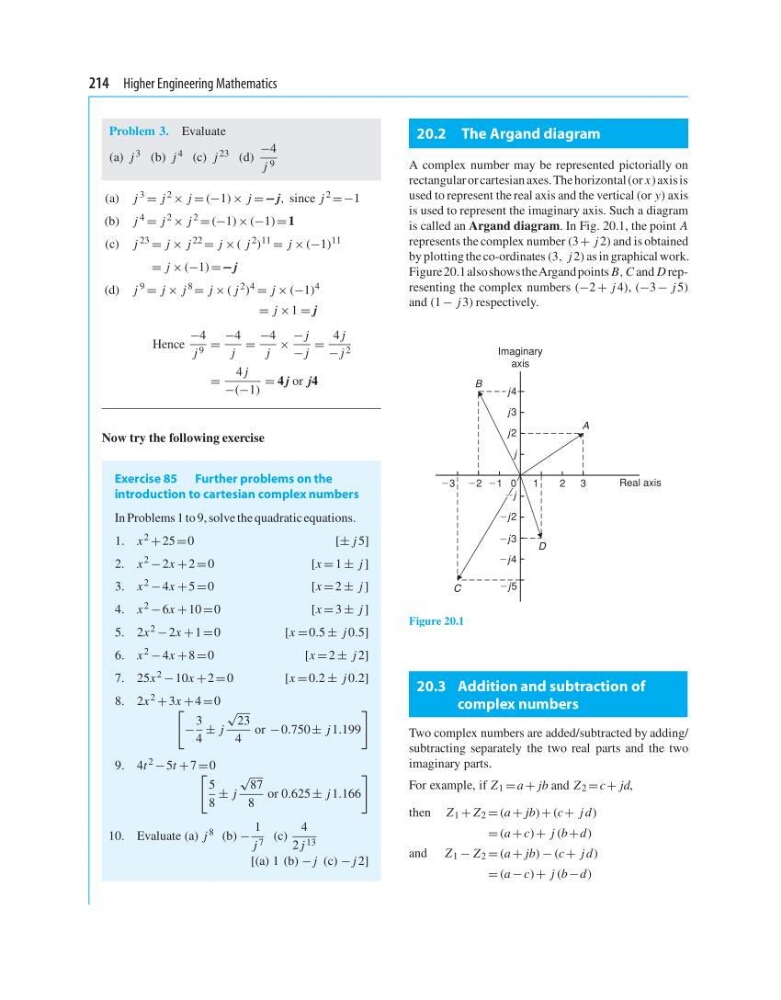
is called an Argand diagram. In Fig. 20.1, the point A
represents the complex number (3 + j 2) and is obtained
by plotting the co-ordinates (3, j 2) as in graphical work.
Figure20.1 also showstheArgand points B, C and D representing the complex numbers (−2 + j 4), (−3 − j 5)
and (1 − j 3) respectively.
2
21
22
2j
j
2j 2
j 2
2j 3
j 3
2j 4
3
Real axis
Imaginary
axis
A
B
D
C
0
1
23
2j 5
j4
Figure 20.1
20.3 Addition and subtraction of
complex numbers
Two complex numbers are added/subtracted by adding/
subtracting separately the two real parts and the two
imaginary parts.
For example, if Z 1 = a + jb and Z 2 = c + jd,
then Z 1 + Z 2 = (a + jb) + (c + j d)
= (a + c) + j (b +d)
and Z 1 − Z 2 = (a + jb) − (c + j d)
= (a − c) + j (b −d)
Problem 3. Evaluate
(a) j 3 (b) j 4 (c) j 23 (d)
−4
j 9
(a) j 3 = j 2 × j = (−1) × j = − j, since j 2 =−1
(b) j 4 = j 2 × j 2 = (−1) × (−1) = 1
(c) j 23 = j × j 22 = j × ( j 2 ) 11 = j × (−1) 11
= j × (−1) = − j
(d) j 9 = j × j 8 = j × ( j 2 ) 4 = j × (−1) 4
= j × 1 = j
Hence
−4
j 9 =
−4
j
=
−4
j
×
− j
− j
=
4 j
− j 2
=
4 j
−(−1)
= 4 j or j4
Now try the following exercise
Exercise 85 Further problems on the
introduction to cartesian complex numbers
In Problems 1 to 9, solve the quadratic equations.
1. x 2 + 25 =0
[ ± j 5]
2. x
2
− 2x + 2 = 0
[ x = 1 ± j ]
3. x 2 − 4x + 5 =0
[ x = 2 ± j ]
4. x 2 − 6x + 10 =0
[ x = 3 ± j ]
5. 2x 2 − 2x + 1 =0
[ x = 0.5 ± j 0.5]
6. x
2
− 4x + 8 =0
[ x = 2 ± j 2]
7. 25x 2 − 10x + 2 = 0
[ x = 0.2 ± j 0.2]
8. 2x 2 + 3x + 4 =0
−
3
4
± j
√
23
4
or − 0.750 ± j 1.199
9. 4t 2 − 5t + 7 =0
5
8
± j
√
87
8
or 0.625 ± j 1.166
10. Evaluate (a) j 8 (b) −
1
j 7 (c)
4
2 j 13
[(a) 1 (b) − j (c) − j 2]
20.2 The Argand diagram
A complex number may be represented pictorially on
rectangular or cartesian axes. The horizontal (or x) axis is
used to represent the real axis and the vertical (or y) axis
is used to represent the imaginary axis. Such a diagram
is called an Argand diagram. In Fig. 20.1, the point A
represents the complex number (3 + j 2) and is obtained
by plotting the co-ordinates (3, j 2) as in graphical work.
Figure20.1 also showstheArgand points B, C and D representing the complex numbers (−2 + j 4), (−3 − j 5)
and (1 − j 3) respectively.
2
21
22
2j
j
2j 2
j 2
2j 3
j 3
2j 4
3
Real axis
Imaginary
axis
A
B
D
C
0
1
23
2j 5
j4
Figure 20.1
20.3 Addition and subtraction of
complex numbers
Two complex numbers are added/subtracted by adding/
subtracting separately the two real parts and the two
imaginary parts.
For example, if Z 1 = a + jb and Z 2 = c + jd,
then Z 1 + Z 2 = (a + jb) + (c + j d)
= (a + c) + j (b +d)
and Z 1 − Z 2 = (a + jb) − (c + j d)
= (a − c) + j (b −d)