

188 Higher Engineering Mathematics
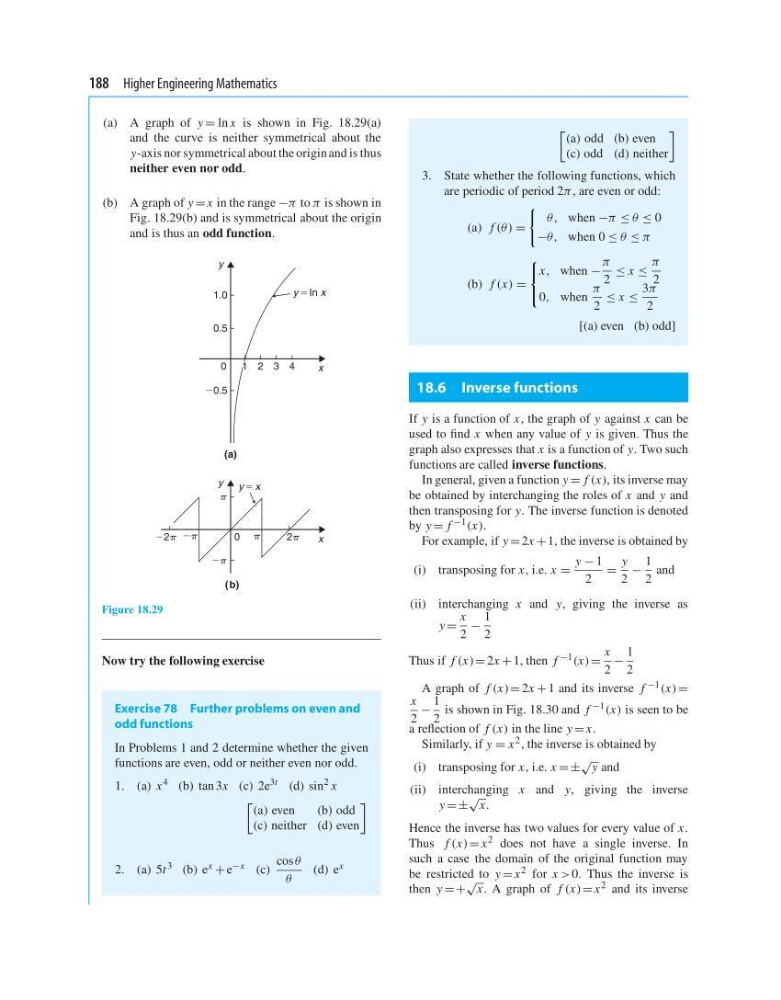
(a) A graph of y = ln x is shown in Fig. 18.29(a)
and the curve is neither symmetrical about the
y-axis nor symmetrical about the origin and is thus
neither even nor odd.
(b) A graph of y = x in the range −π to π is shown in
Fig. 18.29(b) and is symmetrical about the origin
and is thus an odd function.
(a)
y
x
y ϭ In x
Ϫ0.5
1.0
0.5
0
2 3 4
1
(b)
y
x
y ϭ x
0
Ϫ
2
Ϫ2 Ϫ
Figure 18.29
Now try the following exercise
Exercise 78 Further problems on even and
odd functions
In Problems 1 and 2 determine whether the given
functions are even, odd or neither even nor odd.
1. (a) x
4 (b) tan 3x (c) 2e
3t (d) sin
2 x
(a) even
(b) odd
(c) neither (d) even
2. (a) 5t 3 (b) e x + e −x (c)
cos θ
θ
(d) e x
(a) odd (b) even
(c) odd (d) neither
3. State whether the following functions, which
are periodic of period 2π, are even or odd:
(a) f (θ) =
θ, when −π ≤ θ ≤ 0
−θ, when 0 ≤ θ ≤ π
(b) f (x) =
⎧
⎨
⎩
x, when −
π
2
≤ x ≤
π
2
0, when
π
2
≤ x ≤
3π
2
[(a) even (b) odd]
18.6 Inverse functions
If y is a function of x, the graph of y against x can be
used to find x when any value of y is given. Thus the
graph also expresses that x is a function of y. Two such
functions are called inverse functions.
In general, given a function y = f (x), its inverse may
be obtained by interchanging the roles of x and y and
then transposing for y. The inverse function is denoted
by y = f −1 (x).
For example, if y = 2x + 1, the inverse is obtained by
(i) transposing for x, i.e. x =
y − 1
2
=
y
2
−
1
2
and
(ii) interchanging x and y, giving the inverse as
y =
x
2
−
1
2
Thus if f (x) = 2x + 1, then f −1 (x) =
x
2
−
1
2
A graph of f (x) = 2x + 1 and its inverse f −1 (x) =
x
2
−
1
2
is shown in Fig. 18.30 and f −1 (x) is seen to be
a reflection of f (x) in the line y = x.
Similarly, if y = x 2 , the inverse is obtained by
(i) transposing for x, i.e. x =±
√ y and
(ii) interchanging x and y, giving the inverse
y =±
√
x.
Hence the inverse has two values for every value of x.
Thus f (x) = x 2 does not have a single inverse. In
such a case the domain of the original function may
be restricted to y = x 2 for x > 0. Thus the inverse is
then y =+
√
x. A graph of f (x) = x 2 and its inverse
(a) A graph of y = ln x is shown in Fig. 18.29(a)
and the curve is neither symmetrical about the
y-axis nor symmetrical about the origin and is thus
neither even nor odd.
(b) A graph of y = x in the range −π to π is shown in
Fig. 18.29(b) and is symmetrical about the origin
and is thus an odd function.
(a)
y
x
y ϭ In x
Ϫ0.5
1.0
0.5
0
2 3 4
1
(b)
y
x
y ϭ x
0
Ϫ
2
Ϫ2 Ϫ
Figure 18.29
Now try the following exercise
Exercise 78 Further problems on even and
odd functions
In Problems 1 and 2 determine whether the given
functions are even, odd or neither even nor odd.
1. (a) x
4 (b) tan 3x (c) 2e
3t (d) sin
2 x
(a) even
(b) odd
(c) neither (d) even
2. (a) 5t 3 (b) e x + e −x (c)
cos θ
θ
(d) e x
(a) odd (b) even
(c) odd (d) neither
3. State whether the following functions, which
are periodic of period 2π, are even or odd:
(a) f (θ) =
θ, when −π ≤ θ ≤ 0
−θ, when 0 ≤ θ ≤ π
(b) f (x) =
⎧
⎨
⎩
x, when −
π
2
≤ x ≤
π
2
0, when
π
2
≤ x ≤
3π
2
[(a) even (b) odd]
18.6 Inverse functions
If y is a function of x, the graph of y against x can be
used to find x when any value of y is given. Thus the
graph also expresses that x is a function of y. Two such
functions are called inverse functions.
In general, given a function y = f (x), its inverse may
be obtained by interchanging the roles of x and y and
then transposing for y. The inverse function is denoted
by y = f −1 (x).
For example, if y = 2x + 1, the inverse is obtained by
(i) transposing for x, i.e. x =
y − 1
2
=
y
2
−
1
2
and
(ii) interchanging x and y, giving the inverse as
y =
x
2
−
1
2
Thus if f (x) = 2x + 1, then f −1 (x) =
x
2
−
1
2
A graph of f (x) = 2x + 1 and its inverse f −1 (x) =
x
2
−
1
2
is shown in Fig. 18.30 and f −1 (x) is seen to be
a reflection of f (x) in the line y = x.
Similarly, if y = x 2 , the inverse is obtained by
(i) transposing for x, i.e. x =±
√ y and
(ii) interchanging x and y, giving the inverse
y =±
√
x.
Hence the inverse has two values for every value of x.
Thus f (x) = x 2 does not have a single inverse. In
such a case the domain of the original function may
be restricted to y = x 2 for x > 0. Thus the inverse is
then y =+
√
x. A graph of f (x) = x 2 and its inverse