

Functions and their curves 189
y
y5 2x11
y5 x
4
2
2
3
4
1
1
0
21
21
x
y5 2
x
2
1
2
Figure 18.30
y
y5 x
y 5 x
y5 x
2
4
3
1
2
x
2
0
Œ„
Figure 18.31
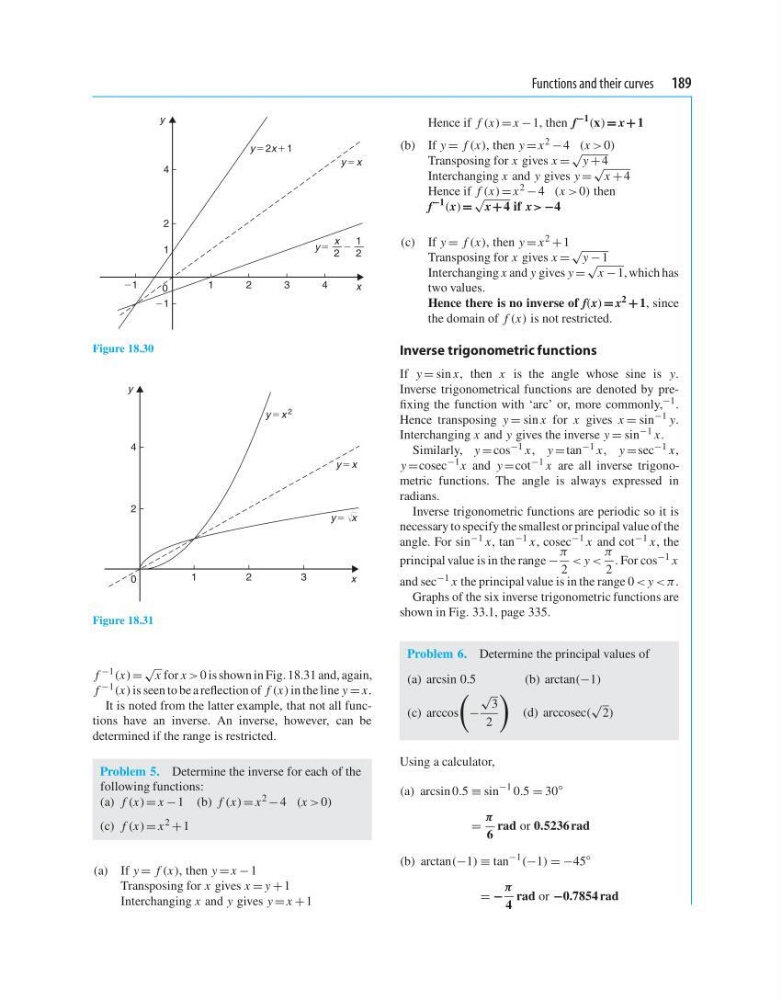
f −1 (x) =
√
x for x > 0 is shown in Fig. 18.31 and, again,
f −1 (x) is seen to be a reflection of f (x) in the line y = x.
It is noted from the latter example, that not all functions have an inverse. An inverse, however, can be
determined if the range is restricted.
Problem 5. Determine the inverse for each of the
following functions:
(a) f (x) = x − 1 (b) f (x) = x 2 − 4 (x > 0)
(c) f (x) = x 2 + 1
(a) If y = f (x), then y = x − 1
Transposing for x gives x = y + 1
Interchanging x and y gives y = x + 1
Hence if f (x) = x − 1, then f
−1
(x) = x + 1
(b) If y = f (x), then y = x 2 − 4 (x > 0)
Transposing for x gives x =
√
y + 4
Interchanging x and y gives y =
√
x + 4
Hence if f (x) = x 2 − 4 (x > 0) then
f
−1
(x) =
√
x + 4 if x > −4
(c) If y = f (x), then y = x 2 + 1
Transposing for x gives x =
√
y − 1
Interchanging x and y gives y =
√
x − 1, which has
two values.
Hence there is no inverse of f(x) = x 2 + 1, since
the domain of f (x) is not restricted.
Inverse trigonometric functions
If y = sin x, then x is the angle whose sine is y.
Inverse trigonometrical functions are denoted by prefixing the function with ‘arc’ or, more commonly, −1 .
Hence transposing y = sin x for x gives x = sin
−1 y.
Interchanging x and y gives the inverse y = sin −1 x.
Similarly, y = cos −1 x, y = tan −1 x, y = sec −1 x,
y =cosec −1 x and y =cot −1 x are all inverse trigonometric functions. The angle is always expressed in
radians.
Inverse trigonometric functions are periodic so it is
necessary to specify the smallest or principal value of the
angle. For sin −1 x, tan −1 x, cosec −1 x and cot −1 x, the
principal value is in the range −
π
2
< y <
π
2
. For cos −1 x
and sec −1 x the principal value is in the range 0 < y <π.
Graphs of the six inverse trigonometric functions are
shown in Fig. 33.1, page 335.
Problem 6. Determine the principal values of
(a) arcsin 0.5
(b) arctan(−1)
(c) arccos
−
√
3
2
(d) arccosec(
√
2)
Using a calculator,
(a) arcsin 0.5 ≡ sin
−1 0.5 = 30
◦
=
π
6
rad or 0.5236 rad
(b) arctan(−1) ≡ tan
−1
(−1) = −45
◦
= −
π
4
rad or −0.7854 rad
y
y5 2x11
y5 x
4
2
2
3
4
1
1
0
21
21
x
y5 2
x
2
1
2
Figure 18.30
y
y5 x
y 5 x
y5 x
2
4
3
1
2
x
2
0
Œ„
Figure 18.31
f −1 (x) =
√
x for x > 0 is shown in Fig. 18.31 and, again,
f −1 (x) is seen to be a reflection of f (x) in the line y = x.
It is noted from the latter example, that not all functions have an inverse. An inverse, however, can be
determined if the range is restricted.
Problem 5. Determine the inverse for each of the
following functions:
(a) f (x) = x − 1 (b) f (x) = x 2 − 4 (x > 0)
(c) f (x) = x 2 + 1
(a) If y = f (x), then y = x − 1
Transposing for x gives x = y + 1
Interchanging x and y gives y = x + 1
Hence if f (x) = x − 1, then f
−1
(x) = x + 1
(b) If y = f (x), then y = x 2 − 4 (x > 0)
Transposing for x gives x =
√
y + 4
Interchanging x and y gives y =
√
x + 4
Hence if f (x) = x 2 − 4 (x > 0) then
f
−1
(x) =
√
x + 4 if x > −4
(c) If y = f (x), then y = x 2 + 1
Transposing for x gives x =
√
y − 1
Interchanging x and y gives y =
√
x − 1, which has
two values.
Hence there is no inverse of f(x) = x 2 + 1, since
the domain of f (x) is not restricted.
Inverse trigonometric functions
If y = sin x, then x is the angle whose sine is y.
Inverse trigonometrical functions are denoted by prefixing the function with ‘arc’ or, more commonly, −1 .
Hence transposing y = sin x for x gives x = sin
−1 y.
Interchanging x and y gives the inverse y = sin −1 x.
Similarly, y = cos −1 x, y = tan −1 x, y = sec −1 x,
y =cosec −1 x and y =cot −1 x are all inverse trigonometric functions. The angle is always expressed in
radians.
Inverse trigonometric functions are periodic so it is
necessary to specify the smallest or principal value of the
angle. For sin −1 x, tan −1 x, cosec −1 x and cot −1 x, the
principal value is in the range −
π
2
< y <
π
2
. For cos −1 x
and sec −1 x the principal value is in the range 0 < y <π.
Graphs of the six inverse trigonometric functions are
shown in Fig. 33.1, page 335.
Problem 6. Determine the principal values of
(a) arcsin 0.5
(b) arctan(−1)
(c) arccos
−
√
3
2
(d) arccosec(
√
2)
Using a calculator,
(a) arcsin 0.5 ≡ sin
−1 0.5 = 30
◦
=
π
6
rad or 0.5236 rad
(b) arctan(−1) ≡ tan
−1
(−1) = −45
◦
= −
π
4
rad or −0.7854 rad