

Functions and their curves 187
Odd functions
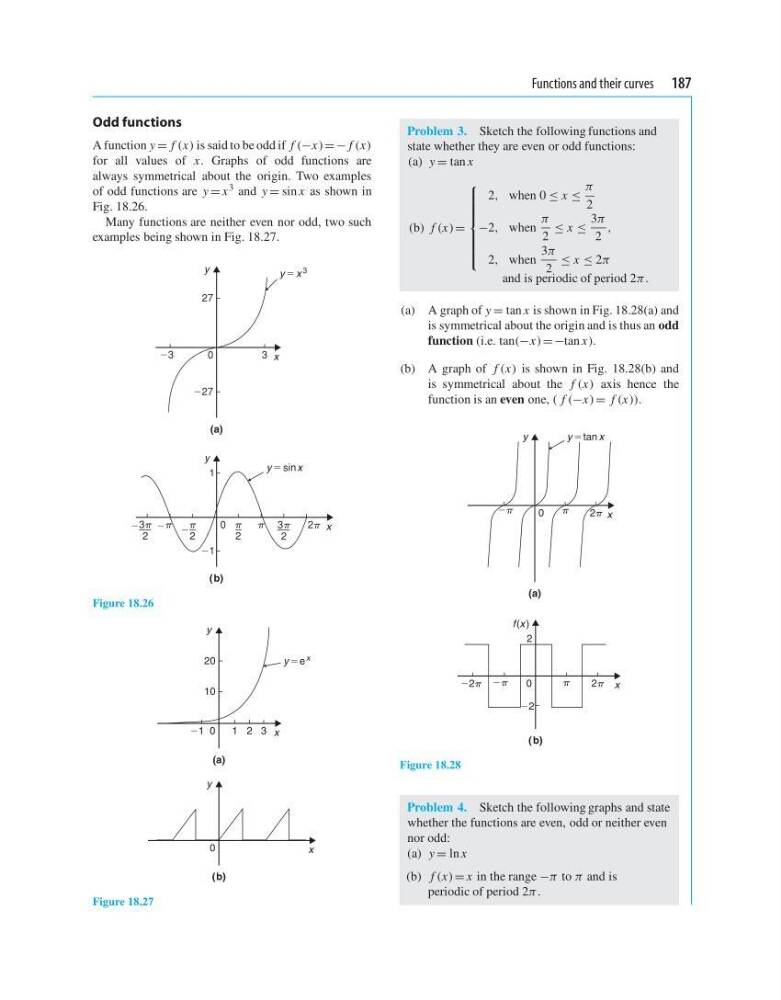
A function y = f (x) is said to be odd if f (−x) = − f (x)
for all values of x. Graphs of odd functions are
always symmetrical about the origin. Two examples
of odd functions are y = x 3 and y = sin x as shown in
Fig. 18.26.
Many functions are neither even nor odd, two such
examples being shown in Fig. 18.27.
(a)
23
y
x
3
27
227
y 5 x 3
0
1
0
(b)
y
x
21
2
y 5 sinx
2 3
2
3
2
2
2
2
2
Figure 18.26
(a)
y
x
3
2
1
Ϫ1
20
10
0
y ϭe
x
y
x
0
(b)
Figure 18.27
Problem 3. Sketch the following functions and
state whether they are even or odd functions:
(a) y = tan x
(b) f (x) =
⎧
⎪ ⎪ ⎪ ⎪ ⎪ ⎨
⎪ ⎪ ⎪ ⎪ ⎪ ⎩
2, when 0 ≤ x ≤
π
2
−2, when
π
2
≤ x ≤
3π
2
,
2, when
3π
2
≤ x ≤ 2π
and is periodic of period 2π.
(a) A graph of y = tan x is shown in Fig. 18.28(a) and
is symmetrical about the origin and is thus an odd
function (i.e. tan(−x) = −tan x).
(b) A graph of f (x) is shown in Fig. 18.28(b) and
is symmetrical about the f (x) axis hence the
function is an even one, ( f (−x) = f (x)).
(a)
y
x
0
2
y ϭ tan x
Ϫ
(b)
f(x )
x
0
2
Ϫ2
2
Ϫ
Ϫ2
Figure 18.28
Problem 4. Sketch the following graphs and state
whether the functions are even, odd or neither even
nor odd:
(a) y = ln x
(b) f (x) = x in the range −π to π and is
periodic of period 2π.
Odd functions
A function y = f (x) is said to be odd if f (−x) = − f (x)
for all values of x. Graphs of odd functions are
always symmetrical about the origin. Two examples
of odd functions are y = x 3 and y = sin x as shown in
Fig. 18.26.
Many functions are neither even nor odd, two such
examples being shown in Fig. 18.27.
(a)
23
y
x
3
27
227
y 5 x 3
0
1
0
(b)
y
x
21
2
y 5 sinx
2 3
2
3
2
2
2
2
2
Figure 18.26
(a)
y
x
3
2
1
Ϫ1
20
10
0
y ϭe
x
y
x
0
(b)
Figure 18.27
Problem 3. Sketch the following functions and
state whether they are even or odd functions:
(a) y = tan x
(b) f (x) =
⎧
⎪ ⎪ ⎪ ⎪ ⎪ ⎨
⎪ ⎪ ⎪ ⎪ ⎪ ⎩
2, when 0 ≤ x ≤
π
2
−2, when
π
2
≤ x ≤
3π
2
,
2, when
3π
2
≤ x ≤ 2π
and is periodic of period 2π.
(a) A graph of y = tan x is shown in Fig. 18.28(a) and
is symmetrical about the origin and is thus an odd
function (i.e. tan(−x) = −tan x).
(b) A graph of f (x) is shown in Fig. 18.28(b) and
is symmetrical about the f (x) axis hence the
function is an even one, ( f (−x) = f (x)).
(a)
y
x
0
2
y ϭ tan x
Ϫ
(b)
f(x )
x
0
2
Ϫ2
2
Ϫ
Ϫ2
Figure 18.28
Problem 4. Sketch the following graphs and state
whether the functions are even, odd or neither even
nor odd:
(a) y = ln x
(b) f (x) = x in the range −π to π and is
periodic of period 2π.