

186 Higher Engineering Mathematics
Now try the following exercise
Exercise 77 Further problems on simple
transformations with curve sketching
Sketch the following graphs, showing relevant
points:
(Answers on page 200, Fig. 18.39)
1. y = 3x − 5
2. y = − 3x + 4
3. y = x 2 + 3
4. y = (x − 3) 2
5. y = (x − 4)
2
+ 2
6. y = x − x 2
7. y = x 3 + 2
8. y = 1 +2 cos 3x
9. y = 3 −2 sin
x +
π
4
10. y = 2 ln x
18.3 Periodic functions
A function f (x) is said to be periodic if f (x + T ) =
f (x) for all values of x, where T is some positive
number. T is the interval between two successive repetitions and is called the period of the function f (x). For
example, y = sin x is periodic in x with period 2π since
sin x = sin(x + 2π)= sin(x + 4π), and so on. Similarly,
y = cos x is a periodic function with period 2π since
cos x = cos(x + 2π)= cos(x + 4π), and so on. In general, if y = sin ωt or y = cos ωt then the period of the
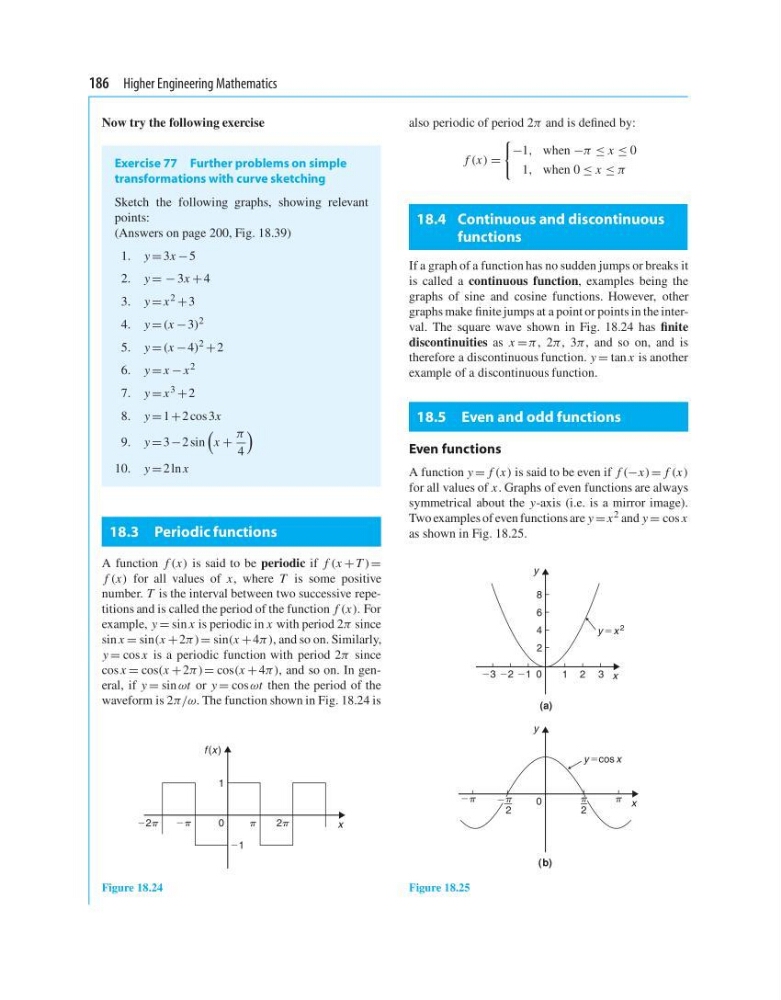
waveform is 2π/ω. The function shown in Fig. 18.24 is
1
Ϫ1
Ϫ2
2
Ϫ
0
f (x)
x
Figure 18.24
also periodic of period 2π and is defined by:
f (x) =
−1, when −π ≤ x ≤ 0
1, when 0 ≤ x ≤ π
18.4 Continuous and discontinuous
functions
If a graph of a function has no sudden jumps or breaks it
is called a continuous function, examples being the
graphs of sine and cosine functions. However, other
graphs make finite jumps at a point or points in the interval. The square wave shown in Fig. 18.24 has finite
discontinuities as x = π, 2π, 3π, and so on, and is
therefore a discontinuous function. y = tan x is another
example of a discontinuous function.
18.5 Even and odd functions
Even functions
A function y = f (x) is said to be even if f (−x) = f (x)
for all values of x. Graphs of even functions are always
symmetrical about the y-axis (i.e. is a mirror image).
Two examples of even functions are y = x 2 and y = cos x
as shown in Fig. 18.25.
23 22 21 0
(a)
y
2
1 2 3
4
6
8
y 5x 2
0
(b)
y
x
2
2
y 5cos x
2
2
x
Figure 18.25
Now try the following exercise
Exercise 77 Further problems on simple
transformations with curve sketching
Sketch the following graphs, showing relevant
points:
(Answers on page 200, Fig. 18.39)
1. y = 3x − 5
2. y = − 3x + 4
3. y = x 2 + 3
4. y = (x − 3) 2
5. y = (x − 4)
2
+ 2
6. y = x − x 2
7. y = x 3 + 2
8. y = 1 +2 cos 3x
9. y = 3 −2 sin
x +
π
4
10. y = 2 ln x
18.3 Periodic functions
A function f (x) is said to be periodic if f (x + T ) =
f (x) for all values of x, where T is some positive
number. T is the interval between two successive repetitions and is called the period of the function f (x). For
example, y = sin x is periodic in x with period 2π since
sin x = sin(x + 2π)= sin(x + 4π), and so on. Similarly,
y = cos x is a periodic function with period 2π since
cos x = cos(x + 2π)= cos(x + 4π), and so on. In general, if y = sin ωt or y = cos ωt then the period of the
waveform is 2π/ω. The function shown in Fig. 18.24 is
1
Ϫ1
Ϫ2
2
Ϫ
0
f (x)
x
Figure 18.24
also periodic of period 2π and is defined by:
f (x) =
−1, when −π ≤ x ≤ 0
1, when 0 ≤ x ≤ π
18.4 Continuous and discontinuous
functions
If a graph of a function has no sudden jumps or breaks it
is called a continuous function, examples being the
graphs of sine and cosine functions. However, other
graphs make finite jumps at a point or points in the interval. The square wave shown in Fig. 18.24 has finite
discontinuities as x = π, 2π, 3π, and so on, and is
therefore a discontinuous function. y = tan x is another
example of a discontinuous function.
18.5 Even and odd functions
Even functions
A function y = f (x) is said to be even if f (−x) = f (x)
for all values of x. Graphs of even functions are always
symmetrical about the y-axis (i.e. is a mirror image).
Two examples of even functions are y = x 2 and y = cos x
as shown in Fig. 18.25.
23 22 21 0
(a)
y
2
1 2 3
4
6
8
y 5x 2
0
(b)
y
x
2
2
y 5cos x
2
2
x
Figure 18.25