

180 Higher Engineering Mathematics
x 2 y 2
a
2
b
2
5 1
1
y
C
b
O
a
D
x
B
A
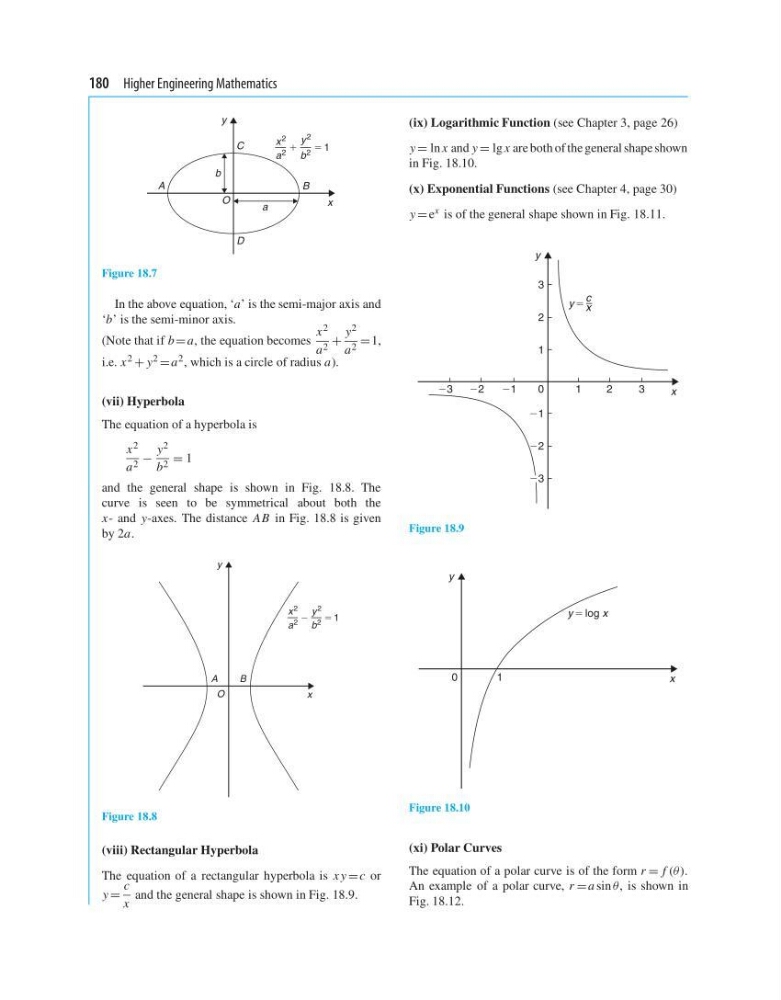
Figure 18.7
In the above equation, ‘a’ is the semi-major axis and
‘b’ is the semi-minor axis.
(Note that if b = a, the equation becomes
x 2
a 2 +
y 2
a 2 = 1,
i.e. x 2 + y 2 = a 2 , which is a circle of radius a).
(vii) Hyperbola
The equation of a hyperbola is
x 2
a 2 −
y 2
b 2 = 1
and the general shape is shown in Fig. 18.8. The
curve is seen to be symmetrical about both the
x- and y-axes. The distance AB in Fig. 18.8 is given
by 2a.
A
B
y
x
O
x 2 y 2
a
2
b
2
5 1
2
Figure 18.8
(viii) Rectangular Hyperbola
The equation of a rectangular hyperbola is x y = c or
y =
c
x
and the general shape is shown in Fig. 18.9.
(ix) Logarithmic Function (see Chapter 3, page 26)
y = ln x and y = lg x are both of the general shape shown
in Fig. 18.10.
(x) Exponential Functions (see Chapter 4, page 30)
y = e x is of the general shape shown in Fig. 18.11.
1
2
3
21
22
23
21
22
23
1
2
3
0
y 5
y
c
x
x
Figure 18.9
0
1
y 5 log x
y
x
Figure 18.10
(xi) Polar Curves
The equation of a polar curve is of the form r = f (θ).
An example of a polar curve, r = a sin θ, is shown in
Fig. 18.12.
x 2 y 2
a
2
b
2
5 1
1
y
C
b
O
a
D
x
B
A
Figure 18.7
In the above equation, ‘a’ is the semi-major axis and
‘b’ is the semi-minor axis.
(Note that if b = a, the equation becomes
x 2
a 2 +
y 2
a 2 = 1,
i.e. x 2 + y 2 = a 2 , which is a circle of radius a).
(vii) Hyperbola
The equation of a hyperbola is
x 2
a 2 −
y 2
b 2 = 1
and the general shape is shown in Fig. 18.8. The
curve is seen to be symmetrical about both the
x- and y-axes. The distance AB in Fig. 18.8 is given
by 2a.
A
B
y
x
O
x 2 y 2
a
2
b
2
5 1
2
Figure 18.8
(viii) Rectangular Hyperbola
The equation of a rectangular hyperbola is x y = c or
y =
c
x
and the general shape is shown in Fig. 18.9.
(ix) Logarithmic Function (see Chapter 3, page 26)
y = ln x and y = lg x are both of the general shape shown
in Fig. 18.10.
(x) Exponential Functions (see Chapter 4, page 30)
y = e x is of the general shape shown in Fig. 18.11.
1
2
3
21
22
23
21
22
23
1
2
3
0
y 5
y
c
x
x
Figure 18.9
0
1
y 5 log x
y
x
Figure 18.10
(xi) Polar Curves
The equation of a polar curve is of the form r = f (θ).
An example of a polar curve, r = a sin θ, is shown in
Fig. 18.12.