

Functions and their curves 179
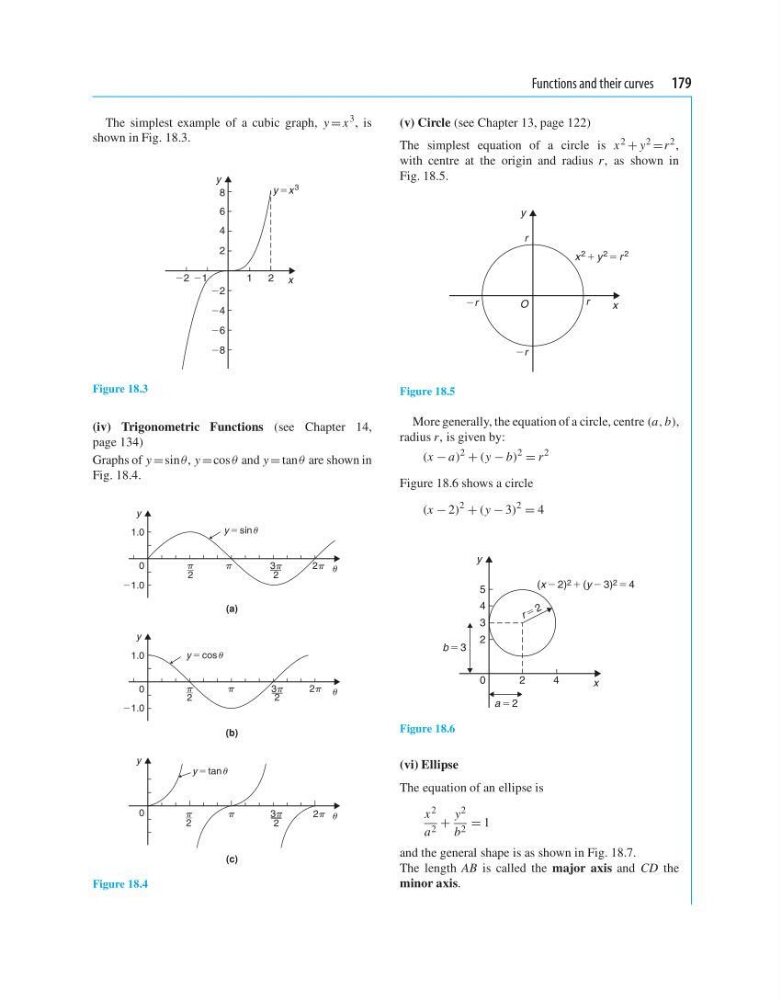
The simplest example of a cubic graph, y = x
3 , is
shown in Fig. 18.3.
y 5x 3
8
6
4
2
22
24
26
28
22 21
1
2
y
x
Figure 18.3
(iv) Trigonometric Functions (see Chapter 14,
page 134)
Graphs of y = sin θ, y = cos θ and y = tan θ are shown in
Fig. 18.4.
y 5 sin
y 5 cos
y 5 tan
1.0
21.0
21.0
0
2
2
3
2
2
2
1.0
0
2
2
3
(a)
(b)
(c)
0
2
2
3
y
y
y
Figure 18.4
(v) Circle (see Chapter 13, page 122)
The simplest equation of a circle is x 2 + y 2 =r 2 ,
with centre at the origin and radius r, as shown in
Fig. 18.5.
2r
2r
r
r
O
x
x 2 1 y 2 5 r 2
y
Figure 18.5
More generally, the equation of a circle, centre (a, b),
radius r, is given by:
(x − a)
2
+ (y − b)
2
= r
2
Figure 18.6 shows a circle
(x − 2)
2
+ (y − 3)
2
= 4
0
2
4
2
3
4
5
b 5 3
a 5 2
r 5 2
(x 2 2) 2 1 (y 2 3) 2 5 4
y
x
Figure 18.6
(vi) Ellipse
The equation of an ellipse is
x 2
a 2 +
y 2
b 2 = 1
and the general shape is as shown in Fig. 18.7.
The length AB is called the major axis and CD the
minor axis.
The simplest example of a cubic graph, y = x
3 , is
shown in Fig. 18.3.
y 5x 3
8
6
4
2
22
24
26
28
22 21
1
2
y
x
Figure 18.3
(iv) Trigonometric Functions (see Chapter 14,
page 134)
Graphs of y = sin θ, y = cos θ and y = tan θ are shown in
Fig. 18.4.
y 5 sin
y 5 cos
y 5 tan
1.0
21.0
21.0
0
2
2
3
2
2
2
1.0
0
2
2
3
(a)
(b)
(c)
0
2
2
3
y
y
y
Figure 18.4
(v) Circle (see Chapter 13, page 122)
The simplest equation of a circle is x 2 + y 2 =r 2 ,
with centre at the origin and radius r, as shown in
Fig. 18.5.
2r
2r
r
r
O
x
x 2 1 y 2 5 r 2
y
Figure 18.5
More generally, the equation of a circle, centre (a, b),
radius r, is given by:
(x − a)
2
+ (y − b)
2
= r
2
Figure 18.6 shows a circle
(x − 2)
2
+ (y − 3)
2
= 4
0
2
4
2
3
4
5
b 5 3
a 5 2
r 5 2
(x 2 2) 2 1 (y 2 3) 2 5 4
y
x
Figure 18.6
(vi) Ellipse
The equation of an ellipse is
x 2
a 2 +
y 2
b 2 = 1
and the general shape is as shown in Fig. 18.7.
The length AB is called the major axis and CD the
minor axis.