

166 Higher Engineering Mathematics
There is only one quadrant where both sin α and cos α
are positive, and this is the first, as shown in Fig. 17.2.
From Fig. 17.2, by Pythagoras’ theorem:
R =
(3 2 + 4 2 ) = 5
R
4
3
␣
Figure 17.2
From trigonometric ratios: α = tan −1 4
3 = 53.13 ◦ or
0.927 radians.
Hence 3 sin ω t + 4 cos ωt = 5 sin(ω t + 0.927).
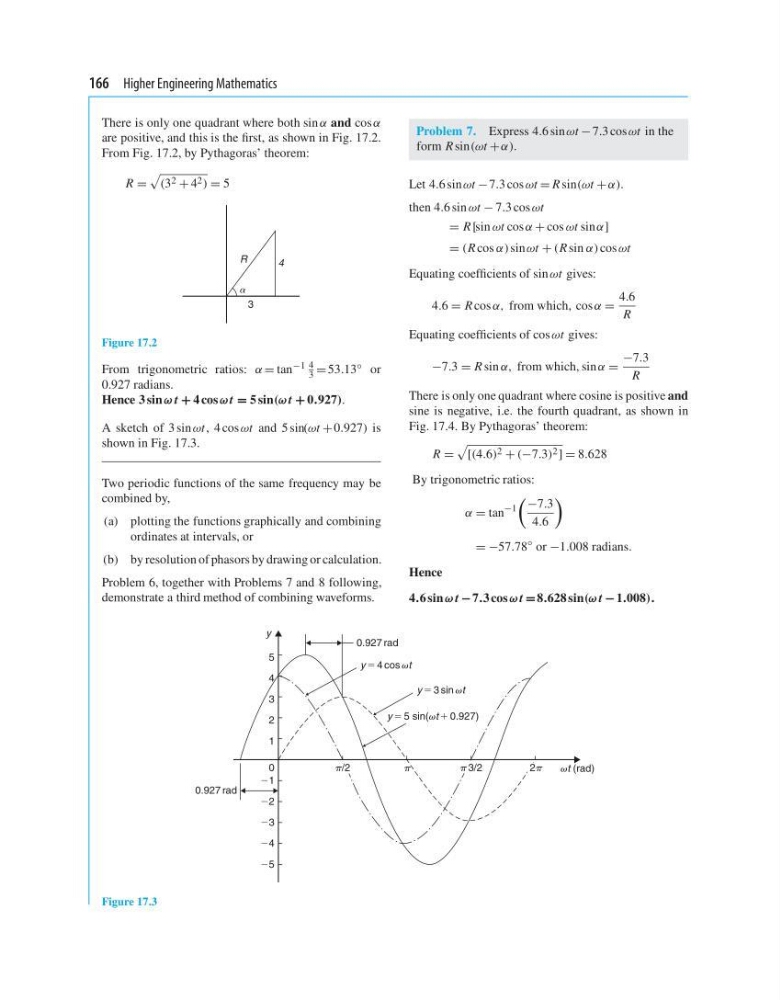
A sketch of 3sinωt , 4cosωt and 5 sin(ωt + 0.927) is
shown in Fig. 17.3.
Two periodic functions of the same frequency may be
combined by,
(a) plotting the functions graphically and combining
ordinates at intervals, or
(b) by resolution of phasors by drawing or calculation.
Problem 6, together with Problems 7 and 8 following,
demonstrate a third method of combining waveforms.
Problem 7. Express 4.6 sinωt − 7.3 cosωt in the
form R sin(ωt + α).
Let 4.6 sinωt − 7.3 cos ωt = R sin(ωt + α).
then 4.6 sin ωt − 7.3 cos ωt
= R [sin ωt cos α + cos ωt sin α]
= (R cos α) sin ωt + (R sin α) cos ωt
Equating coefficients of sin ωt gives:
4.6 = R cos α, from which, cos α =
4.6
R
Equating coefficients of cos ωt gives:
−7.3 = R sin α, from which, sin α =
−7.3
R
There is only one quadrant where cosine is positive and
sine is negative, i.e. the fourth quadrant, as shown in
Fig. 17.4. By Pythagoras’ theorem:
R =
[(4.6) 2 + (−7.3) 2 ] = 8.628
By trigonometric ratios:
α = tan
−1
−7.3
4.6
= −57.78
◦ or −1.008 radians.
Hence
4.6 sin ω t − 7.3 cos ωt = 8.628 sin(ω t − 1.008).
y 5 4 cos t
y 5 3 sin t
y 5 5 sin(t 1 0.927)
0.927 rad
0.927 rad
t (rad)
0
23
21
22
24
25
3
1
2
4
5
y
/2
3/2
2
Figure 17.3
There is only one quadrant where both sin α and cos α
are positive, and this is the first, as shown in Fig. 17.2.
From Fig. 17.2, by Pythagoras’ theorem:
R =
(3 2 + 4 2 ) = 5
R
4
3
␣
Figure 17.2
From trigonometric ratios: α = tan −1 4
3 = 53.13 ◦ or
0.927 radians.
Hence 3 sin ω t + 4 cos ωt = 5 sin(ω t + 0.927).
A sketch of 3sinωt , 4cosωt and 5 sin(ωt + 0.927) is
shown in Fig. 17.3.
Two periodic functions of the same frequency may be
combined by,
(a) plotting the functions graphically and combining
ordinates at intervals, or
(b) by resolution of phasors by drawing or calculation.
Problem 6, together with Problems 7 and 8 following,
demonstrate a third method of combining waveforms.
Problem 7. Express 4.6 sinωt − 7.3 cosωt in the
form R sin(ωt + α).
Let 4.6 sinωt − 7.3 cos ωt = R sin(ωt + α).
then 4.6 sin ωt − 7.3 cos ωt
= R [sin ωt cos α + cos ωt sin α]
= (R cos α) sin ωt + (R sin α) cos ωt
Equating coefficients of sin ωt gives:
4.6 = R cos α, from which, cos α =
4.6
R
Equating coefficients of cos ωt gives:
−7.3 = R sin α, from which, sin α =
−7.3
R
There is only one quadrant where cosine is positive and
sine is negative, i.e. the fourth quadrant, as shown in
Fig. 17.4. By Pythagoras’ theorem:
R =
[(4.6) 2 + (−7.3) 2 ] = 8.628
By trigonometric ratios:
α = tan
−1
−7.3
4.6
= −57.78
◦ or −1.008 radians.
Hence
4.6 sin ω t − 7.3 cos ωt = 8.628 sin(ω t − 1.008).
y 5 4 cos t
y 5 3 sin t
y 5 5 sin(t 1 0.927)
0.927 rad
0.927 rad
t (rad)
0
23
21
22
24
25
3
1
2
4
5
y
/2
3/2
2
Figure 17.3