

Compound angles 167
R
27.3
4.6
␣
Figure 17.4
Problem 8. Express −2.7 sin ωt − 4.1 cosωt in
the form R sin(ωt + α).
Let −2.7 sin ωt − 4.1 cos ωt = R sin(ωt + α)
= R[sin ωt cos α + cos ωt sin α]
= (R cos α)sin ωt + (R sin α)cos ωt
Equating coefficients gives:
−2.7 = R cos α, from which, cos α =
−2.7
R
and
−4.1 = R sin α, from which, sin α =
−4.1
R
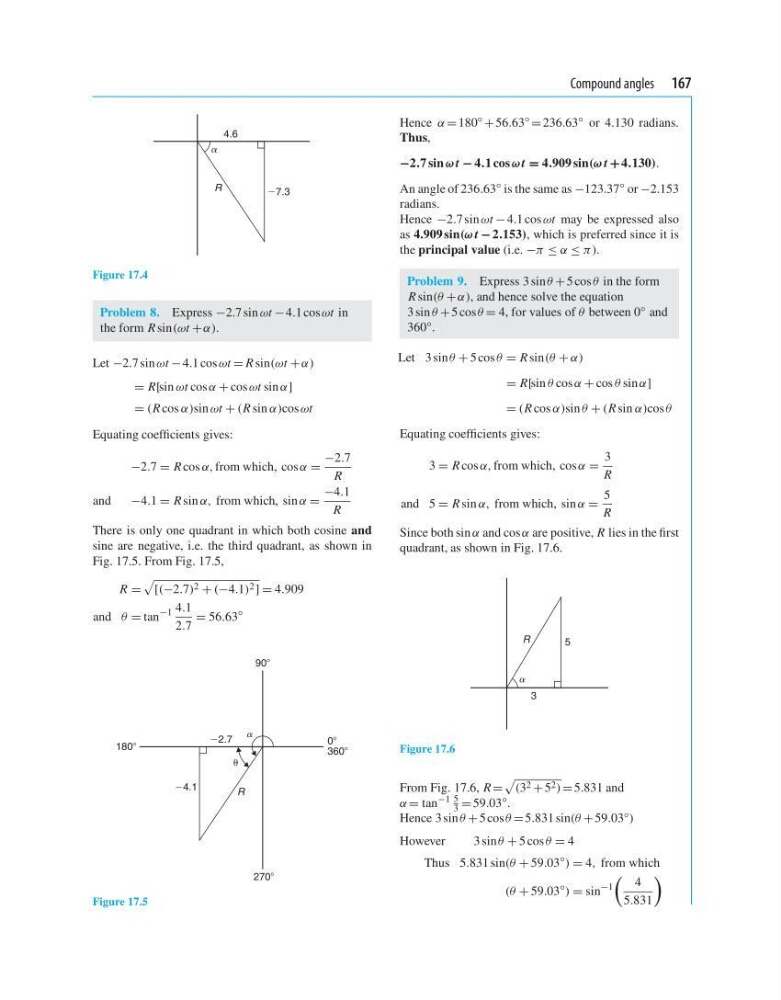
There is only one quadrant in which both cosine and
sine are negative, i.e. the third quadrant, as shown in
Fig. 17.5. From Fig. 17.5,
R =
[(−2.7) 2 + (−4.1) 2 ] = 4.909
and θ = tan
−1 4.1
2.7
= 56.63
◦
2708
908
3608
1808
08
␣
u
R
24.1
22.7
Figure 17.5
Hence α = 180
◦
+ 56.63
◦
= 236.63
◦ or 4.130 radians.
Thus,
−2.7 sin ω t − 4.1 cos ωt = 4.909 sin(ω t + 4.130).
An angle of 236.63
◦ is the same as −123.37
◦ or −2.153
radians.
Hence −2.7 sin ωt − 4.1 cos ωt may be expressed also
as 4.909 sin(ω t − 2.153), which is preferred since it is
the principal value (i.e. −π ≤ α ≤ π).
Problem 9. Express 3 sin θ + 5 cos θ in the form
R sin(θ + α), and hence solve the equation
3 sin θ + 5 cosθ = 4, for values of θ between 0 ◦ and
360
◦ .
Let 3 sin θ + 5 cos θ = R sin(θ + α)
= R[sin θ cos α + cos θ sin α]
= (R cos α)sin θ + (R sin α)cos θ
Equating coefficients gives:
3 = R cos α, from which, cos α =
3
R
and 5 = R sin α, from which, sin α =
5
R
Since both sin α and cos α are positive, R lies in the first
quadrant, as shown in Fig. 17.6.
R
5
3
␣
Figure 17.6
From Fig. 17.6, R =
(3 2 + 5 2 ) = 5.831 and
α = tan
−1 5
3 = 59.03
◦ .
Hence 3 sin θ + 5 cosθ = 5.831 sin(θ + 59.03 ◦ )
However
3 sin θ + 5 cos θ = 4
Thus 5.831 sin(θ + 59.03
◦
) = 4, from which
(θ + 59.03
◦
) = sin
−1
4
5.831
R
27.3
4.6
␣
Figure 17.4
Problem 8. Express −2.7 sin ωt − 4.1 cosωt in
the form R sin(ωt + α).
Let −2.7 sin ωt − 4.1 cos ωt = R sin(ωt + α)
= R[sin ωt cos α + cos ωt sin α]
= (R cos α)sin ωt + (R sin α)cos ωt
Equating coefficients gives:
−2.7 = R cos α, from which, cos α =
−2.7
R
and
−4.1 = R sin α, from which, sin α =
−4.1
R
There is only one quadrant in which both cosine and
sine are negative, i.e. the third quadrant, as shown in
Fig. 17.5. From Fig. 17.5,
R =
[(−2.7) 2 + (−4.1) 2 ] = 4.909
and θ = tan
−1 4.1
2.7
= 56.63
◦
2708
908
3608
1808
08
␣
u
R
24.1
22.7
Figure 17.5
Hence α = 180
◦
+ 56.63
◦
= 236.63
◦ or 4.130 radians.
Thus,
−2.7 sin ω t − 4.1 cos ωt = 4.909 sin(ω t + 4.130).
An angle of 236.63
◦ is the same as −123.37
◦ or −2.153
radians.
Hence −2.7 sin ωt − 4.1 cos ωt may be expressed also
as 4.909 sin(ω t − 2.153), which is preferred since it is
the principal value (i.e. −π ≤ α ≤ π).
Problem 9. Express 3 sin θ + 5 cos θ in the form
R sin(θ + α), and hence solve the equation
3 sin θ + 5 cosθ = 4, for values of θ between 0 ◦ and
360
◦ .
Let 3 sin θ + 5 cos θ = R sin(θ + α)
= R[sin θ cos α + cos θ sin α]
= (R cos α)sin θ + (R sin α)cos θ
Equating coefficients gives:
3 = R cos α, from which, cos α =
3
R
and 5 = R sin α, from which, sin α =
5
R
Since both sin α and cos α are positive, R lies in the first
quadrant, as shown in Fig. 17.6.
R
5
3
␣
Figure 17.6
From Fig. 17.6, R =
(3 2 + 5 2 ) = 5.831 and
α = tan
−1 5
3 = 59.03
◦ .
Hence 3 sin θ + 5 cosθ = 5.831 sin(θ + 59.03 ◦ )
However
3 sin θ + 5 cos θ = 4
Thus 5.831 sin(θ + 59.03
◦
) = 4, from which
(θ + 59.03
◦
) = sin
−1
4
5.831