

Compound angles 165
3. Show that:
(a) sin
x +
π
3
+ sin
x +
2π
3
=
√
3 cos x
and
(b) − sin
3π
2
− φ
= cos φ
4. Prove that:
(a) sin
θ +
π
4
− sin
θ −
3π
4
=
√
2(sin θ + cos θ)
(b)
cos(270 ◦ + θ)
cos(360 ◦ − θ)
= tan θ
5. Given cos A = 0.42 and sin B = 0.73 evaluate
(a) sin(A − B), (b) cos(A − B), (c) tan(A+ B),
correct to 4 decimal places.
[(a) 0.3136 (b) 0.9495 (c) −2.4687]
In Problems 6 and 7, solve the equations for
values of θ between 0 ◦ and 360 ◦ .
6. 3 sin(θ + 30 ◦ ) = 7 cosθ
[64.72 ◦ or 244.72 ◦ ]
7. 4 sin(θ − 40
◦
) = 2 sinθ
[67.52 ◦ or 247.52 ◦ ]
17.2 Conversion of a sin ωt + b cos ωt
into R sin(ωt + α)
(i) R sin(ωt + α) represents a sine wave of maximum value R, periodic time 2π/ω, frequency
ω/2π and leading R sin ωt by angle α. (See
Chapter 14).
(ii) R sin(ωt + α) may be expanded using the
compound-angle formula for sin(A + B), where
A = ωt and B = α. Hence,
R sin(ωt + α)
= R[sin ωt cos α + cos ωt sin α]
= R sin ωt cos α + R cos ωt sin α
= (R cos α) sin ωt + (R sin α) cos ωt
(iii) If a = R cos α and b = R sin α, where a and
b are constants, then R sin(ωt + α) =a sin ωt +
b cos ωt , i.e. a sine and cosine function of the same
frequency when added produce a sine wave of the
same frequency (which is further demonstrated in
Chapter 25).
(iv) Since a = R cos α, then cos α = a/R, and since
b = R sin α, then sin α = b/R.
R
b
a
␣
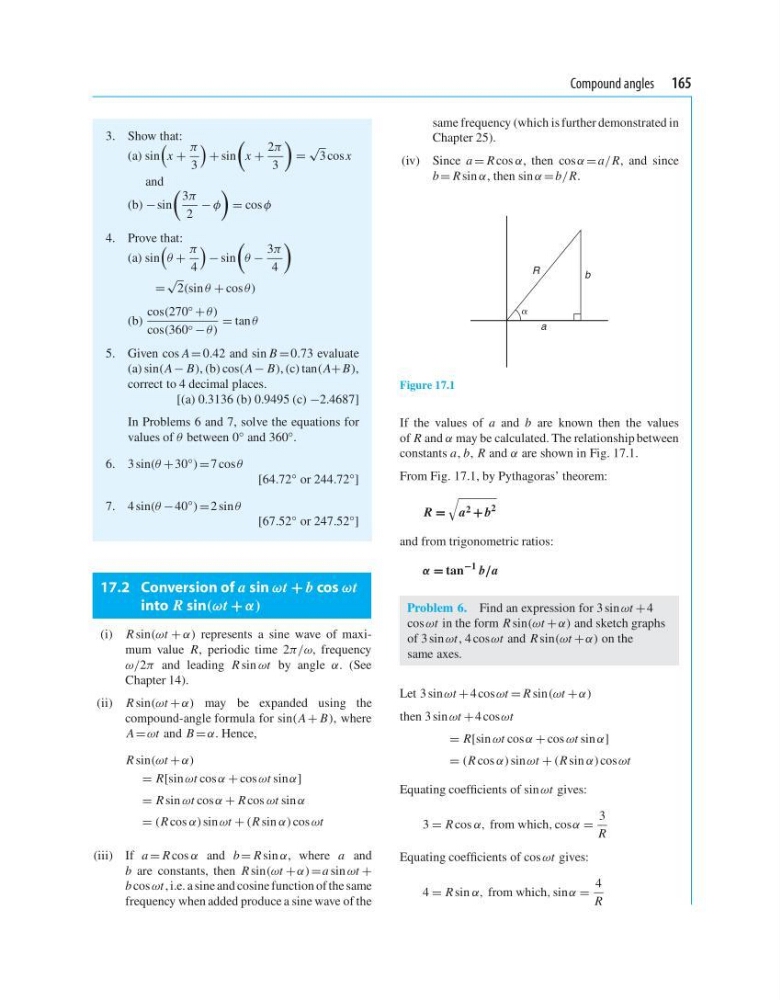
Figure 17.1
If the values of a and b are known then the values
of R and α may be calculated. The relationship between
constants a, b, R and α are shown in Fig. 17.1.
From Fig. 17.1, by Pythagoras’ theorem:
R =
a 2 + b
2
and from trigonometric ratios:
α = tan
−1 b/a
Problem 6. Find an expression for 3 sinωt + 4
cos ωt in the form R sin(ωt + α) and sketch graphs
of 3 sin ωt , 4 cosωt and R sin(ωt + α) on the
same axes.
Let 3 sin ωt + 4 cosωt = R sin(ωt + α)
then 3 sin ωt + 4 cosωt
= R[sin ωt cos α + cos ωt sin α]
= (R cos α) sin ωt + (R sin α) cosωt
Equating coefficients of sin ωt gives:
3 = R cos α, from which, cosα =
3
R
Equating coefficients of cos ωt gives:
4 = R sin α, from which, sin α =
4
R
3. Show that:
(a) sin
x +
π
3
+ sin
x +
2π
3
=
√
3 cos x
and
(b) − sin
3π
2
− φ
= cos φ
4. Prove that:
(a) sin
θ +
π
4
− sin
θ −
3π
4
=
√
2(sin θ + cos θ)
(b)
cos(270 ◦ + θ)
cos(360 ◦ − θ)
= tan θ
5. Given cos A = 0.42 and sin B = 0.73 evaluate
(a) sin(A − B), (b) cos(A − B), (c) tan(A+ B),
correct to 4 decimal places.
[(a) 0.3136 (b) 0.9495 (c) −2.4687]
In Problems 6 and 7, solve the equations for
values of θ between 0 ◦ and 360 ◦ .
6. 3 sin(θ + 30 ◦ ) = 7 cosθ
[64.72 ◦ or 244.72 ◦ ]
7. 4 sin(θ − 40
◦
) = 2 sinθ
[67.52 ◦ or 247.52 ◦ ]
17.2 Conversion of a sin ωt + b cos ωt
into R sin(ωt + α)
(i) R sin(ωt + α) represents a sine wave of maximum value R, periodic time 2π/ω, frequency
ω/2π and leading R sin ωt by angle α. (See
Chapter 14).
(ii) R sin(ωt + α) may be expanded using the
compound-angle formula for sin(A + B), where
A = ωt and B = α. Hence,
R sin(ωt + α)
= R[sin ωt cos α + cos ωt sin α]
= R sin ωt cos α + R cos ωt sin α
= (R cos α) sin ωt + (R sin α) cos ωt
(iii) If a = R cos α and b = R sin α, where a and
b are constants, then R sin(ωt + α) =a sin ωt +
b cos ωt , i.e. a sine and cosine function of the same
frequency when added produce a sine wave of the
same frequency (which is further demonstrated in
Chapter 25).
(iv) Since a = R cos α, then cos α = a/R, and since
b = R sin α, then sin α = b/R.
R
b
a
␣
Figure 17.1
If the values of a and b are known then the values
of R and α may be calculated. The relationship between
constants a, b, R and α are shown in Fig. 17.1.
From Fig. 17.1, by Pythagoras’ theorem:
R =
a 2 + b
2
and from trigonometric ratios:
α = tan
−1 b/a
Problem 6. Find an expression for 3 sinωt + 4
cos ωt in the form R sin(ωt + α) and sketch graphs
of 3 sin ωt , 4 cosωt and R sin(ωt + α) on the
same axes.
Let 3 sin ωt + 4 cosωt = R sin(ωt + α)
then 3 sin ωt + 4 cosωt
= R[sin ωt cos α + cos ωt sin α]
= (R cos α) sin ωt + (R sin α) cosωt
Equating coefficients of sin ωt gives:
3 = R cos α, from which, cosα =
3
R
Equating coefficients of cos ωt gives:
4 = R sin α, from which, sin α =
4
R