

118 Higher Engineering Mathematics
From Pythagoras’ theorem, r =
√
3 2 + 4 2 = 5 (note that
−5 has no meaning in this context). By trigonometric
ratios, θ = tan −1 4
3 = 53.13 ◦ or 0.927 rad.
[note that 53.13 ◦ = 53.13×(π/180) rad = 0.927 rad]
Hence (3, 4) in Cartesian co-ordinates corresponds to (5, 53.13 ◦ ) or (5, 0.927 rad) in polar
co-ordinates.
Problem 2. Express in polar co-ordinates the
position (−4, 3).
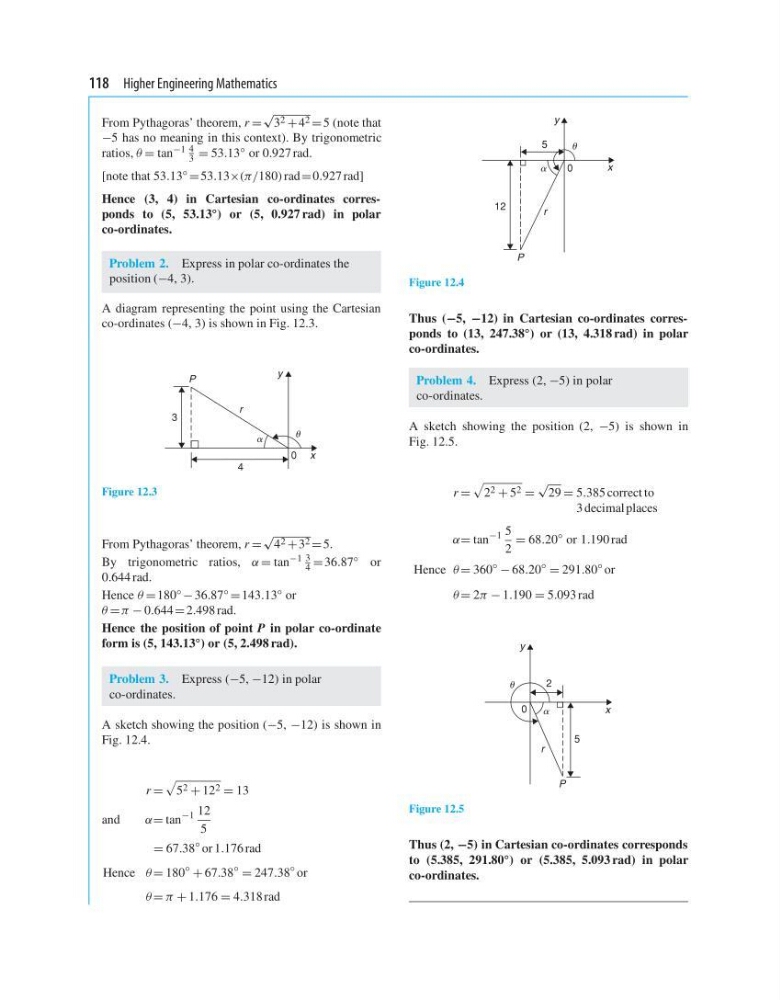
A diagram representing the point using the Cartesian
co-ordinates (−4, 3) is shown in Fig. 12.3.
y
P
3
4
x
0
r
␣
Figure 12.3
From Pythagoras’ theorem, r =
√
4 2 + 3 2 = 5.
By trigonometric ratios, α = tan −1 3
4 = 36.87 ◦ or
0.644 rad.
Hence θ = 180 ◦ − 36.87 ◦ = 143.13 ◦ or
θ = π − 0.644 = 2.498 rad.
Hence the position of point P in polar co-ordinate
form is (5, 143.13 ◦ ) or (5, 2.498 rad).
Problem 3. Express (−5, −12) in polar
co-ordinates.
A sketch showing the position (−5, −12) is shown in
Fig. 12.4.
r =
5 2 + 12 2 = 13
and
α= tan
−1 12
5
= 67.38
◦ or 1.176 rad
Hence θ = 180
◦
+ 67.38
◦
= 247.38
◦ or
θ = π + 1.176 = 4.318 rad
y
P
12
5
x
0
r
␣
Figure 12.4
Thus (−5, −12) in Cartesian co-ordinates corresponds to (13, 247.38 ◦ ) or (13, 4.318 rad) in polar
co-ordinates.
Problem 4. Express (2, −5) in polar
co-ordinates.
A sketch showing the position (2, −5) is shown in
Fig. 12.5.
r =
2 2 + 5 2 =
√
29 = 5.385 correct to
3 decimal places
α= tan
−1 5
2
= 68.20
◦ or 1.190 rad
Hence θ = 360
◦
− 68.20
◦
= 291.80
◦ or
θ = 2π − 1.190 = 5.093 rad
y
x
0
5
2
r
P
␣
Figure 12.5
Thus (2, −5) in Cartesian co-ordinates corresponds
to (5.385, 291.80 ◦ ) or (5.385, 5.093 rad) in polar
co-ordinates.
From Pythagoras’ theorem, r =
√
3 2 + 4 2 = 5 (note that
−5 has no meaning in this context). By trigonometric
ratios, θ = tan −1 4
3 = 53.13 ◦ or 0.927 rad.
[note that 53.13 ◦ = 53.13×(π/180) rad = 0.927 rad]
Hence (3, 4) in Cartesian co-ordinates corresponds to (5, 53.13 ◦ ) or (5, 0.927 rad) in polar
co-ordinates.
Problem 2. Express in polar co-ordinates the
position (−4, 3).
A diagram representing the point using the Cartesian
co-ordinates (−4, 3) is shown in Fig. 12.3.
y
P
3
4
x
0
r
␣
Figure 12.3
From Pythagoras’ theorem, r =
√
4 2 + 3 2 = 5.
By trigonometric ratios, α = tan −1 3
4 = 36.87 ◦ or
0.644 rad.
Hence θ = 180 ◦ − 36.87 ◦ = 143.13 ◦ or
θ = π − 0.644 = 2.498 rad.
Hence the position of point P in polar co-ordinate
form is (5, 143.13 ◦ ) or (5, 2.498 rad).
Problem 3. Express (−5, −12) in polar
co-ordinates.
A sketch showing the position (−5, −12) is shown in
Fig. 12.4.
r =
5 2 + 12 2 = 13
and
α= tan
−1 12
5
= 67.38
◦ or 1.176 rad
Hence θ = 180
◦
+ 67.38
◦
= 247.38
◦ or
θ = π + 1.176 = 4.318 rad
y
P
12
5
x
0
r
␣
Figure 12.4
Thus (−5, −12) in Cartesian co-ordinates corresponds to (13, 247.38 ◦ ) or (13, 4.318 rad) in polar
co-ordinates.
Problem 4. Express (2, −5) in polar
co-ordinates.
A sketch showing the position (2, −5) is shown in
Fig. 12.5.
r =
2 2 + 5 2 =
√
29 = 5.385 correct to
3 decimal places
α= tan
−1 5
2
= 68.20
◦ or 1.190 rad
Hence θ = 360
◦
− 68.20
◦
= 291.80
◦ or
θ = 2π − 1.190 = 5.093 rad
y
x
0
5
2
r
P
␣
Figure 12.5
Thus (2, −5) in Cartesian co-ordinates corresponds
to (5.385, 291.80 ◦ ) or (5.385, 5.093 rad) in polar
co-ordinates.