

Chapter 12
Cartesian and polar
co-ordinates
12.1 Introduction
There are two ways in which the position of a point in
a plane can be represented. These are
(a) by Cartesian co-ordinates, i.e. (x, y), and
(b) by polar co-ordinates, i.e. (r, θ), where r is a
‘radius’ from a fixed point and θ is an angle from
a fixed point.
12.2 Changing from Cartesian into
polar co-ordinates
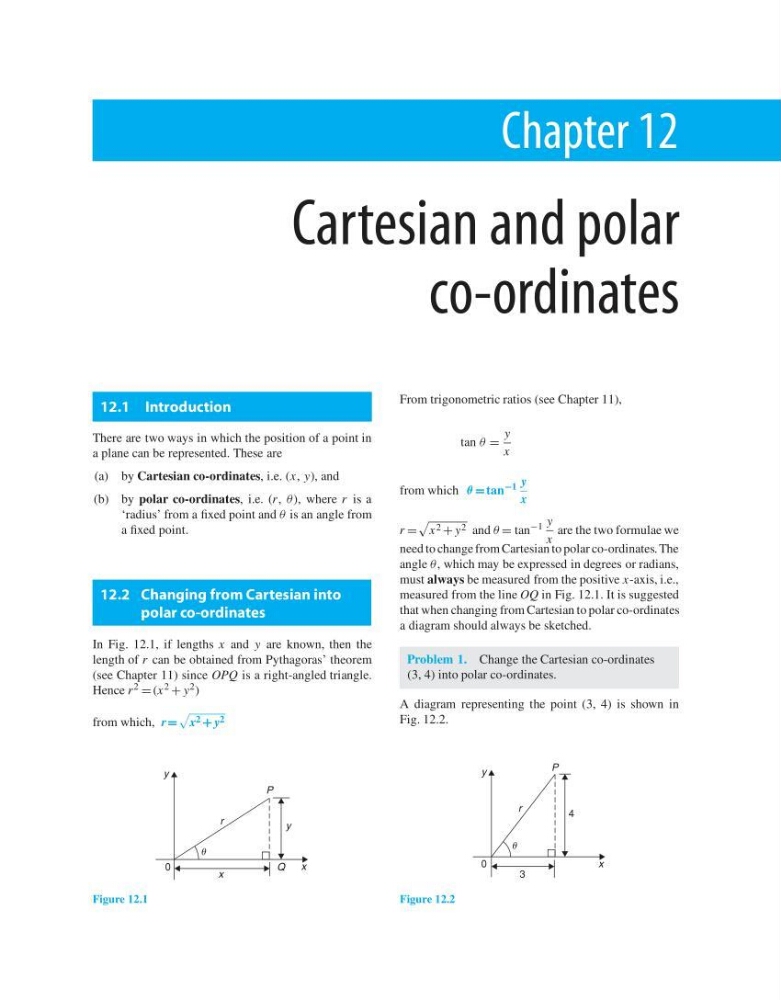
In Fig. 12.1, if lengths x and y are known, then the
length of r can be obtained from Pythagoras’ theorem
(see Chapter 11) since OPQ is a right-angled triangle.
Hence r 2 = (x 2 + y 2 )
from which, r =
x 2 + y 2
y
P
Q
x
0
x
r
y
Figure 12.1
From trigonometric ratios (see Chapter 11),
tan θ =
y
x
from which θ = tan −1 y
x
r =
x 2 + y 2 and θ = tan −1 y
x
are the two formulae we
need to change from Cartesian to polar co-ordinates. The
angle θ, which may be expressed in degrees or radians,
must always be measured from the positive x-axis, i.e.,
measured from the line OQ in Fig. 12.1. It is suggested
that when changing from Cartesian to polar co-ordinates
a diagram should always be sketched.
Problem 1. Change the Cartesian co-ordinates
(3, 4) into polar co-ordinates.
A diagram representing the point (3, 4) is shown in
Fig. 12.2.
P
4
3
y
x
0
r
Figure 12.2
Cartesian and polar
co-ordinates
12.1 Introduction
There are two ways in which the position of a point in
a plane can be represented. These are
(a) by Cartesian co-ordinates, i.e. (x, y), and
(b) by polar co-ordinates, i.e. (r, θ), where r is a
‘radius’ from a fixed point and θ is an angle from
a fixed point.
12.2 Changing from Cartesian into
polar co-ordinates
In Fig. 12.1, if lengths x and y are known, then the
length of r can be obtained from Pythagoras’ theorem
(see Chapter 11) since OPQ is a right-angled triangle.
Hence r 2 = (x 2 + y 2 )
from which, r =
x 2 + y 2
y
P
Q
x
0
x
r
y
Figure 12.1
From trigonometric ratios (see Chapter 11),
tan θ =
y
x
from which θ = tan −1 y
x
r =
x 2 + y 2 and θ = tan −1 y
x
are the two formulae we
need to change from Cartesian to polar co-ordinates. The
angle θ, which may be expressed in degrees or radians,
must always be measured from the positive x-axis, i.e.,
measured from the line OQ in Fig. 12.1. It is suggested
that when changing from Cartesian to polar co-ordinates
a diagram should always be sketched.
Problem 1. Change the Cartesian co-ordinates
(3, 4) into polar co-ordinates.
A diagram representing the point (3, 4) is shown in
Fig. 12.2.
P
4
3
y
x
0
r
Figure 12.2