

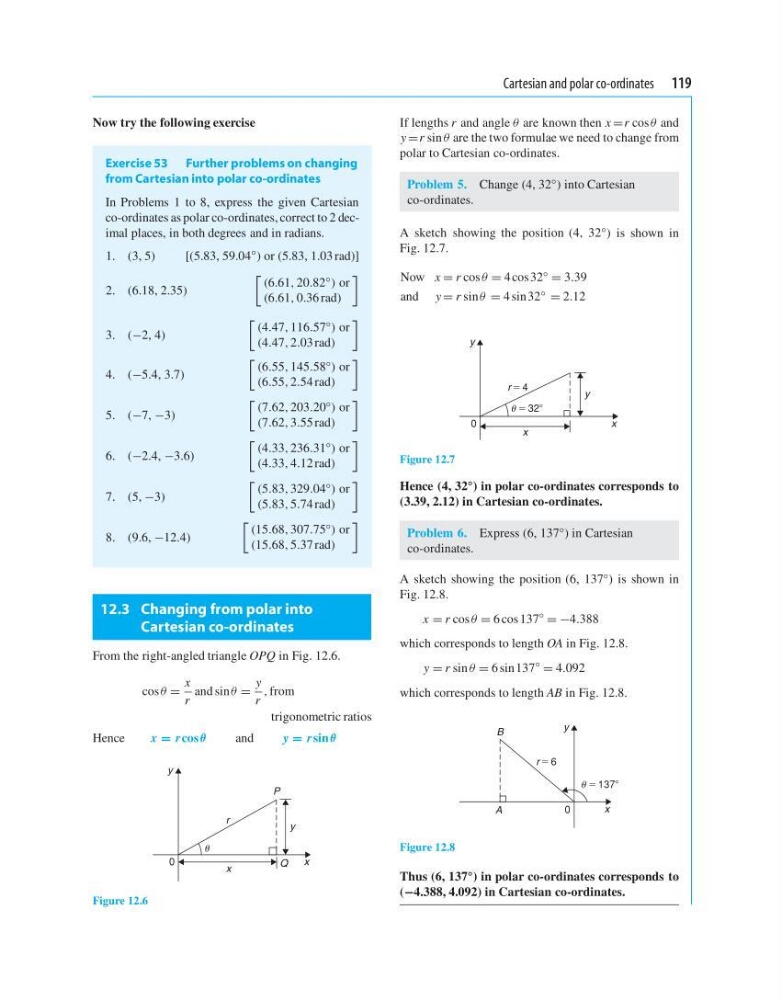
Cartesian and polar co-ordinates 119
Now try the following exercise
Exercise 53 Further problems on changing
from Cartesian into polar co-ordinates
In Problems 1 to 8, express the given Cartesian
co-ordinates as polar co-ordinates, correct to 2 decimal places, in both degrees and in radians.
1. (3, 5)
[(5.83, 59.04
◦ ) or (5.83, 1.03 rad)]
2. (6.18, 2.35)
(6.61, 20.82 ◦ ) or
(6.61, 0.36 rad)
3. (−2, 4)
(4.47, 116.57 ◦ ) or
(4.47, 2.03 rad)
4. (−5.4, 3.7)
(6.55, 145.58 ◦ ) or
(6.55, 2.54 rad)
5. (−7, −3)
(7.62, 203.20 ◦ ) or
(7.62, 3.55 rad)
6. (−2.4, −3.6)
(4.33, 236.31 ◦ ) or
(4.33, 4.12 rad)
7. (5, −3)
(5.83, 329.04 ◦ ) or
(5.83, 5.74 rad)
8. (9.6, −12.4)
(15.68, 307.75 ◦ ) or
(15.68, 5.37 rad)
12.3 Changing from polar into
Cartesian co-ordinates
From the right-angled triangle OPQ in Fig. 12.6.
cos θ =
x
r
and sin θ =
y
r
, from
trigonometric ratios
Hence
x = r cos θ
and
y = r sin θ
y
y
Q
x
x
0
P
r
Figure 12.6
If lengths r and angle θ are known then x =r cos θ and
y =r sin θ are the two formulae we need to change from
polar to Cartesian co-ordinates.
Problem 5. Change (4, 32 ◦ ) into Cartesian
co-ordinates.
A sketch showing the position (4, 32 ◦ ) is shown in
Fig. 12.7.
Now x = r cos θ = 4 cos32 ◦ = 3.39
and y = r sin θ = 4 sin32 ◦ = 2.12
y
y
0
x
x
r 5 4
5 328
Figure 12.7
Hence (4, 32 ◦ ) in polar co-ordinates corresponds to
(3.39, 2.12) in Cartesian co-ordinates.
Problem 6. Express (6, 137 ◦ ) in Cartesian
co-ordinates.
A sketch showing the position (6, 137 ◦ ) is shown in
Fig. 12.8.
x = r cos θ = 6 cos 137
◦
= −4.388
which corresponds to length OA in Fig. 12.8.
y = r sin θ = 6 sin 137
◦
= 4.092
which corresponds to length AB in Fig. 12.8.
B
0
A
y
x
r 5 6
5 1378
Figure 12.8
Thus (6, 137 ◦ ) in polar co-ordinates corresponds to
(−4.388, 4.092) in Cartesian co-ordinates.
Now try the following exercise
Exercise 53 Further problems on changing
from Cartesian into polar co-ordinates
In Problems 1 to 8, express the given Cartesian
co-ordinates as polar co-ordinates, correct to 2 decimal places, in both degrees and in radians.
1. (3, 5)
[(5.83, 59.04
◦ ) or (5.83, 1.03 rad)]
2. (6.18, 2.35)
(6.61, 20.82 ◦ ) or
(6.61, 0.36 rad)
3. (−2, 4)
(4.47, 116.57 ◦ ) or
(4.47, 2.03 rad)
4. (−5.4, 3.7)
(6.55, 145.58 ◦ ) or
(6.55, 2.54 rad)
5. (−7, −3)
(7.62, 203.20 ◦ ) or
(7.62, 3.55 rad)
6. (−2.4, −3.6)
(4.33, 236.31 ◦ ) or
(4.33, 4.12 rad)
7. (5, −3)
(5.83, 329.04 ◦ ) or
(5.83, 5.74 rad)
8. (9.6, −12.4)
(15.68, 307.75 ◦ ) or
(15.68, 5.37 rad)
12.3 Changing from polar into
Cartesian co-ordinates
From the right-angled triangle OPQ in Fig. 12.6.
cos θ =
x
r
and sin θ =
y
r
, from
trigonometric ratios
Hence
x = r cos θ
and
y = r sin θ
y
y
Q
x
x
0
P
r
Figure 12.6
If lengths r and angle θ are known then x =r cos θ and
y =r sin θ are the two formulae we need to change from
polar to Cartesian co-ordinates.
Problem 5. Change (4, 32 ◦ ) into Cartesian
co-ordinates.
A sketch showing the position (4, 32 ◦ ) is shown in
Fig. 12.7.
Now x = r cos θ = 4 cos32 ◦ = 3.39
and y = r sin θ = 4 sin32 ◦ = 2.12
y
y
0
x
x
r 5 4
5 328
Figure 12.7
Hence (4, 32 ◦ ) in polar co-ordinates corresponds to
(3.39, 2.12) in Cartesian co-ordinates.
Problem 6. Express (6, 137 ◦ ) in Cartesian
co-ordinates.
A sketch showing the position (6, 137 ◦ ) is shown in
Fig. 12.8.
x = r cos θ = 6 cos 137
◦
= −4.388
which corresponds to length OA in Fig. 12.8.
y = r sin θ = 6 sin 137
◦
= 4.092
which corresponds to length AB in Fig. 12.8.
B
0
A
y
x
r 5 6
5 1378
Figure 12.8
Thus (6, 137 ◦ ) in polar co-ordinates corresponds to
(−4.388, 4.092) in Cartesian co-ordinates.