

159
One Click LCA requires the user to input information on annual energy consumption, calculation period, and building area, though results can still be generated
without them. When inputting the annual operational energy, the user is asked for
the total electricity use in kWh along with the electricity grid profile being used in
the project, based on the project location. The calculation period is the expected
service life of the building and will be determined in the goal and scope phase of the
study. The building area is used to benchmark the results by square foot or
square meter.
8.4.4.6 View Results
After all of this information has been entered, the results of the study can be viewed
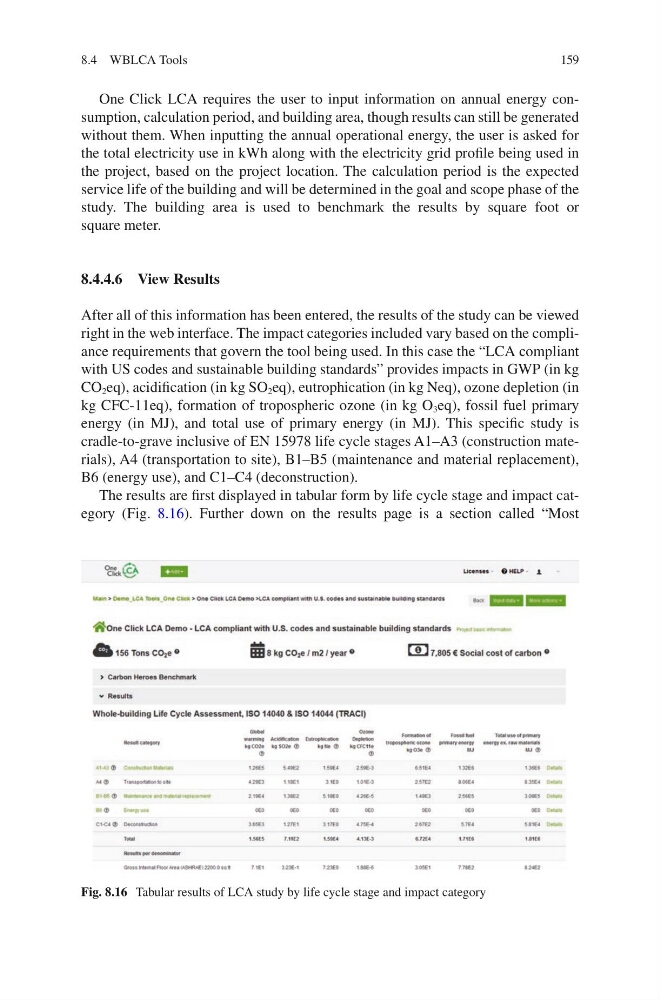
right in the web interface. The impact categories included vary based on the compliance requirements that govern the tool being used. In this case the “LCA compliant
with US codes and sustainable building standards” provides impacts in GWP (in kg
CO 2 eq), acidification (in kg SO 2 eq), eutrophication (in kg Neq), ozone depletion (in
kg CFC-11eq), formation of tropospheric ozone (in kg O 3 eq), fossil fuel primary
energy (in MJ), and total use of primary energy (in MJ). This specific study is
cradle- to-grave inclusive of EN 15978 life cycle stages A1–A3 (construction materials), A4 (transportation to site), B1–B5 (maintenance and material replacement),
B6 (energy use), and C1–C4 (deconstruction).
The results are first displayed in tabular form by life cycle stage and impact category (Fig. 8.16). Further down on the results page is a section called “Most
Fig. 8.16 Tabular results of LCA study by life cycle stage and impact category
8.4 WBLCA Tools
One Click LCA requires the user to input information on annual energy consumption, calculation period, and building area, though results can still be generated
without them. When inputting the annual operational energy, the user is asked for
the total electricity use in kWh along with the electricity grid profile being used in
the project, based on the project location. The calculation period is the expected
service life of the building and will be determined in the goal and scope phase of the
study. The building area is used to benchmark the results by square foot or
square meter.
8.4.4.6 View Results
After all of this information has been entered, the results of the study can be viewed
right in the web interface. The impact categories included vary based on the compliance requirements that govern the tool being used. In this case the “LCA compliant
with US codes and sustainable building standards” provides impacts in GWP (in kg
CO 2 eq), acidification (in kg SO 2 eq), eutrophication (in kg Neq), ozone depletion (in
kg CFC-11eq), formation of tropospheric ozone (in kg O 3 eq), fossil fuel primary
energy (in MJ), and total use of primary energy (in MJ). This specific study is
cradle- to-grave inclusive of EN 15978 life cycle stages A1–A3 (construction materials), A4 (transportation to site), B1–B5 (maintenance and material replacement),
B6 (energy use), and C1–C4 (deconstruction).
The results are first displayed in tabular form by life cycle stage and impact category (Fig. 8.16). Further down on the results page is a section called “Most
Fig. 8.16 Tabular results of LCA study by life cycle stage and impact category
8.4 WBLCA Tools