

s
Section 5.7 Matrices
463
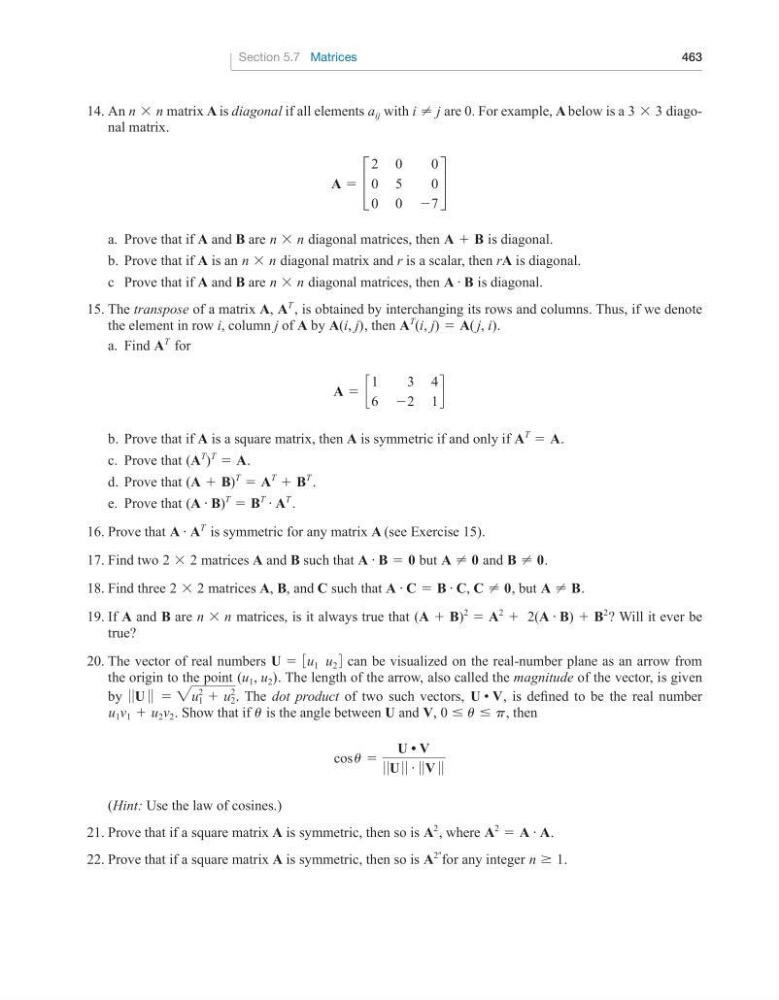
14. An n × n matrix a is diagonal if all elements a ij with i ∙ j are 0. For example, a below is a 3 × 3 diagonal matrix.
a = £
2 0
0
0 5
0
0 0 −7
§
a. Prove that if a and b are n × n diagonal matrices, then a + b is diagonal.
b. Prove that if a is an n × n diagonal matrix and r is a scalar, then ra is diagonal.
c Prove that if a and b are n × n diagonal matrices, then a # b is diagonal.
15. The transpose of a matrix a, a
T
, is obtained by interchanging its rows and columns. Thus, if we denote
the element in row i, column j of a by a(i, j), then a
T
(i, j) = a( j, i).
a. Find a
T
for
a = c
1
3 4
6 −2 1
d
b. Prove that if a is a square matrix, then a is symmetric if and only if a
T
= a.
c. Prove that (a
T
)
T
= a.
d. Prove that (a + b)
T
= a
T
+ b
T
.
e. Prove that (a # b)
T
= b
T # a
T
.
16. Prove that a # a
T
is symmetric for any matrix a (see Exercise 15).
17. Find two 2 × 2 matrices a and b such that a # b = 0 but a ∙ 0 and b ∙ 0.
18. Find three 2 × 2 matrices a, b, and C such that a # C = b # C, C ∙ 0, but a ∙ b.
19. If a and b are n × n matrices, is it always true that (a + b)
2
= a
2
+ 2(a # b) + b
2
? Will it ever be
true?
20. The vector of real numbers U = 3u 1 u 2 4 can be visualized on the real-number plane as an arrow from
the origin to the point (u 1 , u 2 ). The length of the arrow, also called the magnitude of the vector, is given
by 0 0 U 0 0 = "u
2
1 + u
2
2 . The dot product of two such vectors, U • v, is defined to be the real number
u 1 v 1 + u 2 v 2 . Show that if u is the angle between U and v, 0 ≤ u ≤ p, then
cos u =
U • v
0 0 U 0 0 # 0 0 v 0 0
(Hint: Use the law of cosines.)
21. Prove that if a square matrix a is symmetric, then so is a
2
, where a
2
= a # a.
22. Prove that if a square matrix a is symmetric, then so is a
2
n for any integer n ≥ 1.
Section 5.7 Matrices
463
14. An n × n matrix a is diagonal if all elements a ij with i ∙ j are 0. For example, a below is a 3 × 3 diagonal matrix.
a = £
2 0
0
0 5
0
0 0 −7
§
a. Prove that if a and b are n × n diagonal matrices, then a + b is diagonal.
b. Prove that if a is an n × n diagonal matrix and r is a scalar, then ra is diagonal.
c Prove that if a and b are n × n diagonal matrices, then a # b is diagonal.
15. The transpose of a matrix a, a
T
, is obtained by interchanging its rows and columns. Thus, if we denote
the element in row i, column j of a by a(i, j), then a
T
(i, j) = a( j, i).
a. Find a
T
for
a = c
1
3 4
6 −2 1
d
b. Prove that if a is a square matrix, then a is symmetric if and only if a
T
= a.
c. Prove that (a
T
)
T
= a.
d. Prove that (a + b)
T
= a
T
+ b
T
.
e. Prove that (a # b)
T
= b
T # a
T
.
16. Prove that a # a
T
is symmetric for any matrix a (see Exercise 15).
17. Find two 2 × 2 matrices a and b such that a # b = 0 but a ∙ 0 and b ∙ 0.
18. Find three 2 × 2 matrices a, b, and C such that a # C = b # C, C ∙ 0, but a ∙ b.
19. If a and b are n × n matrices, is it always true that (a + b)
2
= a
2
+ 2(a # b) + b
2
? Will it ever be
true?
20. The vector of real numbers U = 3u 1 u 2 4 can be visualized on the real-number plane as an arrow from
the origin to the point (u 1 , u 2 ). The length of the arrow, also called the magnitude of the vector, is given
by 0 0 U 0 0 = "u
2
1 + u
2
2 . The dot product of two such vectors, U • v, is defined to be the real number
u 1 v 1 + u 2 v 2 . Show that if u is the angle between U and v, 0 ≤ u ≤ p, then
cos u =
U • v
0 0 U 0 0 # 0 0 v 0 0
(Hint: Use the law of cosines.)
21. Prove that if a square matrix a is symmetric, then so is a
2
, where a
2
= a # a.
22. Prove that if a square matrix a is symmetric, then so is a
2
n for any integer n ≥ 1.