

462
Relations, Functions, and Matrices
6. Compute (if possible)
a. b − rC
c. r(sC)
e. D # C
b. r(a + D)
d. b # a + D
7. Compute (if possible)
a. a # C
c. b # D
b. C # a
d. C
2
= C # C
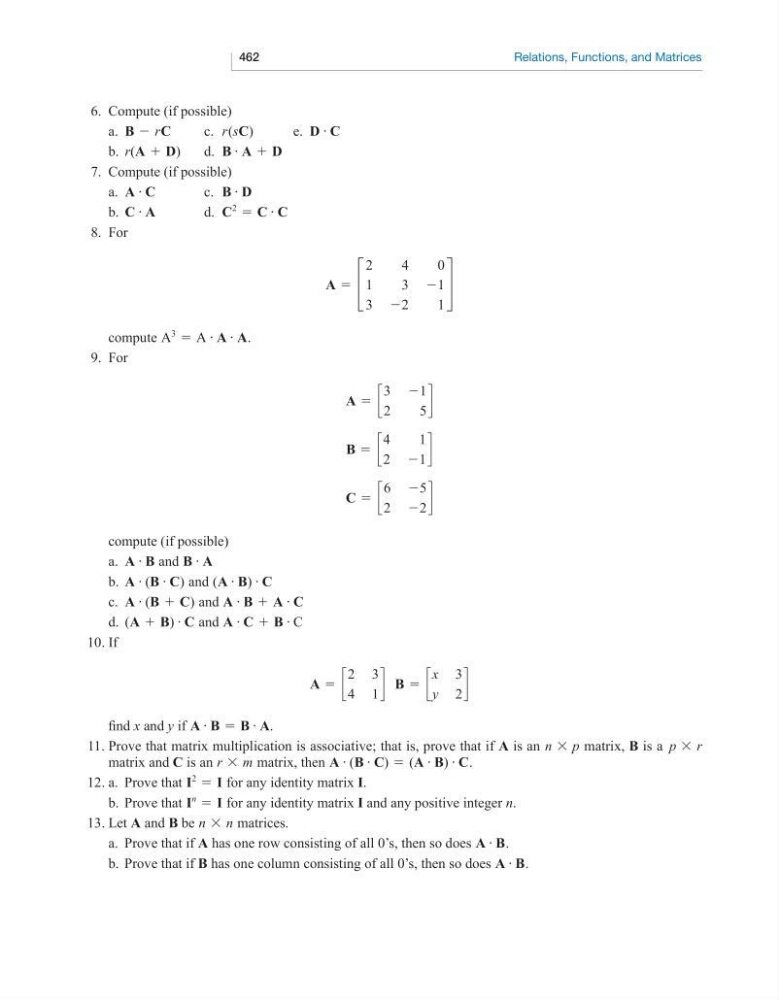
8. For
a = £
2
4
0
1
3 −1
3 −2
1
§
compute A
3
= A # a # a.
9. For
a = c
3 −1
2
5
d
b = c
4
1
2 −1
d
C = c
6 −5
2 −2
d
compute (if possible)
a. a # b and b # a
b. a # (b # C) and (a # b) # C
c. a # (b + C) and a # b + a # C
d. (a + b) # C and a # C + b # C
10. If
a = c
2 3
4 1
d b = c
x 3
y 2
d
find x and y if a # b = b # a.
11. Prove that matrix multiplication is associative; that is, prove that if a is an n × p matrix, b is a p × r
matrix and C is an r × m matrix, then a # (b # C) = (a # b) # C.
12. a. Prove that i
2
= i for any identity matrix i.
b. Prove that i
n
= i for any identity matrix i and any positive integer n.
13. Let a and b be n × n matrices.
a. Prove that if a has one row consisting of all 0’s, then so does a # b.
b. Prove that if b has one column consisting of all 0’s, then so does a # b.
Relations, Functions, and Matrices
6. Compute (if possible)
a. b − rC
c. r(sC)
e. D # C
b. r(a + D)
d. b # a + D
7. Compute (if possible)
a. a # C
c. b # D
b. C # a
d. C
2
= C # C
8. For
a = £
2
4
0
1
3 −1
3 −2
1
§
compute A
3
= A # a # a.
9. For
a = c
3 −1
2
5
d
b = c
4
1
2 −1
d
C = c
6 −5
2 −2
d
compute (if possible)
a. a # b and b # a
b. a # (b # C) and (a # b) # C
c. a # (b + C) and a # b + a # C
d. (a + b) # C and a # C + b # C
10. If
a = c
2 3
4 1
d b = c
x 3
y 2
d
find x and y if a # b = b # a.
11. Prove that matrix multiplication is associative; that is, prove that if a is an n × p matrix, b is a p × r
matrix and C is an r × m matrix, then a # (b # C) = (a # b) # C.
12. a. Prove that i
2
= i for any identity matrix i.
b. Prove that i
n
= i for any identity matrix i and any positive integer n.
13. Let a and b be n × n matrices.
a. Prove that if a has one row consisting of all 0’s, then so does a # b.
b. Prove that if b has one column consisting of all 0’s, then so does a # b.