

464
Relations, Functions, and Matrices
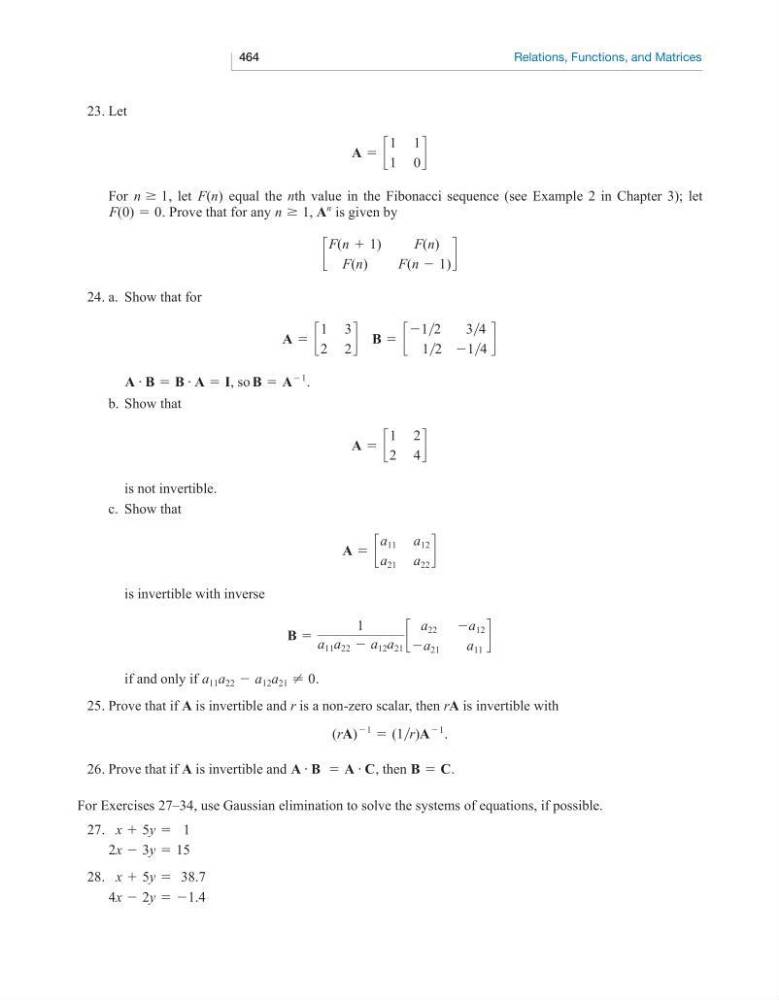
23. Let
a = c
1 1
1 0
d
For n ≥ 1, let F(n) equal the nth value in the Fibonacci sequence (see Example 2 in Chapter 3); let
F(0) = 0. Prove that for any n ≥ 1, a
n
is given by
c
F(n + 1)
F(n)
F(n)
F(n − 1)
d
24. a. Show that for
a = c
1 3
2 2
d b = c
−1∙2
3∙4
1∙2 −1∙4
d
a # b = b # a = i, so b = a
−1
.
b. Show that
a = c
1 2
2 4
d
is not invertible.
c. Show that
a = c
a 11 a 12
a 21 a 22
d
is invertible with inverse
b =
1
a 11 a 22 − a 12 a 21
c
a 22 −a 12
−a 21
a 11
d
if and only if a 11 a 22 − a 12 a 21 ∙ 0.
25. Prove that if a is invertible and r is a non-zero scalar, then ra is invertible with
(ra)
−1
= (1∙r)a
−1
.
26. Prove that if a is invertible and a # b = a # C, then b = C.
For Exercises 27–34, use Gaussian elimination to solve the systems of equations, if possible.
27. x + 5y = 1
2x − 3y = 15
28. x + 5y = 38.7
4x − 2y = −1.4
Relations, Functions, and Matrices
23. Let
a = c
1 1
1 0
d
For n ≥ 1, let F(n) equal the nth value in the Fibonacci sequence (see Example 2 in Chapter 3); let
F(0) = 0. Prove that for any n ≥ 1, a
n
is given by
c
F(n + 1)
F(n)
F(n)
F(n − 1)
d
24. a. Show that for
a = c
1 3
2 2
d b = c
−1∙2
3∙4
1∙2 −1∙4
d
a # b = b # a = i, so b = a
−1
.
b. Show that
a = c
1 2
2 4
d
is not invertible.
c. Show that
a = c
a 11 a 12
a 21 a 22
d
is invertible with inverse
b =
1
a 11 a 22 − a 12 a 21
c
a 22 −a 12
−a 21
a 11
d
if and only if a 11 a 22 − a 12 a 21 ∙ 0.
25. Prove that if a is invertible and r is a non-zero scalar, then ra is invertible with
(ra)
−1
= (1∙r)a
−1
.
26. Prove that if a is invertible and a # b = a # C, then b = C.
For Exercises 27–34, use Gaussian elimination to solve the systems of equations, if possible.
27. x + 5y = 1
2x − 3y = 15
28. x + 5y = 38.7
4x − 2y = −1.4