

456
Relations, Functions, and Matrices
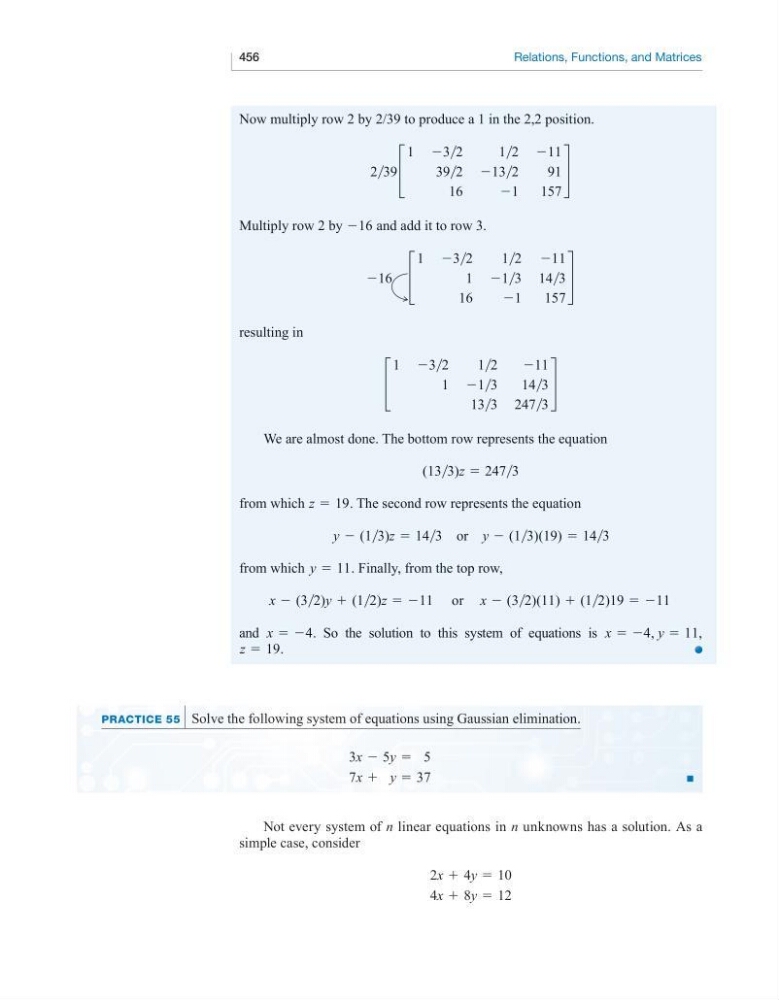
Now multiply row 2 by 2/39 to produce a 1 in the 2,2 position.
2∙39 £
1 −3∙2
1∙2 −11
39∙2 −13∙2
91
16
−1
157
§
Multiply row 2 by −16 and add it to row 3.
−16 £
1 −3∙2
1∙2 −11
1 −1∙3 14∙3
16
−1
157
§
resulting in
£
1 −3∙2
1∙2
−11
1 −1∙3
14∙3
13∙3 247∙3
§
We are almost done. The bottom row represents the equation
(13∙3)z = 247∙3
from which z = 19. The second row represents the equation
y − (1∙3)z = 14∙3 or y − (1∙3)(19) = 14∙3
from which y = 11. Finally, from the top row,
x − (3∙2)y + (1∙2)z = −11 or x − (3∙2)(11) + (1∙2)19 = −11
and x = −4. So the solution to this system of equations is x = −4, y = 11,
z = 19.
■
PRaCtiCe 55 Solve the following system of equations using Gaussian elimination.
3x − 5y = 5
7x + y = 37
Not every system of n linear equations in n unknowns has a solution. As a
simple case, consider
2x + 4y = 10
4x + 8y = 12
Relations, Functions, and Matrices
Now multiply row 2 by 2/39 to produce a 1 in the 2,2 position.
2∙39 £
1 −3∙2
1∙2 −11
39∙2 −13∙2
91
16
−1
157
§
Multiply row 2 by −16 and add it to row 3.
−16 £
1 −3∙2
1∙2 −11
1 −1∙3 14∙3
16
−1
157
§
resulting in
£
1 −3∙2
1∙2
−11
1 −1∙3
14∙3
13∙3 247∙3
§
We are almost done. The bottom row represents the equation
(13∙3)z = 247∙3
from which z = 19. The second row represents the equation
y − (1∙3)z = 14∙3 or y − (1∙3)(19) = 14∙3
from which y = 11. Finally, from the top row,
x − (3∙2)y + (1∙2)z = −11 or x − (3∙2)(11) + (1∙2)19 = −11
and x = −4. So the solution to this system of equations is x = −4, y = 11,
z = 19.
■
PRaCtiCe 55 Solve the following system of equations using Gaussian elimination.
3x − 5y = 5
7x + y = 37
Not every system of n linear equations in n unknowns has a solution. As a
simple case, consider
2x + 4y = 10
4x + 8y = 12