

s
Section 5.7 Matrices
457
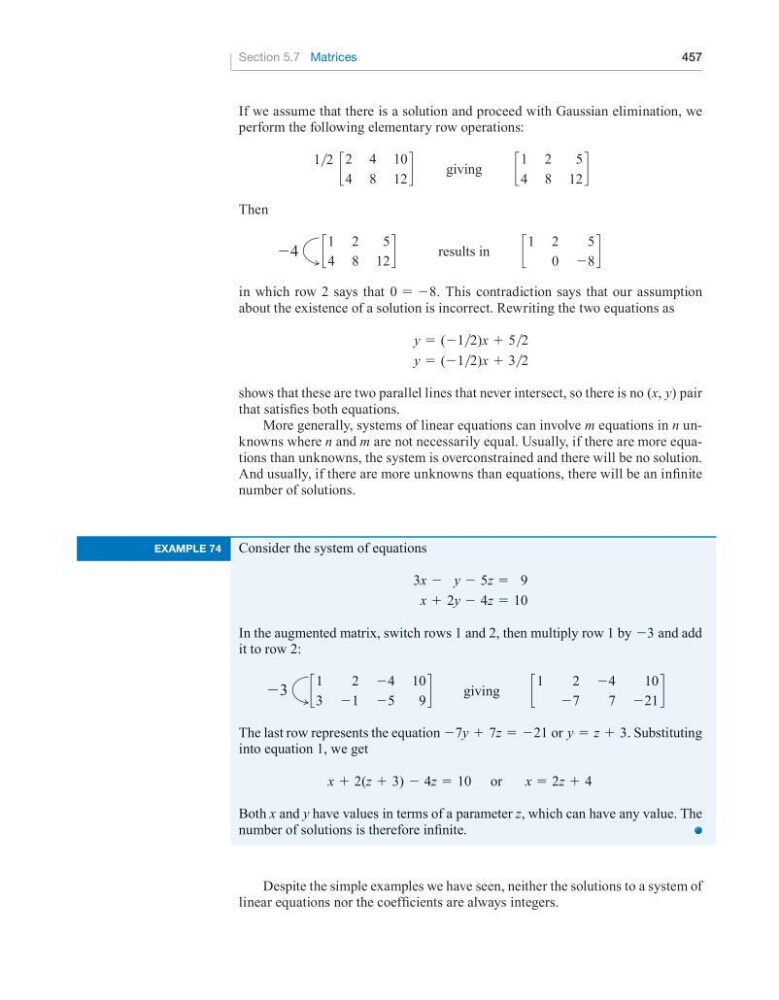
If we assume that there is a solution and proceed with Gaussian elimination, we
perform the following elementary row operations:
1∙2 c
2 4 10
4 8 12
d
giving
c
1 2
5
4 8 12
d
Then
c
1 2
5
4 8 12
d
results in
c
1 2
5
0 −8
d
in which row 2 says that 0 = −8. This contradiction says that our assumption
about the existence of a solution is incorrect. Rewriting the two equations as
y = (−1∙2)x + 5∙2
y = (−1∙2)x + 3∙2
shows that these are two parallel lines that never intersect, so there is no (x, y) pair
that satisfies both equations.
More generally, systems of linear equations can involve m equations in n unknowns where n and m are not necessarily equal. Usually, if there are more equations than unknowns, the system is overconstrained and there will be no solution.
And usually, if there are more unknowns than equations, there will be an infinite
number of solutions.
example 74
Consider the system of equations
3x − y − 5z = 9
x + 2y − 4z = 10
In the augmented matrix, switch rows 1 and 2, then multiply row 1 by −3 and add
it to row 2:
c
1
2 −4 10
3 −1 −5
9
d
giving
c
1
2 −4
10
−7
7 −21
d
The last row represents the equation −7y + 7z = −21 or y = z + 3. Substituting
into equation 1, we get
x + 2(z + 3) − 4z = 10 or
x = 2z + 4
Both x and y have values in terms of a parameter z, which can have any value. The
number of solutions is therefore infinite.
Despite the simple examples we have seen, neither the solutions to a system of
linear equations nor the coefficients are always integers.
−4
−3
Section 5.7 Matrices
457
If we assume that there is a solution and proceed with Gaussian elimination, we
perform the following elementary row operations:
1∙2 c
2 4 10
4 8 12
d
giving
c
1 2
5
4 8 12
d
Then
c
1 2
5
4 8 12
d
results in
c
1 2
5
0 −8
d
in which row 2 says that 0 = −8. This contradiction says that our assumption
about the existence of a solution is incorrect. Rewriting the two equations as
y = (−1∙2)x + 5∙2
y = (−1∙2)x + 3∙2
shows that these are two parallel lines that never intersect, so there is no (x, y) pair
that satisfies both equations.
More generally, systems of linear equations can involve m equations in n unknowns where n and m are not necessarily equal. Usually, if there are more equations than unknowns, the system is overconstrained and there will be no solution.
And usually, if there are more unknowns than equations, there will be an infinite
number of solutions.
example 74
Consider the system of equations
3x − y − 5z = 9
x + 2y − 4z = 10
In the augmented matrix, switch rows 1 and 2, then multiply row 1 by −3 and add
it to row 2:
c
1
2 −4 10
3 −1 −5
9
d
giving
c
1
2 −4
10
−7
7 −21
d
The last row represents the equation −7y + 7z = −21 or y = z + 3. Substituting
into equation 1, we get
x + 2(z + 3) − 4z = 10 or
x = 2z + 4
Both x and y have values in terms of a parameter z, which can have any value. The
number of solutions is therefore infinite.
Despite the simple examples we have seen, neither the solutions to a system of
linear equations nor the coefficients are always integers.
−4
−3