

s
Section 5.7 Matrices
455
We multiply row 1 by the scalar −24 and add the result to row 2 (the third elementary row operation), giving
c
1
1
70
0 −10 −500
d
The last row represents the equation
−10 y = −500
from which y = 50. The first row represents the equation
x + y = 70
and, because y = 50, this is
x + 50 = 70
so x = 20. The solution, as noted in Example 63, is x = 20, y = 50.
example 73
Let’s apply Gaussian elimination to the system of 3 equations in 3 unknowns
shown here:
2x − 3y + z = −22
7x + 9y − 3z = 14
6x + 7y + 2z = 91
The augmented matrix is
£
2 −3
1 −22
7
9 −3
14
6
7
2
91
§
A series of elementary row operations, as shown here, will convert the 3 × 3
matrix of coefficients to upper triangular form. First, multiply row 1 by 1∙2 to
produce a 1 in the 1,1 position.
1∙2 £
2 −3
1 −22
7
9 −3
14
6
7
2
91
§
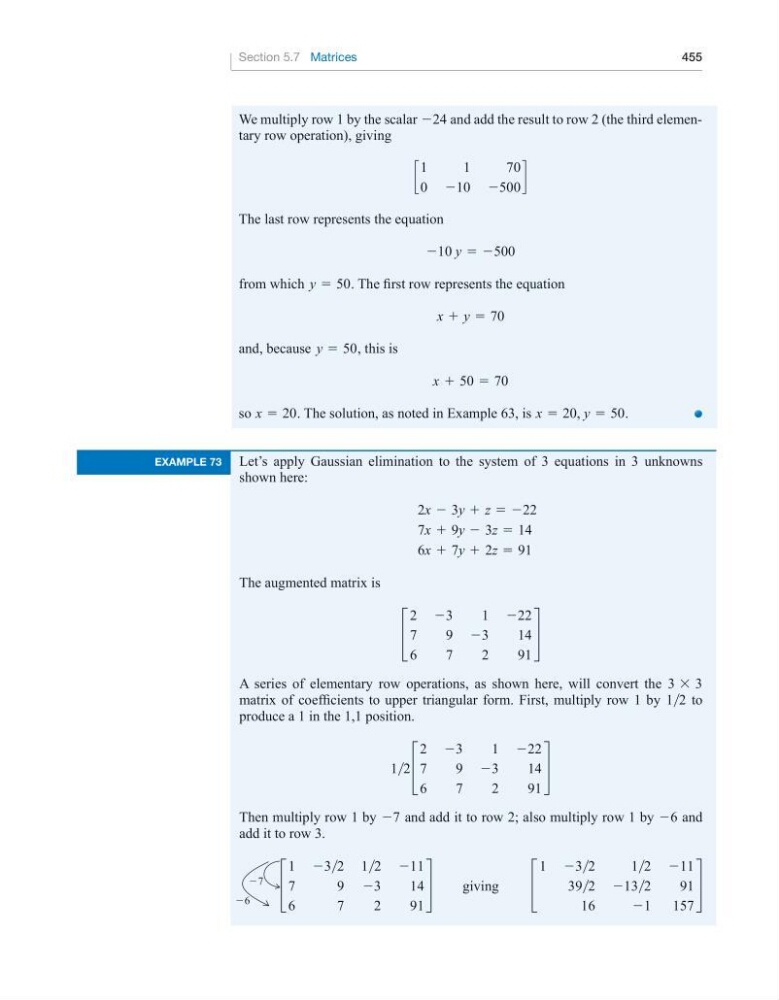
Then multiply row 1 by −7 and add it to row 2; also multiply row 1 by −6 and
add it to row 3.
£
1 −3∙2 1∙2 −11
7
9 −3
14
6
7
2
91
§
giving
£
1 −3∙2
1∙2 −11
39∙2 −13∙2
91
16
−1
157
§
−7
−6
Section 5.7 Matrices
455
We multiply row 1 by the scalar −24 and add the result to row 2 (the third elementary row operation), giving
c
1
1
70
0 −10 −500
d
The last row represents the equation
−10 y = −500
from which y = 50. The first row represents the equation
x + y = 70
and, because y = 50, this is
x + 50 = 70
so x = 20. The solution, as noted in Example 63, is x = 20, y = 50.
example 73
Let’s apply Gaussian elimination to the system of 3 equations in 3 unknowns
shown here:
2x − 3y + z = −22
7x + 9y − 3z = 14
6x + 7y + 2z = 91
The augmented matrix is
£
2 −3
1 −22
7
9 −3
14
6
7
2
91
§
A series of elementary row operations, as shown here, will convert the 3 × 3
matrix of coefficients to upper triangular form. First, multiply row 1 by 1∙2 to
produce a 1 in the 1,1 position.
1∙2 £
2 −3
1 −22
7
9 −3
14
6
7
2
91
§
Then multiply row 1 by −7 and add it to row 2; also multiply row 1 by −6 and
add it to row 3.
£
1 −3∙2 1∙2 −11
7
9 −3
14
6
7
2
91
§
giving
£
1 −3∙2
1∙2 −11
39∙2 −13∙2
91
16
−1
157
§
−7
−6