

s
Section 5.4 Functions
391
S
T
U
g( f(s))
f(s)
s
g ° f
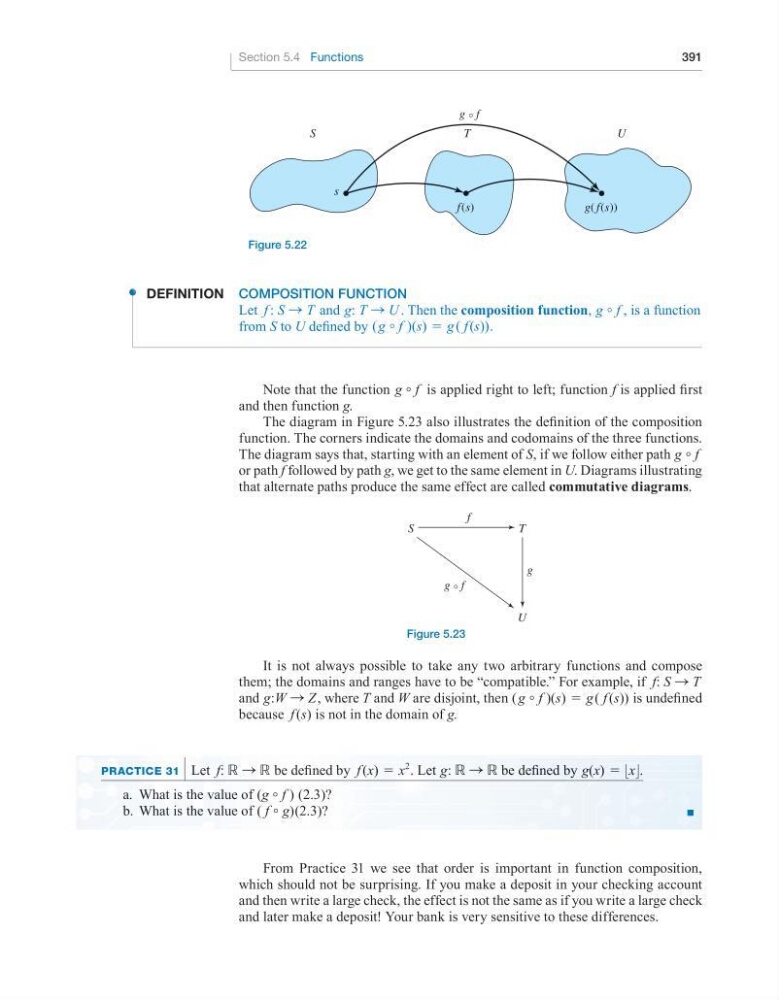
Figure 5.22
DefInItIon coMpoSition Function
Let f : S S T and g: T S U . Then the composition function, g + f , is a function
from S to U defined by ( g + f )(s) = g ( f (s)).
Note that the function g + f is applied right to left; function f is applied first
and then function g.
The diagram in Figure 5.23 also illustrates the definition of the composition
function. The corners indicate the domains and codomains of the three functions.
The diagram says that, starting with an element of S, if we follow either path g + f
or path f followed by path g, we get to the same element in U. Diagrams illustrating
that alternate paths produce the same effect are called commutative diagrams.
g
f
g ° f
S
T
U
Figure 5.23
It is not always possible to take any two arbitrary functions and compose
them; the domains and ranges have to be “compatible.” For example, if f: S S T
and g:W S Z, where T and W are disjoint, then ( g + f )(s) = g ( f (s)) is undefined
because f (s) is not in the domain of g.
PRaCtiCe 31 Let f: R S R be defined by f (x) = x
2
. Let g: R S R be defined by g(x) = :x;.
a. What is the value of (g + f ) (2.3)?
b. What is the value of ( f + g)(2.3)?
■
From Practice 31 we see that order is important in function composition,
which should not be surprising. If you make a deposit in your checking account
and then write a large check, the effect is not the same as if you write a large check
and later make a deposit! Your bank is very sensitive to these differences.
Section 5.4 Functions
391
S
T
U
g( f(s))
f(s)
s
g ° f
Figure 5.22
DefInItIon coMpoSition Function
Let f : S S T and g: T S U . Then the composition function, g + f , is a function
from S to U defined by ( g + f )(s) = g ( f (s)).
Note that the function g + f is applied right to left; function f is applied first
and then function g.
The diagram in Figure 5.23 also illustrates the definition of the composition
function. The corners indicate the domains and codomains of the three functions.
The diagram says that, starting with an element of S, if we follow either path g + f
or path f followed by path g, we get to the same element in U. Diagrams illustrating
that alternate paths produce the same effect are called commutative diagrams.
g
f
g ° f
S
T
U
Figure 5.23
It is not always possible to take any two arbitrary functions and compose
them; the domains and ranges have to be “compatible.” For example, if f: S S T
and g:W S Z, where T and W are disjoint, then ( g + f )(s) = g ( f (s)) is undefined
because f (s) is not in the domain of g.
PRaCtiCe 31 Let f: R S R be defined by f (x) = x
2
. Let g: R S R be defined by g(x) = :x;.
a. What is the value of (g + f ) (2.3)?
b. What is the value of ( f + g)(2.3)?
■
From Practice 31 we see that order is important in function composition,
which should not be surprising. If you make a deposit in your checking account
and then write a large check, the effect is not the same as if you write a large check
and later make a deposit! Your bank is very sensitive to these differences.