

392
Relations, Functions, and Matrices
Function composition preserves the properties of being onto and being oneto-one. Again, let f: S S T and g: T S U , but also suppose that both f and g
are onto functions. Then the composition function g + f is also onto. Recall that
g + f : S S U , so we must pick an arbitrary u [ U and show that it has a
preimage under g + f in S. Because g is onto, there exists t [ T such that
g(t) = u. And because f is onto, there exists s [ S such that f (s) = t. Then
(g + f )(s) = g( f (s)) = g(t) = u, and g + f is an onto function.
PRaCtiCe 32 Let f : S S T and g: T S U , and assume that both f and g are one-to-one functions.
Prove that g + f is a one-to-one function. (Hint: Assume that (g + f )(s 1 ) = (g + f )(s 2 ).)
■
We have now proved the following theorem.
theoRem on coMpoSing two BijectionS
The composition of two bijections is a bijection.
inverse Functions
Bijective functions have another important property. Let f : S S T be a bijection.
Because f is onto, every t [ T has a preimage in S. Because f is one-to-one, that
preimage is unique. We can associate with each element t of T a unique member of
S, namely, that s [ S such that f (s) = t. This association describes a function g,
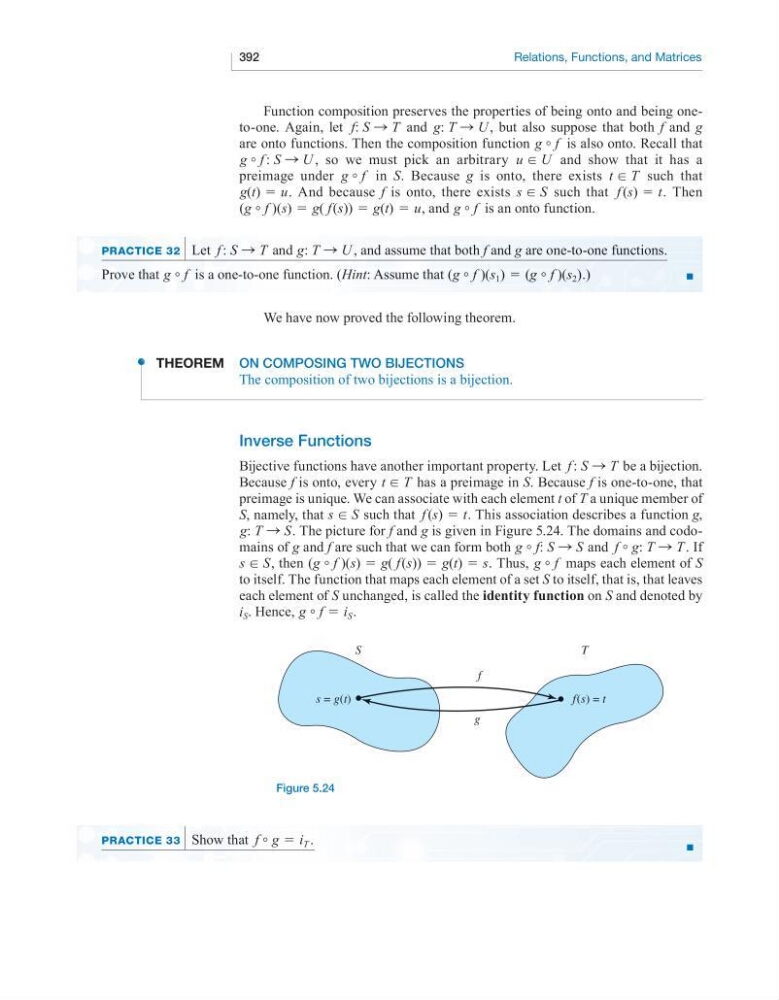
g: T S S. The picture for f and g is given in Figure 5.24. The domains and codomains of g and f are such that we can form both g + f: S S S and f + g: T S T . If
s [ S, then (g + f )(s) = g( f (s)) = g(t) = s. Thus, g + f maps each element of S
to itself. The function that maps each element of a set S to itself, that is, that leaves
each element of S unchanged, is called the identity function on S and denoted by
i S . Hence, g + f = i S .
S
T
f(s) = t
s = g(t)
f
g
Figure 5.24
PRaCtiCe 33 Show that f + g = i T .
■
Relations, Functions, and Matrices
Function composition preserves the properties of being onto and being oneto-one. Again, let f: S S T and g: T S U , but also suppose that both f and g
are onto functions. Then the composition function g + f is also onto. Recall that
g + f : S S U , so we must pick an arbitrary u [ U and show that it has a
preimage under g + f in S. Because g is onto, there exists t [ T such that
g(t) = u. And because f is onto, there exists s [ S such that f (s) = t. Then
(g + f )(s) = g( f (s)) = g(t) = u, and g + f is an onto function.
PRaCtiCe 32 Let f : S S T and g: T S U , and assume that both f and g are one-to-one functions.
Prove that g + f is a one-to-one function. (Hint: Assume that (g + f )(s 1 ) = (g + f )(s 2 ).)
■
We have now proved the following theorem.
theoRem on coMpoSing two BijectionS
The composition of two bijections is a bijection.
inverse Functions
Bijective functions have another important property. Let f : S S T be a bijection.
Because f is onto, every t [ T has a preimage in S. Because f is one-to-one, that
preimage is unique. We can associate with each element t of T a unique member of
S, namely, that s [ S such that f (s) = t. This association describes a function g,
g: T S S. The picture for f and g is given in Figure 5.24. The domains and codomains of g and f are such that we can form both g + f: S S S and f + g: T S T . If
s [ S, then (g + f )(s) = g( f (s)) = g(t) = s. Thus, g + f maps each element of S
to itself. The function that maps each element of a set S to itself, that is, that leaves
each element of S unchanged, is called the identity function on S and denoted by
i S . Hence, g + f = i S .
S
T
f(s) = t
s = g(t)
f
g
Figure 5.24
PRaCtiCe 33 Show that f + g = i T .
■