

390
Relations, Functions, and Matrices
example 37
The floor function and the ceiling function of Example 32 are clearly not one-toone. This is evident also in the graphs of these functions (Practice 26), which have
a number of horizontal sections, indicating that many different domain values in R
are mapped by the function to the same codomain value in Z.
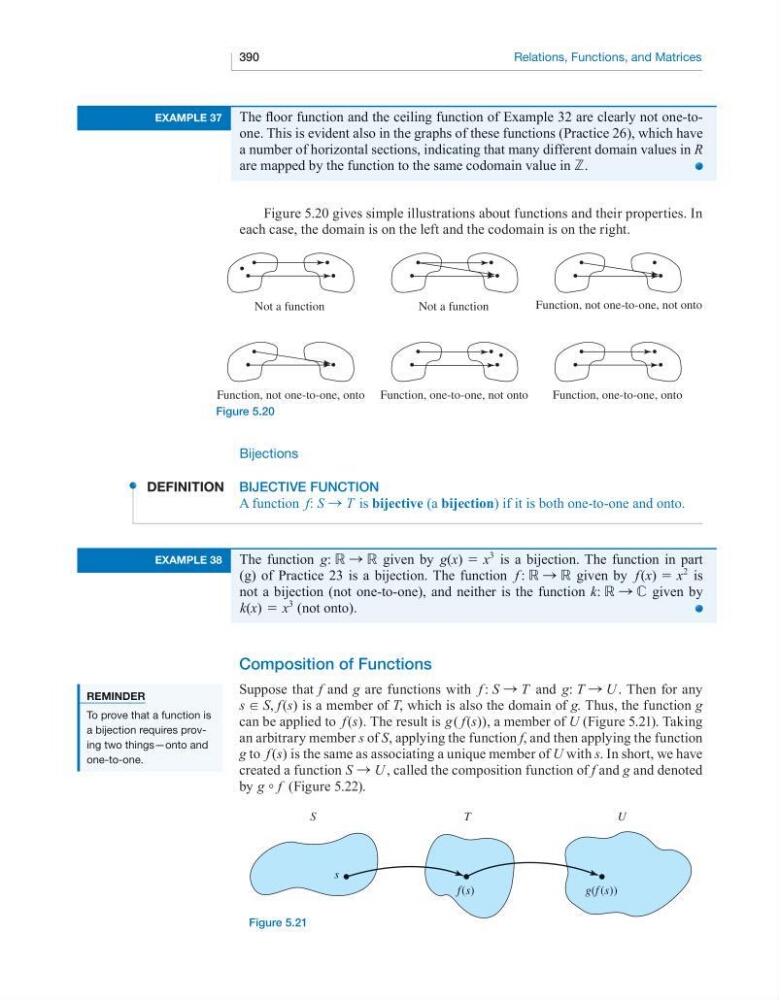
Figure 5.20 gives simple illustrations about functions and their properties. In
each case, the domain is on the left and the codomain is on the right.
Function, not one-to-one, onto Function, one-to-one, not onto
Function, one-to-one, onto
Not a function
Not a function
Function, not one-to-one, not onto
Bijections
Figure 5.20
DefInItIon Bijective Function
A function f: S S T is bijective (a bijection) if it is both one-to-one and onto.
RemInDeR
To prove that a function is
a bijection requires proving two things—onto and
one-to-one.
example 38
The function g: R S R given by g(x) = x
3
is a bijection. The function in part
(g) of Practice 23 is a bijection. The function f : R S R given by f (x) = x
2
is
not a bijection (not one-to-one), and neither is the function k: R S C given by
k(x) = x
3
(not onto).
composition of Functions
Suppose that f and g are functions with f : S S T and g: T S U . Then for any
s [ S, f (s) is a member of T, which is also the domain of g. Thus, the function g
can be applied to f (s). The result is g ( f (s)), a member of U (Figure 5.21). Taking
an arbitrary member s of S, applying the function f, and then applying the function
g to f (s) is the same as associating a unique member of U with s. In short, we have
created a function S S U , called the composition function of f and g and denoted
by g + f (Figure 5.22).
S
T
U
g(f (s))
f(s)
s
Figure 5.21
Relations, Functions, and Matrices
example 37
The floor function and the ceiling function of Example 32 are clearly not one-toone. This is evident also in the graphs of these functions (Practice 26), which have
a number of horizontal sections, indicating that many different domain values in R
are mapped by the function to the same codomain value in Z.
Figure 5.20 gives simple illustrations about functions and their properties. In
each case, the domain is on the left and the codomain is on the right.
Function, not one-to-one, onto Function, one-to-one, not onto
Function, one-to-one, onto
Not a function
Not a function
Function, not one-to-one, not onto
Bijections
Figure 5.20
DefInItIon Bijective Function
A function f: S S T is bijective (a bijection) if it is both one-to-one and onto.
RemInDeR
To prove that a function is
a bijection requires proving two things—onto and
one-to-one.
example 38
The function g: R S R given by g(x) = x
3
is a bijection. The function in part
(g) of Practice 23 is a bijection. The function f : R S R given by f (x) = x
2
is
not a bijection (not one-to-one), and neither is the function k: R S C given by
k(x) = x
3
(not onto).
composition of Functions
Suppose that f and g are functions with f : S S T and g: T S U . Then for any
s [ S, f (s) is a member of T, which is also the domain of g. Thus, the function g
can be applied to f (s). The result is g ( f (s)), a member of U (Figure 5.21). Taking
an arbitrary member s of S, applying the function f, and then applying the function
g to f (s) is the same as associating a unique member of U with s. In short, we have
created a function S S U , called the composition function of f and g and denoted
by g + f (Figure 5.22).
S
T
U
g(f (s))
f(s)
s
Figure 5.21