

312
Sets, Combinatorics, and Probability
E(X ) = ∙
8
i=1
X(x i )p(x i )
= 3(27/64) + 2(9/64) + 2(9/64) + 1(3/64) + 2(9/64) + 1(3/64) + 1(3/64) + 0(1/64)
= 144/64 = 2.25
The expected number of heads is now higher because the coin is much more likely
than before to come up heads.
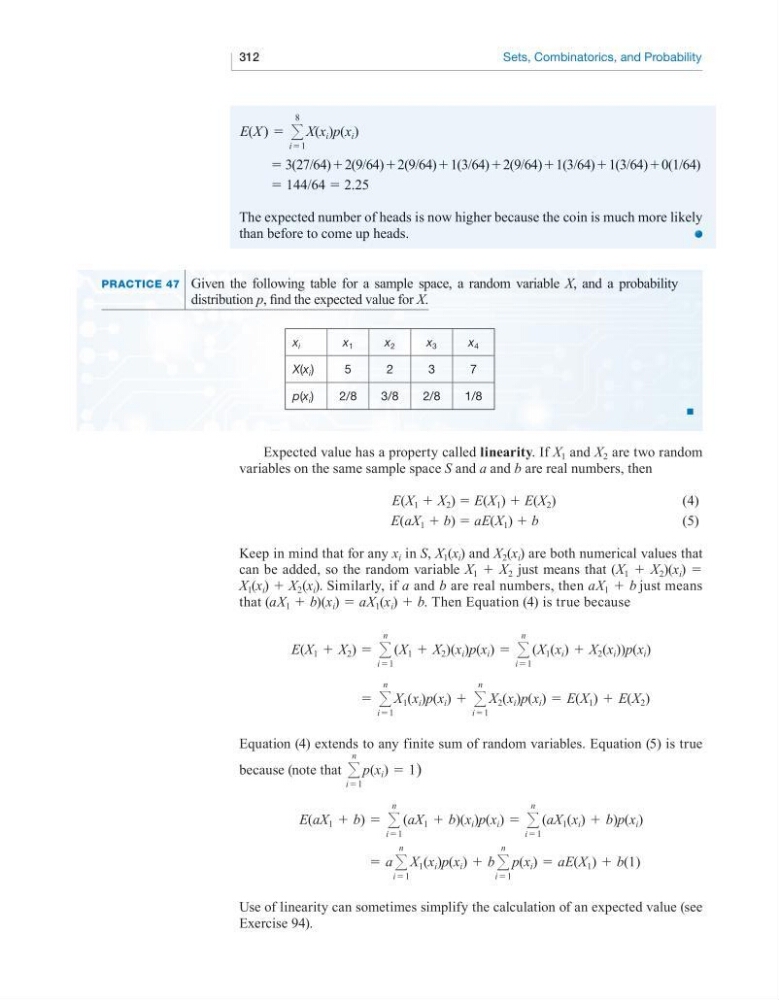
PraCtiCe 47 Given the following table for a sample space, a random variable X, and a probability
distribution p, find the expected value for X.
x i
x 1
x 2
x 3
x 4
X(x i )
5
2
3
7
p(x i )
2/8
3/8
2/8
1/8
■
Expected value has a property called linearity. If X 1 and X 2 are two random
variables on the same sample space S and a and b are real numbers, then
E(X 1 + X 2 ) = E(X 1 ) + E(X 2 )
(4)
E(aX 1 + b) = aE(X 1 ) + b
(5)
Keep in mind that for any x i in S, X 1 (x i ) and X 2 (x i ) are both numerical values that
can be added, so the random variable X 1 + X 2 just means that (X 1 + X 2 )(x i ) =
X 1 (x i ) + X 2 (x i ). Similarly, if a and b are real numbers, then aX 1 + b just means
that (aX 1 + b)(x i ) = aX 1 (x i ) + b. Then Equation (4) is true because
E(X 1 + X 2 ) = ∙
n
i=1
(X 1 + X 2 )(x i )p(x i ) = ∙
n
i=1
(X 1 (x i ) + X 2 (x i ))p(x i )
= ∙
n
i=1
X 1 (x i )p(x i ) + ∙
n
i=1
X 2 (x i )p(x i ) = E(X 1 ) + E(X 2 )
Equation (4) extends to any finite sum of random variables. Equation (5) is true
because (note that ∙
n
i=1
p(x i ) = 1)
E(aX 1 + b) = ∙
n
i=1
(aX 1 + b)(x i )p(x i ) = ∙
n
i=1
(aX 1 (x i ) + b)p(x i )
= a ∙
n
i=1
X 1 (x i )p(x i ) + b ∙
n
i=1
p(x i ) = aE(X 1 ) + b(1)
Use of linearity can sometimes simplify the calculation of an expected value (see
Exercise 94).
Sets, Combinatorics, and Probability
E(X ) = ∙
8
i=1
X(x i )p(x i )
= 3(27/64) + 2(9/64) + 2(9/64) + 1(3/64) + 2(9/64) + 1(3/64) + 1(3/64) + 0(1/64)
= 144/64 = 2.25
The expected number of heads is now higher because the coin is much more likely
than before to come up heads.
PraCtiCe 47 Given the following table for a sample space, a random variable X, and a probability
distribution p, find the expected value for X.
x i
x 1
x 2
x 3
x 4
X(x i )
5
2
3
7
p(x i )
2/8
3/8
2/8
1/8
■
Expected value has a property called linearity. If X 1 and X 2 are two random
variables on the same sample space S and a and b are real numbers, then
E(X 1 + X 2 ) = E(X 1 ) + E(X 2 )
(4)
E(aX 1 + b) = aE(X 1 ) + b
(5)
Keep in mind that for any x i in S, X 1 (x i ) and X 2 (x i ) are both numerical values that
can be added, so the random variable X 1 + X 2 just means that (X 1 + X 2 )(x i ) =
X 1 (x i ) + X 2 (x i ). Similarly, if a and b are real numbers, then aX 1 + b just means
that (aX 1 + b)(x i ) = aX 1 (x i ) + b. Then Equation (4) is true because
E(X 1 + X 2 ) = ∙
n
i=1
(X 1 + X 2 )(x i )p(x i ) = ∙
n
i=1
(X 1 (x i ) + X 2 (x i ))p(x i )
= ∙
n
i=1
X 1 (x i )p(x i ) + ∙
n
i=1
X 2 (x i )p(x i ) = E(X 1 ) + E(X 2 )
Equation (4) extends to any finite sum of random variables. Equation (5) is true
because (note that ∙
n
i=1
p(x i ) = 1)
E(aX 1 + b) = ∙
n
i=1
(aX 1 + b)(x i )p(x i ) = ∙
n
i=1
(aX 1 (x i ) + b)p(x i )
= a ∙
n
i=1
X 1 (x i )p(x i ) + b ∙
n
i=1
p(x i ) = aE(X 1 ) + b(1)
Use of linearity can sometimes simplify the calculation of an expected value (see
Exercise 94).