

Section 4.6 Probability
311
example 74
A fair coin is tossed three times. The sample space S is
S = {HHH, HHT, HTH, HTT, THH, THT, TTH, TTT}
Let the random variable X assign to each outcome in S the number of heads in that
outcome, which will be an integer value between 0 and 3. Because this is a fair
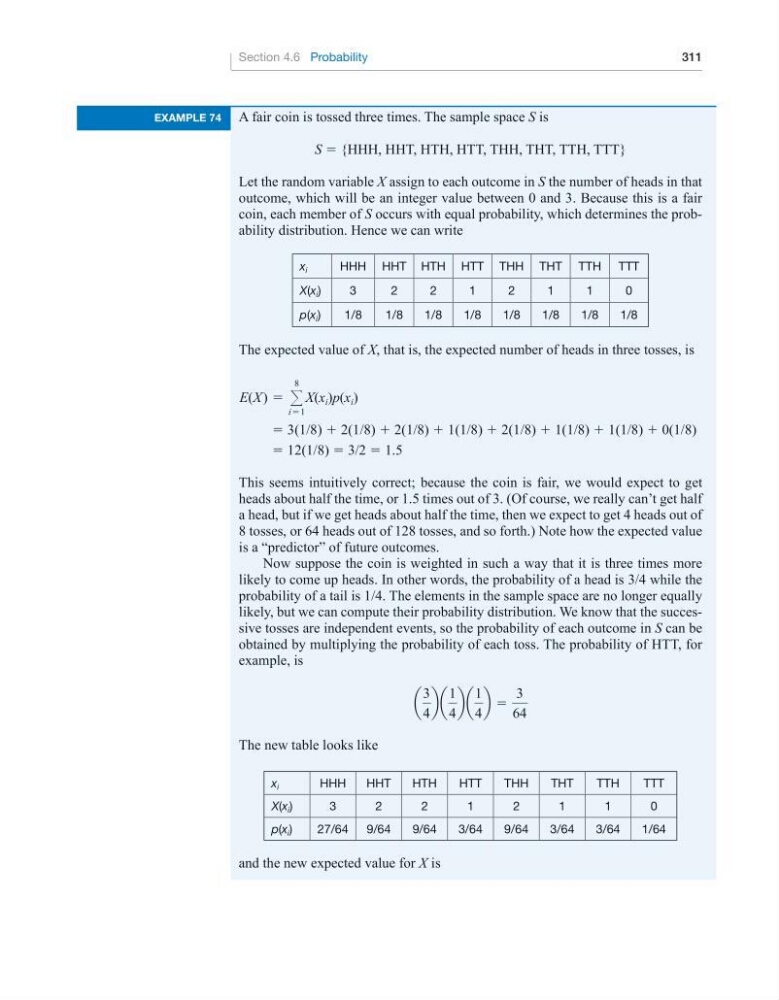
coin, each member of S occurs with equal probability, which determines the probability distribution. Hence we can write
x i
HHH HHT HTH HTT THH THT TTH TTT
X(x i )
3
2
2
1
2
1
1
0
p(x i )
1/8
1/8
1/8
1/8
1/8
1/8
1/8
1/8
The expected value of X, that is, the expected number of heads in three tosses, is
E(X ) = ∙
8
i=1
X(x i )p(x i )
= 3(1/8) + 2(1/8) + 2(1/8) + 1(1/8) + 2(1/8) + 1(1/8) + 1(1/8) + 0(1/8)
= 12(1/8) = 3/2 = 1.5
This seems intuitively correct; because the coin is fair, we would expect to get
heads about half the time, or 1.5 times out of 3. (Of course, we really can’t get half
a head, but if we get heads about half the time, then we expect to get 4 heads out of
8 tosses, or 64 heads out of 128 tosses, and so forth.) Note how the expected value
is a “predictor” of future outcomes.
Now suppose the coin is weighted in such a way that it is three times more
likely to come up heads. In other words, the probability of a head is 3/4 while the
probability of a tail is 1/4. The elements in the sample space are no longer equally
likely, but we can compute their probability distribution. We know that the successive tosses are independent events, so the probability of each outcome in S can be
obtained by multiplying the probability of each toss. The probability of HTT, for
example, is
a
3
4
b a
1
4
b a
1
4
b =
3
64
The new table looks like
x i
HHH
HHT
HTH
HTT
THH
THT
TTH
TTT
X(x i )
3
2
2
1
2
1
1
0
p(x i )
27/64 9/64
9/64
3/64
9/64
3/64
3/64
1/64
and the new expected value for X is
311
example 74
A fair coin is tossed three times. The sample space S is
S = {HHH, HHT, HTH, HTT, THH, THT, TTH, TTT}
Let the random variable X assign to each outcome in S the number of heads in that
outcome, which will be an integer value between 0 and 3. Because this is a fair
coin, each member of S occurs with equal probability, which determines the probability distribution. Hence we can write
x i
HHH HHT HTH HTT THH THT TTH TTT
X(x i )
3
2
2
1
2
1
1
0
p(x i )
1/8
1/8
1/8
1/8
1/8
1/8
1/8
1/8
The expected value of X, that is, the expected number of heads in three tosses, is
E(X ) = ∙
8
i=1
X(x i )p(x i )
= 3(1/8) + 2(1/8) + 2(1/8) + 1(1/8) + 2(1/8) + 1(1/8) + 1(1/8) + 0(1/8)
= 12(1/8) = 3/2 = 1.5
This seems intuitively correct; because the coin is fair, we would expect to get
heads about half the time, or 1.5 times out of 3. (Of course, we really can’t get half
a head, but if we get heads about half the time, then we expect to get 4 heads out of
8 tosses, or 64 heads out of 128 tosses, and so forth.) Note how the expected value
is a “predictor” of future outcomes.
Now suppose the coin is weighted in such a way that it is three times more
likely to come up heads. In other words, the probability of a head is 3/4 while the
probability of a tail is 1/4. The elements in the sample space are no longer equally
likely, but we can compute their probability distribution. We know that the successive tosses are independent events, so the probability of each outcome in S can be
obtained by multiplying the probability of each toss. The probability of HTT, for
example, is
a
3
4
b a
1
4
b a
1
4
b =
3
64
The new table looks like
x i
HHH
HHT
HTH
HTT
THH
THT
TTH
TTT
X(x i )
3
2
2
1
2
1
1
0
p(x i )
27/64 9/64
9/64
3/64
9/64
3/64
3/64
1/64
and the new expected value for X is