

310
Sets, Combinatorics, and Probability
expected Value
A student takes three tests; the set of grades received is S = {g 1 , g 2 , g 3 }. The
student computes the average test grade A(g) by
A(g) =
g 1 + g 2 + g 3
3
This assumes that the three tests are equally weighted. If we write
A(g) =
1
3
(g 1 + g 2 + g 3 ) = g 1 a
1
3
b + g 2 a
1
3
b + g 3 a
1
3
b
we can also see that A(g) is the sum of the product of each test grade times the
amount of its contribution to the total grade. If the last test counts twice as much
as the other two, then the “weighted average” grade would be
A(g) =
1
4
(g 1 + g 2 + 2g 3 ) = g 1 a
1
4
b + g 2 a
1
4
b + g 3 a
2
4
b
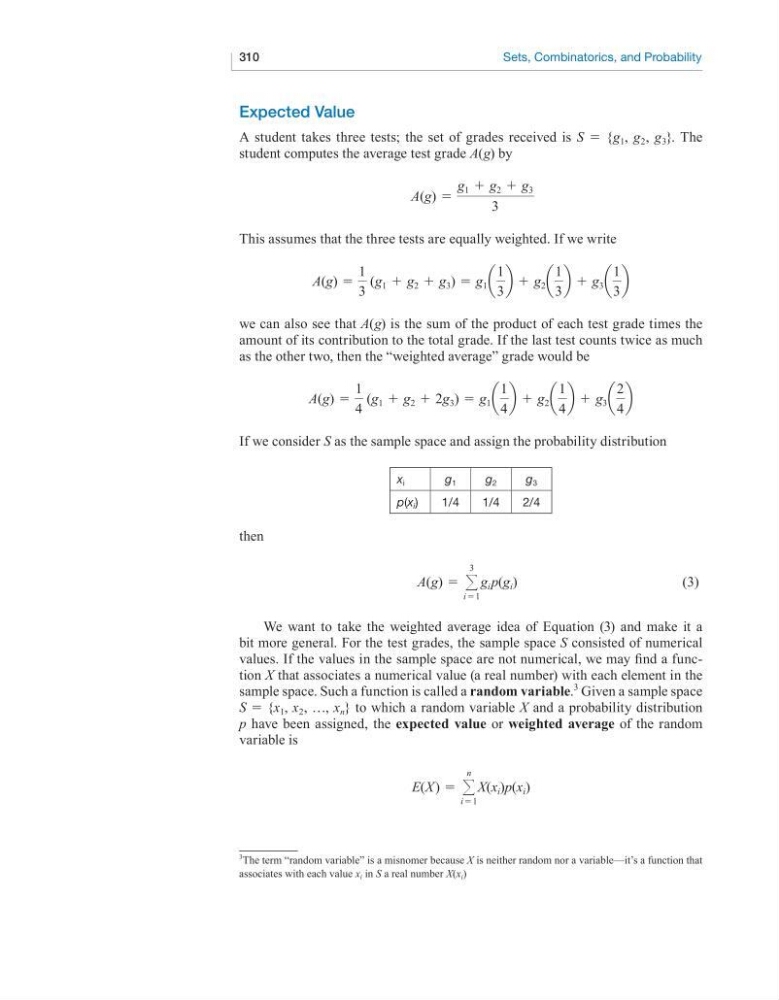
If we consider S as the sample space and assign the probability distribution
x i
g 1
g 2
g 3
p(x i )
1/4
1/4
2/4
then
A(g) = ∙
3
i=1
g i p(g i )
(3)
We want to take the weighted average idea of Equation (3) and make it a
bit more general. For the test grades, the sample space S consisted of numerical
values. If the values in the sample space are not numerical, we may find a function X that associates a numerical value (a real number) with each element in the
sample space. Such a function is called a random variable.
3
Given a sample space
S = {x 1 , x 2 , …, x n } to which a random variable X and a probability distribution
p have been assigned, the expected value or weighted average of the random
variable is
E(X ) = ∙
n
i=1
X(x i )p(x i )
3 The term “random variable” is a misnomer because X is neither random nor a variable—it’s a function that
associates with each value x i in S a real number X(x i )
Sets, Combinatorics, and Probability
expected Value
A student takes three tests; the set of grades received is S = {g 1 , g 2 , g 3 }. The
student computes the average test grade A(g) by
A(g) =
g 1 + g 2 + g 3
3
This assumes that the three tests are equally weighted. If we write
A(g) =
1
3
(g 1 + g 2 + g 3 ) = g 1 a
1
3
b + g 2 a
1
3
b + g 3 a
1
3
b
we can also see that A(g) is the sum of the product of each test grade times the
amount of its contribution to the total grade. If the last test counts twice as much
as the other two, then the “weighted average” grade would be
A(g) =
1
4
(g 1 + g 2 + 2g 3 ) = g 1 a
1
4
b + g 2 a
1
4
b + g 3 a
2
4
b
If we consider S as the sample space and assign the probability distribution
x i
g 1
g 2
g 3
p(x i )
1/4
1/4
2/4
then
A(g) = ∙
3
i=1
g i p(g i )
(3)
We want to take the weighted average idea of Equation (3) and make it a
bit more general. For the test grades, the sample space S consisted of numerical
values. If the values in the sample space are not numerical, we may find a function X that associates a numerical value (a real number) with each element in the
sample space. Such a function is called a random variable.
3
Given a sample space
S = {x 1 , x 2 , …, x n } to which a random variable X and a probability distribution
p have been assigned, the expected value or weighted average of the random
variable is
E(X ) = ∙
n
i=1
X(x i )p(x i )
3 The term “random variable” is a misnomer because X is neither random nor a variable—it’s a function that
associates with each value x i in S a real number X(x i )