

120
L. Schorr et al.
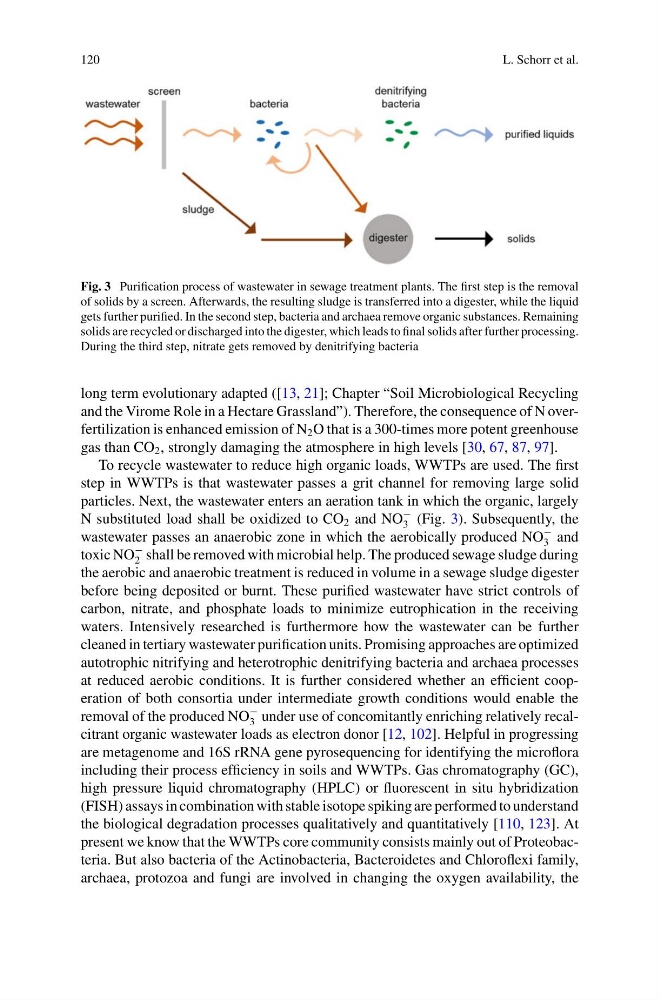
Fig. 3 Purification process of wastewater in sewage treatment plants. The first step is the removal
of solids by a screen. Afterwards, the resulting sludge is transferred into a digester, while the liquid
gets further purified. In the second step, bacteria and archaea remove organic substances. Remaining
solids are recycled or discharged into the digester, which leads to final solids after further processing.
During the third step, nitrate gets removed by denitrifying bacteria
long term evolutionary adapted ([13, 21]; Chapter “Soil Microbiological Recycling
and the Virome Role in a Hectare Grassland”). Therefore, the consequence of N overfertilization is enhanced emission of N 2 O that is a 300-times more potent greenhouse
gas than CO 2 , strongly damaging the atmosphere in high levels [30, 67, 87, 97].
To recycle wastewater to reduce high organic loads, WWTPs are used. The first
step in WWTPs is that wastewater passes a grit channel for removing large solid
particles. Next, the wastewater enters an aeration tank in which the organic, largely
N substituted load shall be oxidized to CO 2 and NO
−
3 (Fig. 3). Subsequently, the
wastewater passes an anaerobic zone in which the aerobically produced NO
−
3 and
toxic NO
−
2 shall be removed with microbial help. The produced sewage sludge during
the aerobic and anaerobic treatment is reduced in volume in a sewage sludge digester
before being deposited or burnt. These purified wastewater have strict controls of
carbon, nitrate, and phosphate loads to minimize eutrophication in the receiving
waters. Intensively researched is furthermore how the wastewater can be further
cleaned in tertiary wastewater purification units. Promising approaches are optimized
autotrophic nitrifying and heterotrophic denitrifying bacteria and archaea processes
at reduced aerobic conditions. It is further considered whether an efficient cooperation of both consortia under intermediate growth conditions would enable the
removal of the produced NO
−
3 under use of concomitantly enriching relatively recalcitrant organic wastewater loads as electron donor [12, 102]. Helpful in progressing
are metagenome and 16S rRNA gene pyrosequencing for identifying the microflora
including their process efficiency in soils and WWTPs. Gas chromatography (GC),
high pressure liquid chromatography (HPLC) or fluorescent in situ hybridization
(FISH) assays in combination with stable isotope spiking are performed to understand
the biological degradation processes qualitatively and quantitatively [110, 123]. At
present we know that the WWTPs core community consists mainly out of Proteobacteria. But also bacteria of the Actinobacteria, Bacteroidetes and Chloroflexi family,
archaea, protozoa and fungi are involved in changing the oxygen availability, the
L. Schorr et al.
Fig. 3 Purification process of wastewater in sewage treatment plants. The first step is the removal
of solids by a screen. Afterwards, the resulting sludge is transferred into a digester, while the liquid
gets further purified. In the second step, bacteria and archaea remove organic substances. Remaining
solids are recycled or discharged into the digester, which leads to final solids after further processing.
During the third step, nitrate gets removed by denitrifying bacteria
long term evolutionary adapted ([13, 21]; Chapter “Soil Microbiological Recycling
and the Virome Role in a Hectare Grassland”). Therefore, the consequence of N overfertilization is enhanced emission of N 2 O that is a 300-times more potent greenhouse
gas than CO 2 , strongly damaging the atmosphere in high levels [30, 67, 87, 97].
To recycle wastewater to reduce high organic loads, WWTPs are used. The first
step in WWTPs is that wastewater passes a grit channel for removing large solid
particles. Next, the wastewater enters an aeration tank in which the organic, largely
N substituted load shall be oxidized to CO 2 and NO
−
3 (Fig. 3). Subsequently, the
wastewater passes an anaerobic zone in which the aerobically produced NO
−
3 and
toxic NO
−
2 shall be removed with microbial help. The produced sewage sludge during
the aerobic and anaerobic treatment is reduced in volume in a sewage sludge digester
before being deposited or burnt. These purified wastewater have strict controls of
carbon, nitrate, and phosphate loads to minimize eutrophication in the receiving
waters. Intensively researched is furthermore how the wastewater can be further
cleaned in tertiary wastewater purification units. Promising approaches are optimized
autotrophic nitrifying and heterotrophic denitrifying bacteria and archaea processes
at reduced aerobic conditions. It is further considered whether an efficient cooperation of both consortia under intermediate growth conditions would enable the
removal of the produced NO
−
3 under use of concomitantly enriching relatively recalcitrant organic wastewater loads as electron donor [12, 102]. Helpful in progressing
are metagenome and 16S rRNA gene pyrosequencing for identifying the microflora
including their process efficiency in soils and WWTPs. Gas chromatography (GC),
high pressure liquid chromatography (HPLC) or fluorescent in situ hybridization
(FISH) assays in combination with stable isotope spiking are performed to understand
the biological degradation processes qualitatively and quantitatively [110, 123]. At
present we know that the WWTPs core community consists mainly out of Proteobacteria. But also bacteria of the Actinobacteria, Bacteroidetes and Chloroflexi family,
archaea, protozoa and fungi are involved in changing the oxygen availability, the