

Soil Fauna Activities in Agricultural Greek Landscapes
91
B
Aporrectodea sp A
Octodrilus complanatus
D
E
C
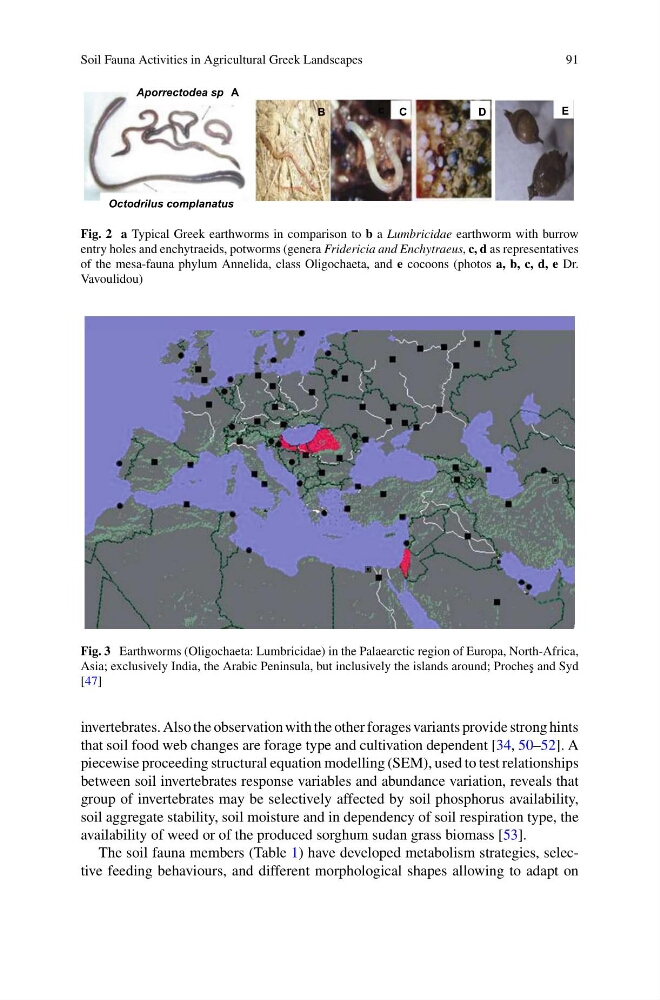
Fig. 2 a Typical Greek earthworms in comparison to b a Lumbricidae earthworm with burrow
entry holes and enchytraeids, potworms (genera Fridericia and Enchytraeus, c, d as representatives
of the mesa-fauna phylum Annelida, class Oligochaeta, and e cocoons (photos a, b, c, d, e Dr.
Vavoulidou)
Fig. 3 Earthworms (Oligochaeta: Lumbricidae) in the Palaearctic region of Europa, North-Africa,
Asia; exclusively India, the Arabic Peninsula, but inclusively the islands around; Proche¸ s and Syd
[47]
invertebrates. Also the observation with the other forages variants provide strong hints
that soil food web changes are forage type and cultivation dependent [34, 50–52]. A
piecewise proceeding structural equation modelling (SEM), used to test relationships
between soil invertebrates response variables and abundance variation, reveals that
group of invertebrates may be selectively affected by soil phosphorus availability,
soil aggregate stability, soil moisture and in dependency of soil respiration type, the
availability of weed or of the produced sorghum sudan grass biomass [53].
The soil fauna members (Table 1) have developed metabolism strategies, selective feeding behaviours, and different morphological shapes allowing to adapt on
91
B
Aporrectodea sp A
Octodrilus complanatus
D
E
C
Fig. 2 a Typical Greek earthworms in comparison to b a Lumbricidae earthworm with burrow
entry holes and enchytraeids, potworms (genera Fridericia and Enchytraeus, c, d as representatives
of the mesa-fauna phylum Annelida, class Oligochaeta, and e cocoons (photos a, b, c, d, e Dr.
Vavoulidou)
Fig. 3 Earthworms (Oligochaeta: Lumbricidae) in the Palaearctic region of Europa, North-Africa,
Asia; exclusively India, the Arabic Peninsula, but inclusively the islands around; Proche¸ s and Syd
[47]
invertebrates. Also the observation with the other forages variants provide strong hints
that soil food web changes are forage type and cultivation dependent [34, 50–52]. A
piecewise proceeding structural equation modelling (SEM), used to test relationships
between soil invertebrates response variables and abundance variation, reveals that
group of invertebrates may be selectively affected by soil phosphorus availability,
soil aggregate stability, soil moisture and in dependency of soil respiration type, the
availability of weed or of the produced sorghum sudan grass biomass [53].
The soil fauna members (Table 1) have developed metabolism strategies, selective feeding behaviours, and different morphological shapes allowing to adapt on