

60
Internet of Things (IoT)
4.1 Introduction
In the digital era, the rapidly growing Internet of Things (IoT) comes with enormous solutions for relating and communicating among smart objects. Right now there are 14 billion
IoT devices installed, and IoT acts as an umbrella covering different fields like manufacturing and logistics, agriculture, social networks, transport, health care, and hospitals.
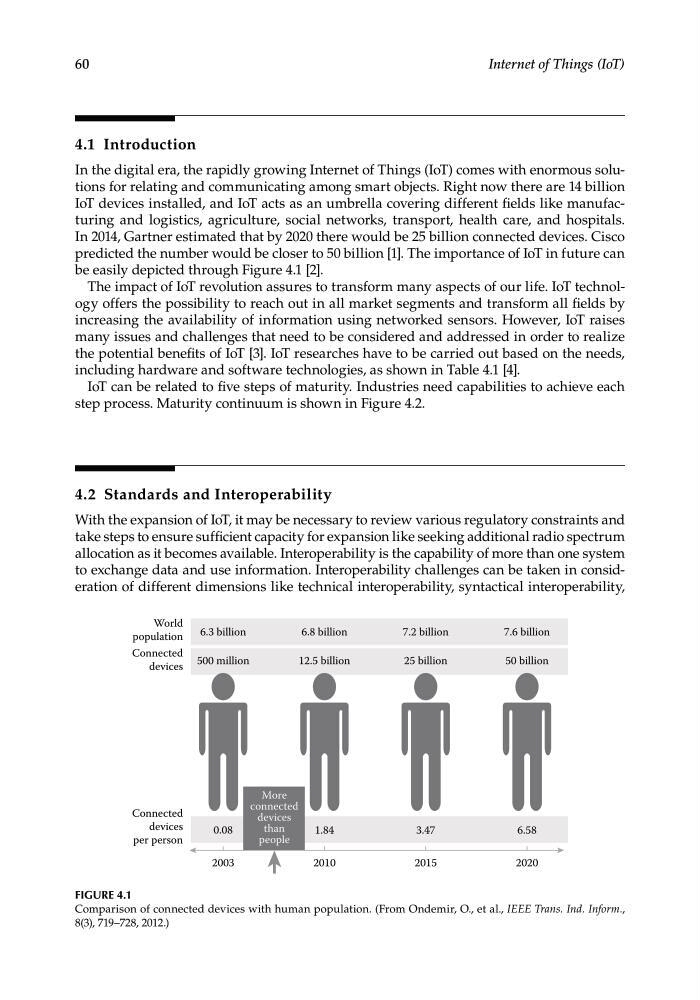
In 2014, Gartner estimated that by 2020 there would be 25 billion connected devices. Cisco
predicted the number would be closer to 50 billion [1]. The importance of IoT in future can
be easily depicted through Figure 4.1 [2].
The impact of IoT revolution assures to transform many aspects of our life. IoT technology offers the possibility to reach out in all market segments and transform all fields by
increasing the availability of information using networked sensors. However, IoT raises
many issues and challenges that need to be considered and addressed in order to realize
the potential benefits of IoT [3]. IoT researches have to be carried out based on the needs,
including hardware and software technologies, as shown in Table 4.1 [4].
IoT can be related to five steps of maturity. Industries need capabilities to achieve each
step process. Maturity continuum is shown in Figure 4.2.
4.2 Standards and Interoperability
With the expansion of IoT, it may be necessary to review various regulatory constraints and
take steps to ensure sufficient capacity for expansion like seeking additional radio spectrum
allocation as it becomes available. Interoperability is the capability of more than one system
to exchange data and use information. Interoperability challenges can be taken in consideration of different dimensions like technical interoperability, syntactical interoperability,
World
population
6.3 billion
6.8 billion
7.2 billion
7.6 billion
500 million
12.5 billion
25 billion
50 billion
Connected
devices
Connected
devices
per person
0.08
1.84
3.47
6.58
More
connected
devices
than
people
2003
2010
2015
2020
FIGURE 4.1
Comparison of connected devices with human population. (From Ondemir, O., et al., IEEE Trans. Ind. Inform.,
8(3), 719–728, 2012.)
Internet of Things (IoT)
4.1 Introduction
In the digital era, the rapidly growing Internet of Things (IoT) comes with enormous solutions for relating and communicating among smart objects. Right now there are 14 billion
IoT devices installed, and IoT acts as an umbrella covering different fields like manufacturing and logistics, agriculture, social networks, transport, health care, and hospitals.
In 2014, Gartner estimated that by 2020 there would be 25 billion connected devices. Cisco
predicted the number would be closer to 50 billion [1]. The importance of IoT in future can
be easily depicted through Figure 4.1 [2].
The impact of IoT revolution assures to transform many aspects of our life. IoT technology offers the possibility to reach out in all market segments and transform all fields by
increasing the availability of information using networked sensors. However, IoT raises
many issues and challenges that need to be considered and addressed in order to realize
the potential benefits of IoT [3]. IoT researches have to be carried out based on the needs,
including hardware and software technologies, as shown in Table 4.1 [4].
IoT can be related to five steps of maturity. Industries need capabilities to achieve each
step process. Maturity continuum is shown in Figure 4.2.
4.2 Standards and Interoperability
With the expansion of IoT, it may be necessary to review various regulatory constraints and
take steps to ensure sufficient capacity for expansion like seeking additional radio spectrum
allocation as it becomes available. Interoperability is the capability of more than one system
to exchange data and use information. Interoperability challenges can be taken in consideration of different dimensions like technical interoperability, syntactical interoperability,
World
population
6.3 billion
6.8 billion
7.2 billion
7.6 billion
500 million
12.5 billion
25 billion
50 billion
Connected
devices
Connected
devices
per person
0.08
1.84
3.47
6.58
More
connected
devices
than
people
2003
2010
2015
2020
FIGURE 4.1
Comparison of connected devices with human population. (From Ondemir, O., et al., IEEE Trans. Ind. Inform.,
8(3), 719–728, 2012.)