

61
Technical and Societal Challenges
and semantic and organizational interoperability [5]. Table 4.2 depicts
the challenges in IoT technical interoperability.
A specific challenge in this regard is ensuring global
interoperability, especially for things and devices which make
use of radio spectrum. Without interoperability, devices cannot
be networked around them. It is important to connect between
two or more random devices which exchange messages anytime
anywhere. Users don’t wish to get committed to a single vendor
and they expect their devices to be connected among different
vendors. The approaches to be addressed are (1) Do all devices
speak the same language? (2) Are intermediates required to
translate their communication? The first issue arises due to the
heterogeneity of the IoT, and this issue can be solved if we can
agree on standards instead of constantly aiming to disrupt, define
our own aspects of this growing ecosystem. The second issue is
translating between many protocols and systems automatically,
which means we are moving from concrete data models to an
abstract information model. The open-source project Eclipse
Smart Home is an example of an intermediate-based approach.
The standard can be defined as a model or a specific template to
be followed. Standards should be designed to support a range of
applications, and it should address the requirements of industry,
TABLE 4.1
Internet of Things Scenario
IoT Research Needs
2011–2015
2015–2020
Beyond 2020
Identification
technology
• Combination of IP, IDs, and
addressing scheme
• Unique ID
• Multiple IDs for specific cases
• Enhancing the IDs
• Electromagnetic identification
(EMID)
Beyond EMID
Multimethods—
one ID
IoT architecture
• Extranet of things
• Partner to partner applications, basic
interoperability, billions-of-things
• IoT with global
perspectives
SOA software
services for IoT
• Composed of IoT services
• Process IoT services
IoT architecture
technology
• Variation of symmetric encryption
and public key algorithms
• Worldwide certification of objects
• Graceful recovery of tags following
power loss
• Increased memory
• Reduces utilization of energy
consumption
• Location tracing embedded systems
• IoT governance scheme
• Code in tags to be
executed in the tag
or in trusted readers
• Global applications
• Adaptive coverage
• Context awareness
• Object intelligence
Intelligent and
collaborative
functions
Source: Vermesan, O. and Friess, P., Internet of Things—Converging Technologies for Smart Environments and
Integrated Ecosystems, River, Alaborg, 2013.
Monitoring
Control
Optimization
Autonomy
System
autonomy
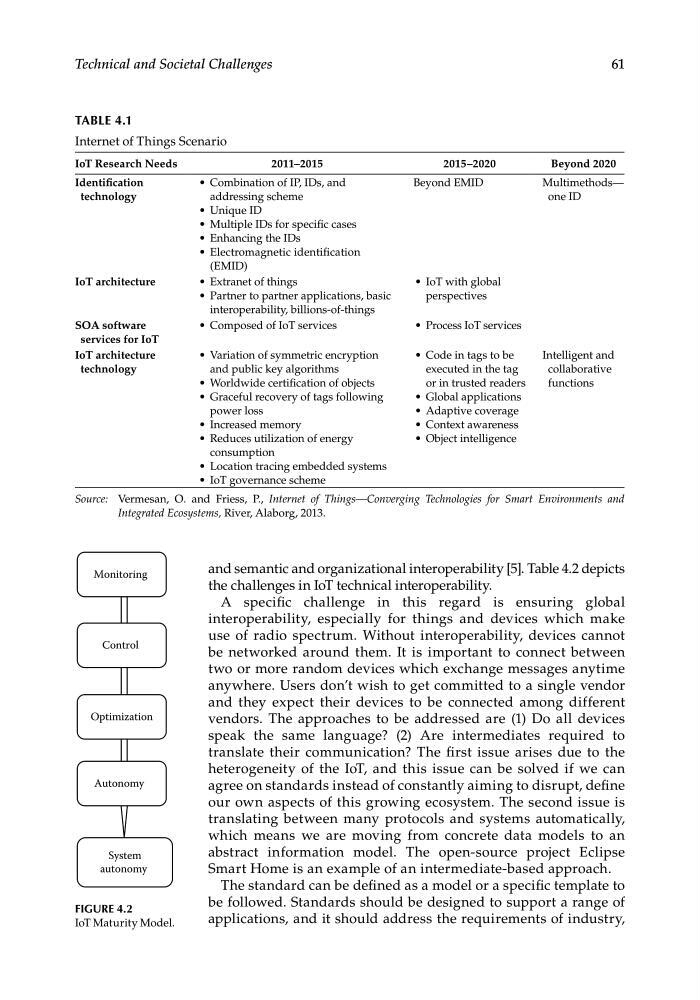
FIGURE 4.2
IoT Maturity Model.
Technical and Societal Challenges
and semantic and organizational interoperability [5]. Table 4.2 depicts
the challenges in IoT technical interoperability.
A specific challenge in this regard is ensuring global
interoperability, especially for things and devices which make
use of radio spectrum. Without interoperability, devices cannot
be networked around them. It is important to connect between
two or more random devices which exchange messages anytime
anywhere. Users don’t wish to get committed to a single vendor
and they expect their devices to be connected among different
vendors. The approaches to be addressed are (1) Do all devices
speak the same language? (2) Are intermediates required to
translate their communication? The first issue arises due to the
heterogeneity of the IoT, and this issue can be solved if we can
agree on standards instead of constantly aiming to disrupt, define
our own aspects of this growing ecosystem. The second issue is
translating between many protocols and systems automatically,
which means we are moving from concrete data models to an
abstract information model. The open-source project Eclipse
Smart Home is an example of an intermediate-based approach.
The standard can be defined as a model or a specific template to
be followed. Standards should be designed to support a range of
applications, and it should address the requirements of industry,
TABLE 4.1
Internet of Things Scenario
IoT Research Needs
2011–2015
2015–2020
Beyond 2020
Identification
technology
• Combination of IP, IDs, and
addressing scheme
• Unique ID
• Multiple IDs for specific cases
• Enhancing the IDs
• Electromagnetic identification
(EMID)
Beyond EMID
Multimethods—
one ID
IoT architecture
• Extranet of things
• Partner to partner applications, basic
interoperability, billions-of-things
• IoT with global
perspectives
SOA software
services for IoT
• Composed of IoT services
• Process IoT services
IoT architecture
technology
• Variation of symmetric encryption
and public key algorithms
• Worldwide certification of objects
• Graceful recovery of tags following
power loss
• Increased memory
• Reduces utilization of energy
consumption
• Location tracing embedded systems
• IoT governance scheme
• Code in tags to be
executed in the tag
or in trusted readers
• Global applications
• Adaptive coverage
• Context awareness
• Object intelligence
Intelligent and
collaborative
functions
Source: Vermesan, O. and Friess, P., Internet of Things—Converging Technologies for Smart Environments and
Integrated Ecosystems, River, Alaborg, 2013.
Monitoring
Control
Optimization
Autonomy
System
autonomy
FIGURE 4.2
IoT Maturity Model.