

172
Internet of Things (IoT)
9.2.1 Requirements
In this section we discuss the functional and performance requirements of IoT name
services. Functional requirement means the functionality and services that a system
should provide. Nonfunctional requirements include the constraints on the system functionality such as performance, quality, safety, etc. The following high-level functional,
scalability, performance, and robustness requirements of an IoT name service S can be
identified.
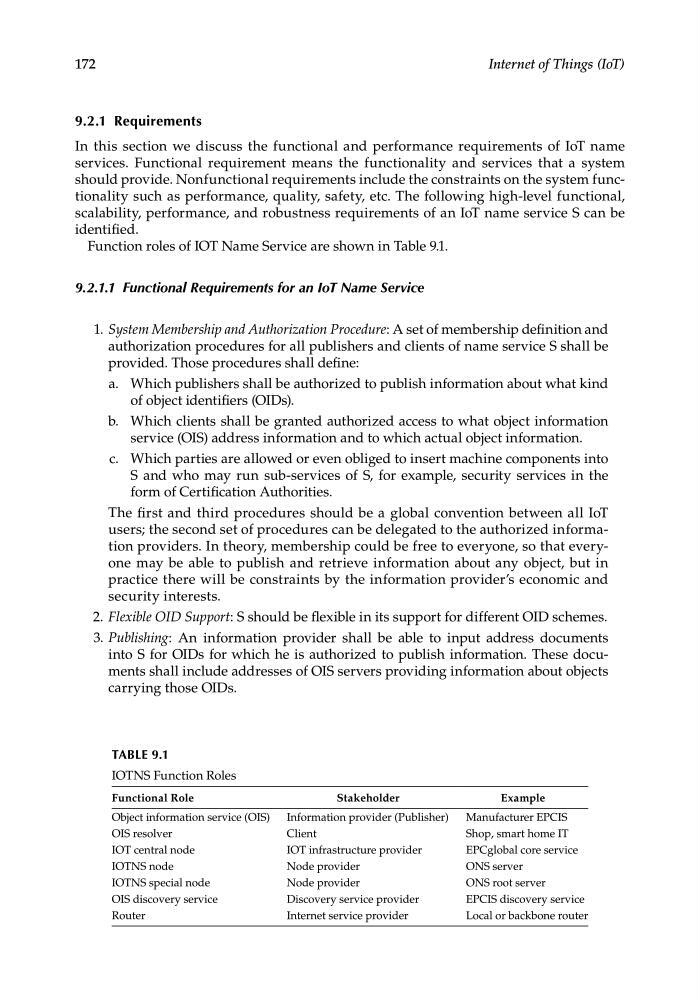
Function roles of IOT Name Service are shown in Table 9.1.
9.2.1.1 Functional Requirements for an IoT Name Service
1. System Membership and Authorization Procedure: A set of membership definition and
authorization procedures for all publishers and clients of name service S shall be
provided. Those procedures shall define:
a. Which publishers shall be authorized to publish information about what kind
of object identifiers (OIDs).
b. Which clients shall be granted authorized access to what object information
service (OIS) address information and to which actual object information.
c. Which parties are allowed or even obliged to insert machine components into
S and who may run sub-services of S, for example, security services in the
form of Certification Authorities.
The first and third procedures should be a global convention between all IoT
users; the second set of procedures can be delegated to the authorized information providers. In theory, membership could be free to everyone, so that everyone may be able to publish and retrieve information about any object, but in
practice there will be constraints by the information provider’s economic and
security interests.
2. Flexible OID Support: S should be flexible in its support for different OID schemes.
3. Publishing: An information provider shall be able to input address documents
into S for OIDs for which he is authorized to publish information. These documents shall include addresses of OIS servers providing information about objects
carrying those OIDs.
TABLE 9.1
IOTNS Function Roles
Functional Role
Stakeholder
Example
Object information service (OIS)
Information provider (Publisher)
Manufacturer EPCIS
OIS resolver
Client
Shop, smart home IT
IOT central node
IOT infrastructure provider
EPCglobal core service
IOTNS node
Node provider
ONS server
IOTNS special node
Node provider
ONS root server
OIS discovery service
Discovery service provider
EPCIS discovery service
Router
Internet service provider
Local or backbone router
Internet of Things (IoT)
9.2.1 Requirements
In this section we discuss the functional and performance requirements of IoT name
services. Functional requirement means the functionality and services that a system
should provide. Nonfunctional requirements include the constraints on the system functionality such as performance, quality, safety, etc. The following high-level functional,
scalability, performance, and robustness requirements of an IoT name service S can be
identified.
Function roles of IOT Name Service are shown in Table 9.1.
9.2.1.1 Functional Requirements for an IoT Name Service
1. System Membership and Authorization Procedure: A set of membership definition and
authorization procedures for all publishers and clients of name service S shall be
provided. Those procedures shall define:
a. Which publishers shall be authorized to publish information about what kind
of object identifiers (OIDs).
b. Which clients shall be granted authorized access to what object information
service (OIS) address information and to which actual object information.
c. Which parties are allowed or even obliged to insert machine components into
S and who may run sub-services of S, for example, security services in the
form of Certification Authorities.
The first and third procedures should be a global convention between all IoT
users; the second set of procedures can be delegated to the authorized information providers. In theory, membership could be free to everyone, so that everyone may be able to publish and retrieve information about any object, but in
practice there will be constraints by the information provider’s economic and
security interests.
2. Flexible OID Support: S should be flexible in its support for different OID schemes.
3. Publishing: An information provider shall be able to input address documents
into S for OIDs for which he is authorized to publish information. These documents shall include addresses of OIS servers providing information about objects
carrying those OIDs.
TABLE 9.1
IOTNS Function Roles
Functional Role
Stakeholder
Example
Object information service (OIS)
Information provider (Publisher)
Manufacturer EPCIS
OIS resolver
Client
Shop, smart home IT
IOT central node
IOT infrastructure provider
EPCglobal core service
IOTNS node
Node provider
ONS server
IOTNS special node
Node provider
ONS root server
OIS discovery service
Discovery service provider
EPCIS discovery service
Router
Internet service provider
Local or backbone router