

171
Naming Services in the Internet of Things
without explicitly listing the end-node that ultimately serves the request. This level of indirection allows applications to seamlessly continue communicating with end-nodes even
though the mapping from name to end-node addresses may change during the session.
Finally, unique identifier generation problem is investigated by Shen et al. [26], where they
designed a correlated lookup scheme with a distributed hash table to improve the performance of identifier management.
However, none of these schemes are motivated from the service layer as part of the
middleware at the back-end data center, nor they tackle the fundamental problem of providing a homogenous, both human and machine understandable, and unique naming
and addressing convention across different platforms. Furthermore, none of them support
profile services and legacy system integration.
9.2 Name Service
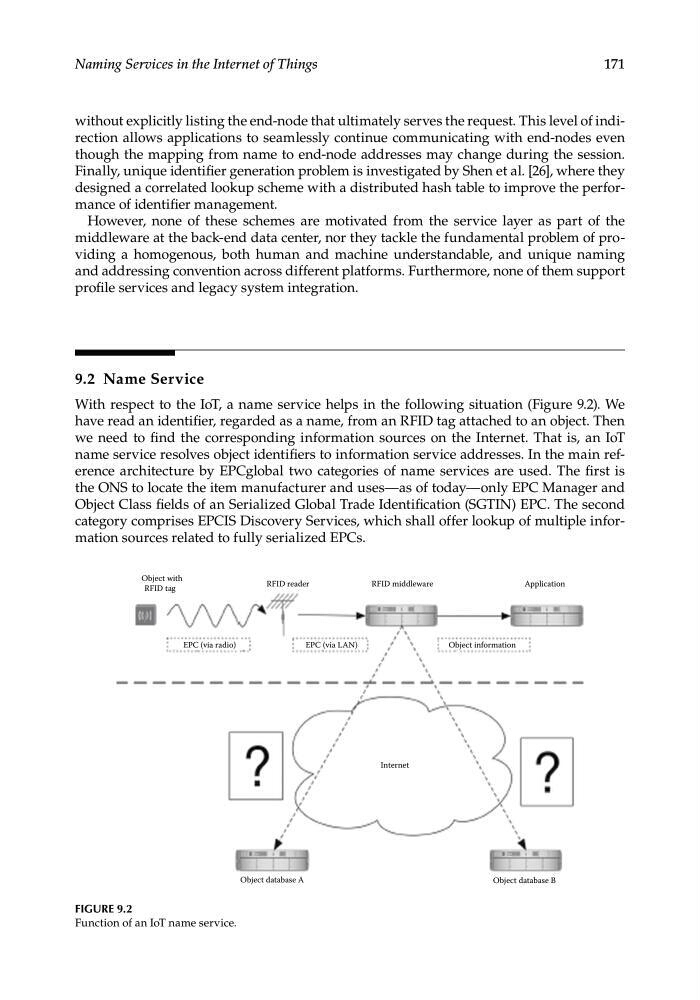
With respect to the IoT, a name service helps in the following situation (Figure 9.2). We
have read an identifier, regarded as a name, from an RFID tag attached to an object. Then
we need to find the corresponding information sources on the Internet. That is, an IoT
name service resolves object identifiers to information service addresses. In the main reference architecture by EPCglobal two categories of name services are used. The first is
the ONS to locate the item manufacturer and uses—as of today—only EPC Manager and
Object Class fields of an Serialized Global Trade Identification (SGTIN) EPC. The second
category comprises EPCIS Discovery Services, which shall offer lookup of multiple information sources related to fully serialized EPCs.
Object with
RFID tag
EPC (via radio)
EPC (via LAN)
RFID reader
RFID middleware
Object information
Object database B
Object database A
Internet
Application
FIGURE 9.2
Function of an IoT name service.
Naming Services in the Internet of Things
without explicitly listing the end-node that ultimately serves the request. This level of indirection allows applications to seamlessly continue communicating with end-nodes even
though the mapping from name to end-node addresses may change during the session.
Finally, unique identifier generation problem is investigated by Shen et al. [26], where they
designed a correlated lookup scheme with a distributed hash table to improve the performance of identifier management.
However, none of these schemes are motivated from the service layer as part of the
middleware at the back-end data center, nor they tackle the fundamental problem of providing a homogenous, both human and machine understandable, and unique naming
and addressing convention across different platforms. Furthermore, none of them support
profile services and legacy system integration.
9.2 Name Service
With respect to the IoT, a name service helps in the following situation (Figure 9.2). We
have read an identifier, regarded as a name, from an RFID tag attached to an object. Then
we need to find the corresponding information sources on the Internet. That is, an IoT
name service resolves object identifiers to information service addresses. In the main reference architecture by EPCglobal two categories of name services are used. The first is
the ONS to locate the item manufacturer and uses—as of today—only EPC Manager and
Object Class fields of an Serialized Global Trade Identification (SGTIN) EPC. The second
category comprises EPCIS Discovery Services, which shall offer lookup of multiple information sources related to fully serialized EPCs.
Object with
RFID tag
EPC (via radio)
EPC (via LAN)
RFID reader
RFID middleware
Object information
Object database B
Object database A
Internet
Application
FIGURE 9.2
Function of an IoT name service.