

173
Naming Services in the Internet of Things
4. Multiple Publishers (Independent): Multiple independent but authorized publishers should be able to provide information for an OID by storing corresponding
address data in S, without possible mutual interference, like censorship.
5. Querying: On input of OID e by a client, S shall output a current list of servers
offering information about the object corresponding to e.
6. Updating: Authorized publishers shall be able to update the data records they
published at will.
7. Deleting: Authorized publishers shall be able to delete the data records they
published at will. A time-to-live (TTL) value should be provided for each document to indicate old data and to reduce overhead for deletion.
8. Class-Level Addresses: If the OID is structured into a class-level and serial-level
part, S shall be able to work with partial OIDs at the class-level; for example, a
partial SGTIN EPC consisting of EPC Manager and Object Class.
9. Serial-Level Addresses: If the OID is structured into a class-level and serial-level part,
S should be able to work with fully serialized OIDs, for example a complete SGTIN
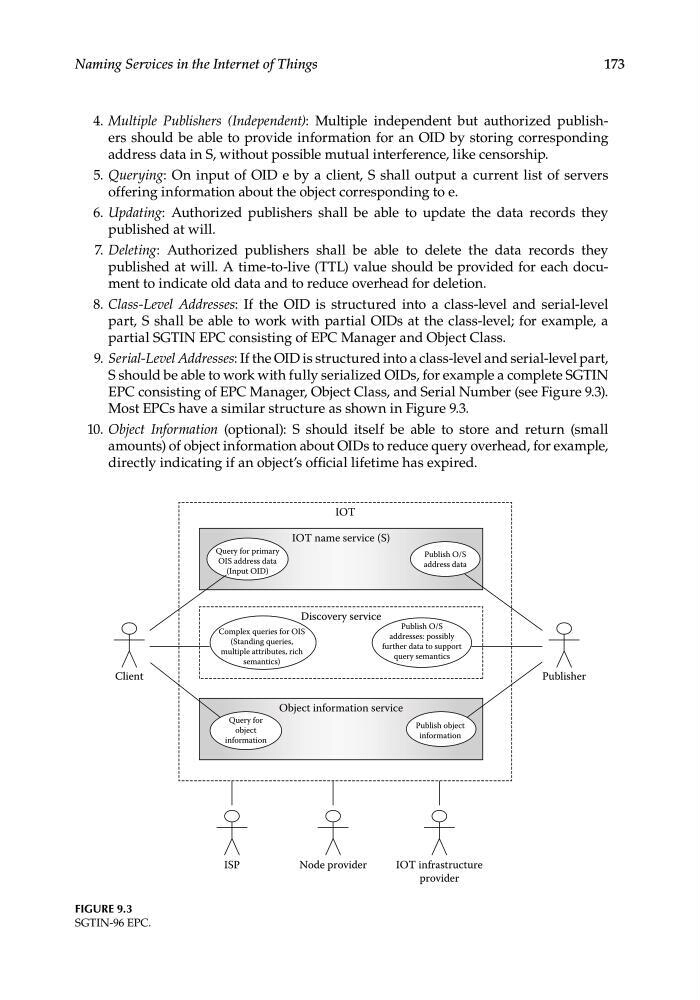
EPC consisting of EPC Manager, Object Class, and Serial Number (see Figure 9.3).
Most EPCs have a similar structure as shown in Figure 9.3.
10. Object Information (optional): S should itself be able to store and return (small
amounts) of object information about OIDs to reduce query overhead, for example,
directly indicating if an object’s official lifetime has expired.
IOT
IOT name service (S)
Query for primary
OIS address data
(Input OID)
Complex queries for OIS
(Standing queries,
multiple attributes, rich
semantics)
Query for
object
information
Client
ISP
Node provider
IOT infrastructure
provider
Publish object
information
Publisher
Publish O/S
addresses: possibly
further data to support
query semantics
Publish O/S
address data
Discovery service
Object information service
FIGURE 9.3
SGTIN-96 EPC.
Naming Services in the Internet of Things
4. Multiple Publishers (Independent): Multiple independent but authorized publishers should be able to provide information for an OID by storing corresponding
address data in S, without possible mutual interference, like censorship.
5. Querying: On input of OID e by a client, S shall output a current list of servers
offering information about the object corresponding to e.
6. Updating: Authorized publishers shall be able to update the data records they
published at will.
7. Deleting: Authorized publishers shall be able to delete the data records they
published at will. A time-to-live (TTL) value should be provided for each document to indicate old data and to reduce overhead for deletion.
8. Class-Level Addresses: If the OID is structured into a class-level and serial-level
part, S shall be able to work with partial OIDs at the class-level; for example, a
partial SGTIN EPC consisting of EPC Manager and Object Class.
9. Serial-Level Addresses: If the OID is structured into a class-level and serial-level part,
S should be able to work with fully serialized OIDs, for example a complete SGTIN
EPC consisting of EPC Manager, Object Class, and Serial Number (see Figure 9.3).
Most EPCs have a similar structure as shown in Figure 9.3.
10. Object Information (optional): S should itself be able to store and return (small
amounts) of object information about OIDs to reduce query overhead, for example,
directly indicating if an object’s official lifetime has expired.
IOT
IOT name service (S)
Query for primary
OIS address data
(Input OID)
Complex queries for OIS
(Standing queries,
multiple attributes, rich
semantics)
Query for
object
information
Client
ISP
Node provider
IOT infrastructure
provider
Publish object
information
Publisher
Publish O/S
addresses: possibly
further data to support
query semantics
Publish O/S
address data
Discovery service
Object information service
FIGURE 9.3
SGTIN-96 EPC.