

Innovative Bridge Concept
13
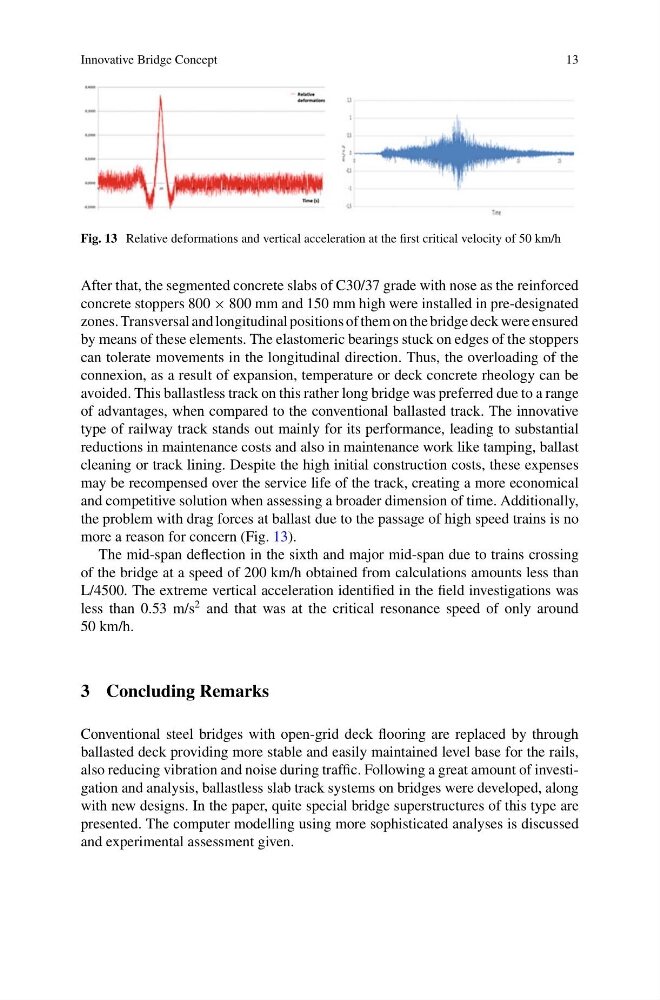
Fig. 13 Relative deformations and vertical acceleration at the first critical velocity of 50 km/h
After that, the segmented concrete slabs of C30/37 grade with nose as the reinforced
concrete stoppers 800 × 800 mm and 150 mm high were installed in pre-designated
zones. Transversal and longitudinal positions of them on the bridge deck were ensured
by means of these elements. The elastomeric bearings stuck on edges of the stoppers
can tolerate movements in the longitudinal direction. Thus, the overloading of the
connexion, as a result of expansion, temperature or deck concrete rheology can be
avoided. This ballastless track on this rather long bridge was preferred due to a range
of advantages, when compared to the conventional ballasted track. The innovative
type of railway track stands out mainly for its performance, leading to substantial
reductions in maintenance costs and also in maintenance work like tamping, ballast
cleaning or track lining. Despite the high initial construction costs, these expenses
may be recompensed over the service life of the track, creating a more economical
and competitive solution when assessing a broader dimension of time. Additionally,
the problem with drag forces at ballast due to the passage of high speed trains is no
more a reason for concern (Fig. 13).
The mid-span deflection in the sixth and major mid-span due to trains crossing
of the bridge at a speed of 200 km/h obtained from calculations amounts less than
L/4500. The extreme vertical acceleration identified in the field investigations was
less than 0.53 m/s
2 and that was at the critical resonance speed of only around
50 km/h.
3 Concluding Remarks
Conventional steel bridges with open-grid deck flooring are replaced by through
ballasted deck providing more stable and easily maintained level base for the rails,
also reducing vibration and noise during traffic. Following a great amount of investigation and analysis, ballastless slab track systems on bridges were developed, along
with new designs. In the paper, quite special bridge superstructures of this type are
presented. The computer modelling using more sophisticated analyses is discussed
and experimental assessment given.
13
Fig. 13 Relative deformations and vertical acceleration at the first critical velocity of 50 km/h
After that, the segmented concrete slabs of C30/37 grade with nose as the reinforced
concrete stoppers 800 × 800 mm and 150 mm high were installed in pre-designated
zones. Transversal and longitudinal positions of them on the bridge deck were ensured
by means of these elements. The elastomeric bearings stuck on edges of the stoppers
can tolerate movements in the longitudinal direction. Thus, the overloading of the
connexion, as a result of expansion, temperature or deck concrete rheology can be
avoided. This ballastless track on this rather long bridge was preferred due to a range
of advantages, when compared to the conventional ballasted track. The innovative
type of railway track stands out mainly for its performance, leading to substantial
reductions in maintenance costs and also in maintenance work like tamping, ballast
cleaning or track lining. Despite the high initial construction costs, these expenses
may be recompensed over the service life of the track, creating a more economical
and competitive solution when assessing a broader dimension of time. Additionally,
the problem with drag forces at ballast due to the passage of high speed trains is no
more a reason for concern (Fig. 13).
The mid-span deflection in the sixth and major mid-span due to trains crossing
of the bridge at a speed of 200 km/h obtained from calculations amounts less than
L/4500. The extreme vertical acceleration identified in the field investigations was
less than 0.53 m/s
2 and that was at the critical resonance speed of only around
50 km/h.
3 Concluding Remarks
Conventional steel bridges with open-grid deck flooring are replaced by through
ballasted deck providing more stable and easily maintained level base for the rails,
also reducing vibration and noise during traffic. Following a great amount of investigation and analysis, ballastless slab track systems on bridges were developed, along
with new designs. In the paper, quite special bridge superstructures of this type are
presented. The computer modelling using more sophisticated analyses is discussed
and experimental assessment given.