

150
A. Kaleta-Jurowska et al.
CI
CIG
CI+30%VG
CI+30% V
CI+30%SG
CI+30%S
0
1000
2000
3000
4000
5000
6000
4.0
5.0
6.0
7.0
8.0
Blain specific surface area
(cm2/g)
Flexural strength (MPa)
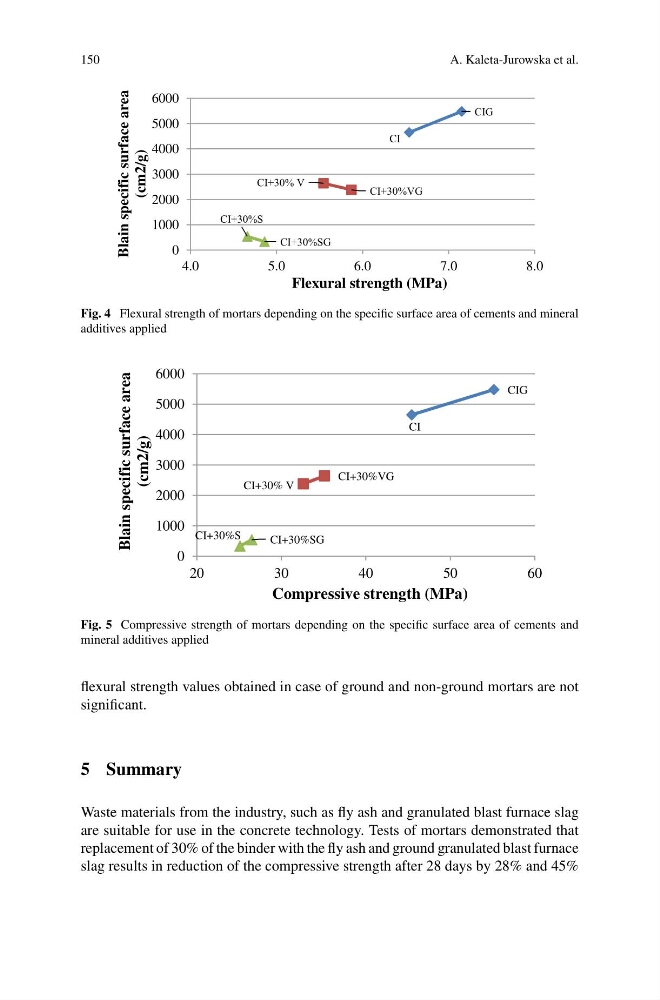
Fig. 4 Flexural strength of mortars depending on the specific surface area of cements and mineral
additives applied
CI
CIG
CI+30% V
CI+30%VG
CI+30%S
CI+30%SG
0
1000
2000
3000
4000
5000
6000
20
30
40
50
60
Blain specific surface area
(cm2/g)
Compressive strength (MPa)
Fig. 5 Compressive strength of mortars depending on the specific surface area of cements and
mineral additives applied
flexural strength values obtained in case of ground and non-ground mortars are not
significant.
5 Summary
Waste materials from the industry, such as fly ash and granulated blast furnace slag
are suitable for use in the concrete technology. Tests of mortars demonstrated that
replacement of 30% of the binder with the fly ash and ground granulated blast furnace
slag results in reduction of the compressive strength after 28 days by 28% and 45%
A. Kaleta-Jurowska et al.
CI
CIG
CI+30%VG
CI+30% V
CI+30%SG
CI+30%S
0
1000
2000
3000
4000
5000
6000
4.0
5.0
6.0
7.0
8.0
Blain specific surface area
(cm2/g)
Flexural strength (MPa)
Fig. 4 Flexural strength of mortars depending on the specific surface area of cements and mineral
additives applied
CI
CIG
CI+30% V
CI+30%VG
CI+30%S
CI+30%SG
0
1000
2000
3000
4000
5000
6000
20
30
40
50
60
Blain specific surface area
(cm2/g)
Compressive strength (MPa)
Fig. 5 Compressive strength of mortars depending on the specific surface area of cements and
mineral additives applied
flexural strength values obtained in case of ground and non-ground mortars are not
significant.
5 Summary
Waste materials from the industry, such as fly ash and granulated blast furnace slag
are suitable for use in the concrete technology. Tests of mortars demonstrated that
replacement of 30% of the binder with the fly ash and ground granulated blast furnace
slag results in reduction of the compressive strength after 28 days by 28% and 45%