

Calculation of Thermal Dynamic Characteristics …
109
where: n is the number of layers of the wall. For each layer, the thermal and physical
parameters λ i , ρ i , c i and thickness d i are defined. Counting starts from the inside.
The product of all the Z i matrices is Z N = Z n Z n−1 … Z 3 Z 2 Z 1 .
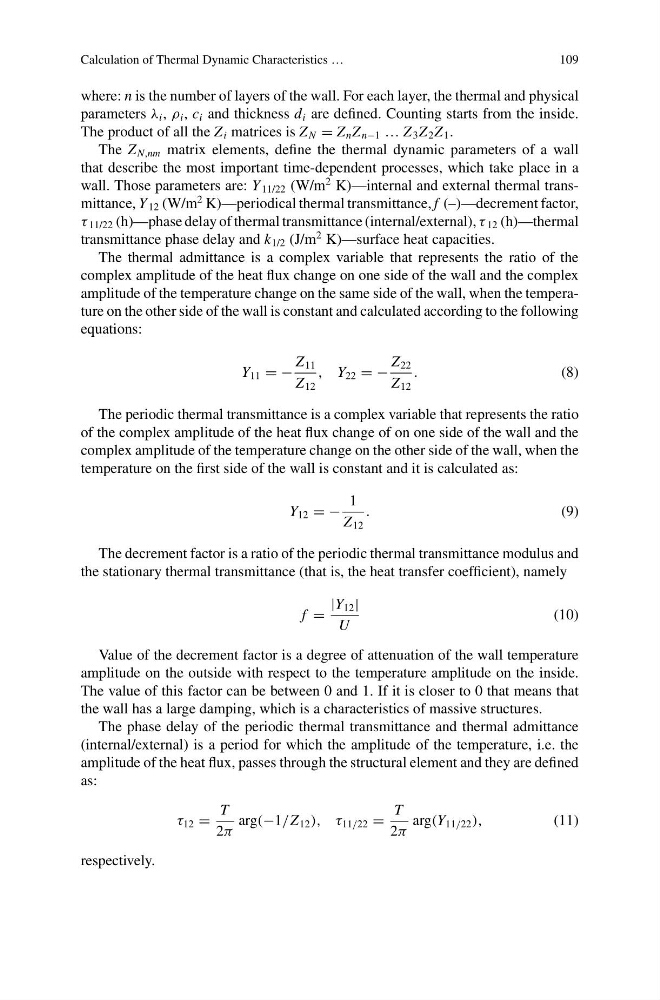
The Z N,nm matrix elements, define the thermal dynamic parameters of a wall
that describe the most important time-dependent processes, which take place in a
wall. Those parameters are: Y 11/22 (W/m
2 K)—internal and external thermal transmittance, Y 12 (W/m
2 K)—periodical thermal transmittance, f (–)—decrement factor,
τ 11/22 (h)—phase delay of thermal transmittance (internal/external), τ 12 (h)—thermal
transmittance phase delay and k 1/2 (J/m
2 K)—surface heat capacities.
The thermal admittance is a complex variable that represents the ratio of the
complex amplitude of the heat flux change on one side of the wall and the complex
amplitude of the temperature change on the same side of the wall, when the temperature on the other side of the wall is constant and calculated according to the following
equations:
Y 11 = −
Z 11
Z 12
, Y 22 = −
Z 22
Z 12
.
(8)
The periodic thermal transmittance is a complex variable that represents the ratio
of the complex amplitude of the heat flux change of on one side of the wall and the
complex amplitude of the temperature change on the other side of the wall, when the
temperature on the first side of the wall is constant and it is calculated as:
Y 12 = −
1
Z 12
.
(9)
The decrement factor is a ratio of the periodic thermal transmittance modulus and
the stationary thermal transmittance (that is, the heat transfer coefficient), namely
f =
|Y 12 |
U
(10)
Value of the decrement factor is a degree of attenuation of the wall temperature
amplitude on the outside with respect to the temperature amplitude on the inside.
The value of this factor can be between 0 and 1. If it is closer to 0 that means that
the wall has a large damping, which is a characteristics of massive structures.
The phase delay of the periodic thermal transmittance and thermal admittance
(internal/external) is a period for which the amplitude of the temperature, i.e. the
amplitude of the heat flux, passes through the structural element and they are defined
as:
τ 12 =
T
2π
arg(−1/Z 12 ), τ 11/22 =
T
2π
arg(Y 11/22 ),
(11)
respectively.
109
where: n is the number of layers of the wall. For each layer, the thermal and physical
parameters λ i , ρ i , c i and thickness d i are defined. Counting starts from the inside.
The product of all the Z i matrices is Z N = Z n Z n−1 … Z 3 Z 2 Z 1 .
The Z N,nm matrix elements, define the thermal dynamic parameters of a wall
that describe the most important time-dependent processes, which take place in a
wall. Those parameters are: Y 11/22 (W/m
2 K)—internal and external thermal transmittance, Y 12 (W/m
2 K)—periodical thermal transmittance, f (–)—decrement factor,
τ 11/22 (h)—phase delay of thermal transmittance (internal/external), τ 12 (h)—thermal
transmittance phase delay and k 1/2 (J/m
2 K)—surface heat capacities.
The thermal admittance is a complex variable that represents the ratio of the
complex amplitude of the heat flux change on one side of the wall and the complex
amplitude of the temperature change on the same side of the wall, when the temperature on the other side of the wall is constant and calculated according to the following
equations:
Y 11 = −
Z 11
Z 12
, Y 22 = −
Z 22
Z 12
.
(8)
The periodic thermal transmittance is a complex variable that represents the ratio
of the complex amplitude of the heat flux change of on one side of the wall and the
complex amplitude of the temperature change on the other side of the wall, when the
temperature on the first side of the wall is constant and it is calculated as:
Y 12 = −
1
Z 12
.
(9)
The decrement factor is a ratio of the periodic thermal transmittance modulus and
the stationary thermal transmittance (that is, the heat transfer coefficient), namely
f =
|Y 12 |
U
(10)
Value of the decrement factor is a degree of attenuation of the wall temperature
amplitude on the outside with respect to the temperature amplitude on the inside.
The value of this factor can be between 0 and 1. If it is closer to 0 that means that
the wall has a large damping, which is a characteristics of massive structures.
The phase delay of the periodic thermal transmittance and thermal admittance
(internal/external) is a period for which the amplitude of the temperature, i.e. the
amplitude of the heat flux, passes through the structural element and they are defined
as:
τ 12 =
T
2π
arg(−1/Z 12 ), τ 11/22 =
T
2π
arg(Y 11/22 ),
(11)
respectively.