

108
S. M. Kalinovi´ c et al.
Relationship between the complex temperature amplitude and flux at surfaces of
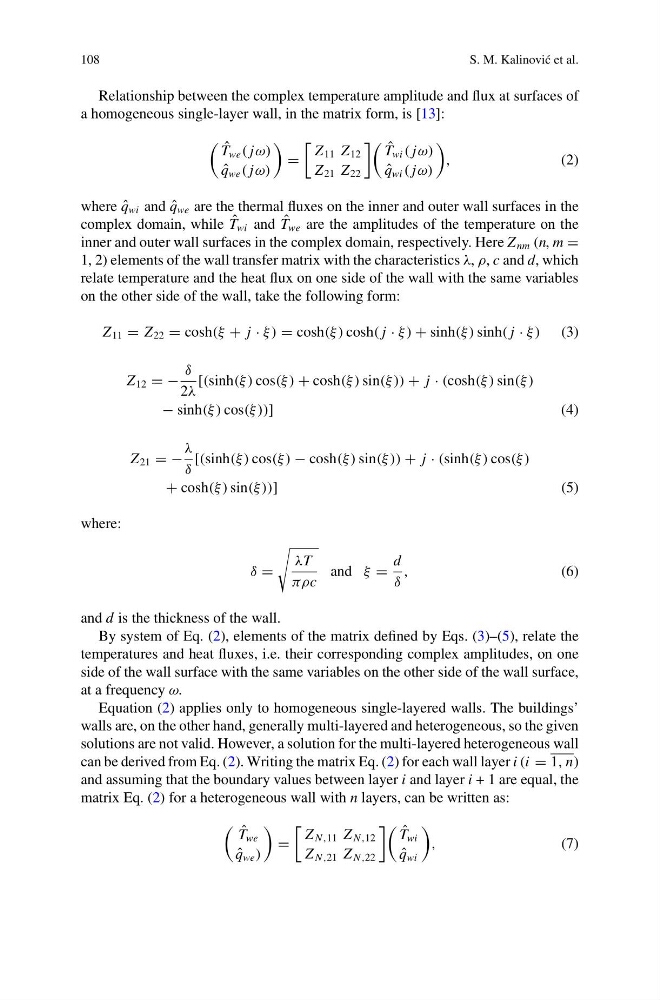
a homogeneous single-layer wall, in the matrix form, is [13]:
ˆ
T we ( jω)
ˆ
q we ( jω)
=
Z 11 Z 12
Z 21 Z 22
ˆ
T wi ( jω)
ˆ
q wi ( jω)
,
(2)
where ˆ
q wi and ˆ
q we are the thermal fluxes on the inner and outer wall surfaces in the
complex domain, while ˆ
T wi and ˆ
T we are the amplitudes of the temperature on the
inner and outer wall surfaces in the complex domain, respectively. Here Z nm (n, m =
1, 2) elements of the wall transfer matrix with the characteristics λ, ρ, c and d, which
relate temperature and the heat flux on one side of the wall with the same variables
on the other side of the wall, take the following form:
Z 11 = Z 22 = cosh(ξ + j · ξ) = cosh(ξ ) cosh( j · ξ) + sinh(ξ ) sinh( j · ξ) (3)
Z 12 = −
δ
2λ
[(sinh(ξ ) cos(ξ ) + cosh(ξ ) sin(ξ )) + j · (cosh(ξ ) sin(ξ )
− sinh(ξ ) cos(ξ ))]
(4)
Z 21 = −
λ
δ
[(sinh(ξ ) cos(ξ ) − cosh(ξ ) sin(ξ )) + j · (sinh(ξ ) cos(ξ )
+ cosh(ξ ) sin(ξ ))]
(5)
where:
δ =
λT
πρc
and ξ =
d
δ
,
(6)
and d is the thickness of the wall.
By system of Eq. (2), elements of the matrix defined by Eqs. (3)–(5), relate the
temperatures and heat fluxes, i.e. their corresponding complex amplitudes, on one
side of the wall surface with the same variables on the other side of the wall surface,
at a frequency ω.
Equation (2) applies only to homogeneous single-layered walls. The buildings’
walls are, on the other hand, generally multi-layered and heterogeneous, so the given
solutions are not valid. However, a solution for the multi-layered heterogeneous wall
can be derived from Eq. (2). Writing the matrix Eq. (2) for each wall layer i (i = 1, n)
and assuming that the boundary values between layer i and layer i + 1 are equal, the
matrix Eq. (2) for a heterogeneous wall with n layers, can be written as:
ˆ
T we
ˆ
q we )
=
Z N ,11 Z N ,12
Z N ,21 Z N ,22
ˆ
T wi
ˆ
q wi
,
(7)
S. M. Kalinovi´ c et al.
Relationship between the complex temperature amplitude and flux at surfaces of
a homogeneous single-layer wall, in the matrix form, is [13]:
ˆ
T we ( jω)
ˆ
q we ( jω)
=
Z 11 Z 12
Z 21 Z 22
ˆ
T wi ( jω)
ˆ
q wi ( jω)
,
(2)
where ˆ
q wi and ˆ
q we are the thermal fluxes on the inner and outer wall surfaces in the
complex domain, while ˆ
T wi and ˆ
T we are the amplitudes of the temperature on the
inner and outer wall surfaces in the complex domain, respectively. Here Z nm (n, m =
1, 2) elements of the wall transfer matrix with the characteristics λ, ρ, c and d, which
relate temperature and the heat flux on one side of the wall with the same variables
on the other side of the wall, take the following form:
Z 11 = Z 22 = cosh(ξ + j · ξ) = cosh(ξ ) cosh( j · ξ) + sinh(ξ ) sinh( j · ξ) (3)
Z 12 = −
δ
2λ
[(sinh(ξ ) cos(ξ ) + cosh(ξ ) sin(ξ )) + j · (cosh(ξ ) sin(ξ )
− sinh(ξ ) cos(ξ ))]
(4)
Z 21 = −
λ
δ
[(sinh(ξ ) cos(ξ ) − cosh(ξ ) sin(ξ )) + j · (sinh(ξ ) cos(ξ )
+ cosh(ξ ) sin(ξ ))]
(5)
where:
δ =
λT
πρc
and ξ =
d
δ
,
(6)
and d is the thickness of the wall.
By system of Eq. (2), elements of the matrix defined by Eqs. (3)–(5), relate the
temperatures and heat fluxes, i.e. their corresponding complex amplitudes, on one
side of the wall surface with the same variables on the other side of the wall surface,
at a frequency ω.
Equation (2) applies only to homogeneous single-layered walls. The buildings’
walls are, on the other hand, generally multi-layered and heterogeneous, so the given
solutions are not valid. However, a solution for the multi-layered heterogeneous wall
can be derived from Eq. (2). Writing the matrix Eq. (2) for each wall layer i (i = 1, n)
and assuming that the boundary values between layer i and layer i + 1 are equal, the
matrix Eq. (2) for a heterogeneous wall with n layers, can be written as:
ˆ
T we
ˆ
q we )
=
Z N ,11 Z N ,12
Z N ,21 Z N ,22
ˆ
T wi
ˆ
q wi
,
(7)