

Calculation of Thermal Dynamic Characteristics …
107
0.7 °C across all the facades depending on orientation and time of day. The results
presented in that paper show that ivy walls can lead to low energy savings during
the summer sunshine conditions and achieve additional energy savings by reducing
the rate of air infiltration due to vegetation. Researchers in [8] studied the feasibility
of applying a dual-faceted green facade to residential buildings in Hong Kong in
order to reduce the cooling energy consumption during hot and humid summers.
They came to the conclusion that significant energy savings were possible. In the
work [9], the results of experimental studies, performed on a vertical green wall in a
continental Mediterranean climate, are presented. The effect of insulation thickness
on the energy performance of the green wall was analyzed using a new methodology
called the Green Facade Optimization (GFO). The results showed that a complex wall
structure acts as a passive cooling system when the facade is moderately insulated, up
to an insulation thickness of 9 cm, above which, more insulation becomes redundant
and inefficient. Authors of [10] have performed a two-year experiment at the University of Bari in Italy to determine whether evergreens were suitable for green facades
in the Mediterranean climate. The results presented in that paper make it possible
to fill the gap in the literature regarding the lack of data for all the seasons in order
to be able to see the complete picture of the thermal characteristics of buildings in
the Mediterranean climate region. In [11] different technical and economic aspects
of creepers on the façade, when climatic restraint differ, were considered through a
case study. In [12] authors have focused on influence of the leaf thickness on thermal
characteristics of green facades in hot and humid climates. The measurements were
made on the south-facing wall that was covered with green ivy facade systems in
Suzhou, China. Their results confirmed the importance of the leaf thickness for the
thermal characteristics of the green facade systems.
Considering the importance of green walls, in this paper are analyzed the thermal
dynamic characteristics of three different structures of walls, with and without the
plant cover, in order to find the best solutions for residential buildings in Serbia.
The analysis was limited to living wall analysis, while the green facades will be the
subject of further research.
2 Problem Formulation
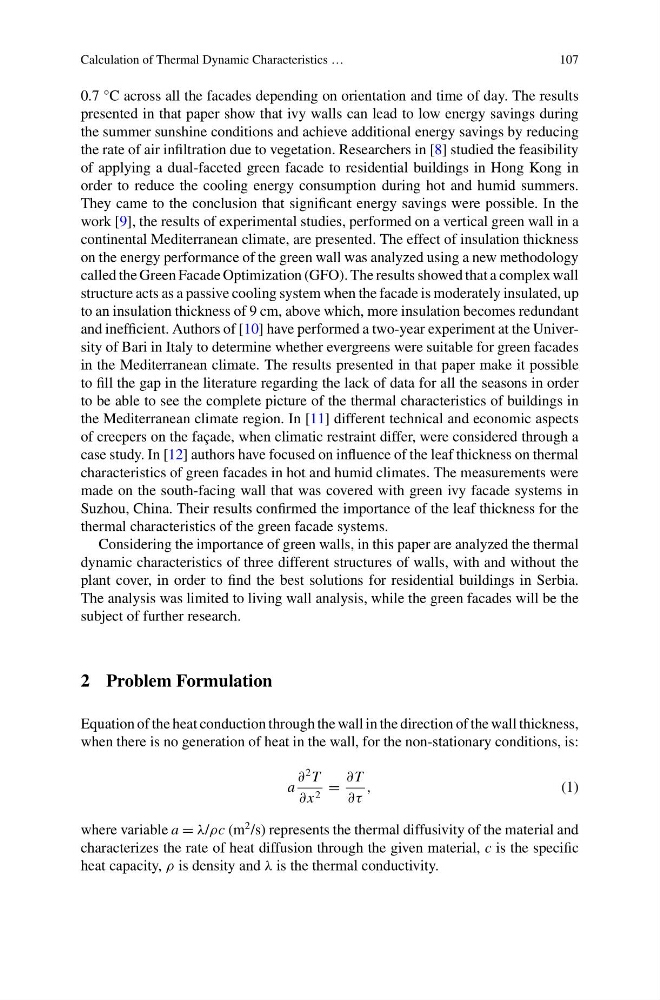
Equation of the heat conduction through the wall in the direction of the wall thickness,
when there is no generation of heat in the wall, for the non-stationary conditions, is:
a
∂
2 T
∂ x 2 =
∂ T
∂τ
,
(1)
where variable a = λ/ρc (m
2 /s) represents the thermal diffusivity of the material and
characterizes the rate of heat diffusion through the given material, c is the specific
heat capacity, ρ is density and λ is the thermal conductivity.
107
0.7 °C across all the facades depending on orientation and time of day. The results
presented in that paper show that ivy walls can lead to low energy savings during
the summer sunshine conditions and achieve additional energy savings by reducing
the rate of air infiltration due to vegetation. Researchers in [8] studied the feasibility
of applying a dual-faceted green facade to residential buildings in Hong Kong in
order to reduce the cooling energy consumption during hot and humid summers.
They came to the conclusion that significant energy savings were possible. In the
work [9], the results of experimental studies, performed on a vertical green wall in a
continental Mediterranean climate, are presented. The effect of insulation thickness
on the energy performance of the green wall was analyzed using a new methodology
called the Green Facade Optimization (GFO). The results showed that a complex wall
structure acts as a passive cooling system when the facade is moderately insulated, up
to an insulation thickness of 9 cm, above which, more insulation becomes redundant
and inefficient. Authors of [10] have performed a two-year experiment at the University of Bari in Italy to determine whether evergreens were suitable for green facades
in the Mediterranean climate. The results presented in that paper make it possible
to fill the gap in the literature regarding the lack of data for all the seasons in order
to be able to see the complete picture of the thermal characteristics of buildings in
the Mediterranean climate region. In [11] different technical and economic aspects
of creepers on the façade, when climatic restraint differ, were considered through a
case study. In [12] authors have focused on influence of the leaf thickness on thermal
characteristics of green facades in hot and humid climates. The measurements were
made on the south-facing wall that was covered with green ivy facade systems in
Suzhou, China. Their results confirmed the importance of the leaf thickness for the
thermal characteristics of the green facade systems.
Considering the importance of green walls, in this paper are analyzed the thermal
dynamic characteristics of three different structures of walls, with and without the
plant cover, in order to find the best solutions for residential buildings in Serbia.
The analysis was limited to living wall analysis, while the green facades will be the
subject of further research.
2 Problem Formulation
Equation of the heat conduction through the wall in the direction of the wall thickness,
when there is no generation of heat in the wall, for the non-stationary conditions, is:
a
∂
2 T
∂ x 2 =
∂ T
∂τ
,
(1)
where variable a = λ/ρc (m
2 /s) represents the thermal diffusivity of the material and
characterizes the rate of heat diffusion through the given material, c is the specific
heat capacity, ρ is density and λ is the thermal conductivity.