

Discovery of the Oldest Construction Phases of the Convent …
95
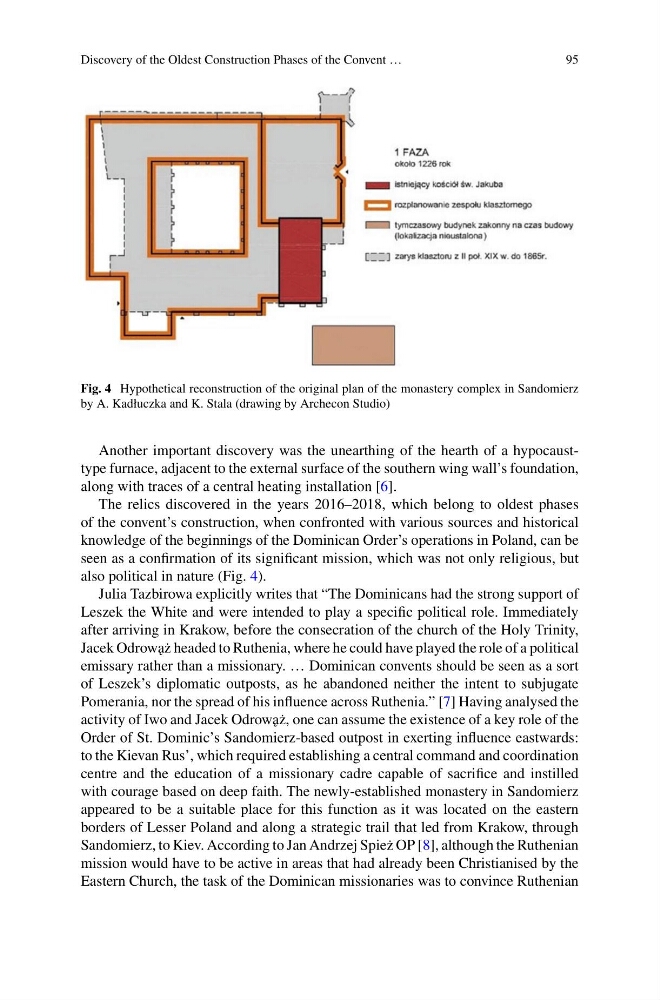
Fig. 4 Hypothetical reconstruction of the original plan of the monastery complex in Sandomierz
by A. Kadłuczka and K. Stala (drawing by Archecon Studio)
Another important discovery was the unearthing of the hearth of a hypocausttype furnace, adjacent to the external surface of the southern wing wall’s foundation,
along with traces of a central heating installation [6].
The relics discovered in the years 2016–2018, which belong to oldest phases
of the convent’s construction, when confronted with various sources and historical
knowledge of the beginnings of the Dominican Order’s operations in Poland, can be
seen as a confirmation of its significant mission, which was not only religious, but
also political in nature (Fig. 4).
Julia Tazbirowa explicitly writes that “The Dominicans had the strong support of
Leszek the White and were intended to play a specific political role. Immediately
after arriving in Krakow, before the consecration of the church of the Holy Trinity,
Jacek Odrow˛ a˙ z headed to Ruthenia, where he could have played the role of a political
emissary rather than a missionary. … Dominican convents should be seen as a sort
of Leszek’s diplomatic outposts, as he abandoned neither the intent to subjugate
Pomerania, nor the spread of his influence across Ruthenia.” [7] Having analysed the
activity of Iwo and Jacek Odrow˛ a˙ z, one can assume the existence of a key role of the
Order of St. Dominic’s Sandomierz-based outpost in exerting influence eastwards:
to the Kievan Rus’, which required establishing a central command and coordination
centre and the education of a missionary cadre capable of sacrifice and instilled
with courage based on deep faith. The newly-established monastery in Sandomierz
appeared to be a suitable place for this function as it was located on the eastern
borders of Lesser Poland and along a strategic trail that led from Krakow, through
Sandomierz, to Kiev. According to Jan Andrzej Spie˙ z OP [8], although the Ruthenian
mission would have to be active in areas that had already been Christianised by the
Eastern Church, the task of the Dominican missionaries was to convince Ruthenian
95
Fig. 4 Hypothetical reconstruction of the original plan of the monastery complex in Sandomierz
by A. Kadłuczka and K. Stala (drawing by Archecon Studio)
Another important discovery was the unearthing of the hearth of a hypocausttype furnace, adjacent to the external surface of the southern wing wall’s foundation,
along with traces of a central heating installation [6].
The relics discovered in the years 2016–2018, which belong to oldest phases
of the convent’s construction, when confronted with various sources and historical
knowledge of the beginnings of the Dominican Order’s operations in Poland, can be
seen as a confirmation of its significant mission, which was not only religious, but
also political in nature (Fig. 4).
Julia Tazbirowa explicitly writes that “The Dominicans had the strong support of
Leszek the White and were intended to play a specific political role. Immediately
after arriving in Krakow, before the consecration of the church of the Holy Trinity,
Jacek Odrow˛ a˙ z headed to Ruthenia, where he could have played the role of a political
emissary rather than a missionary. … Dominican convents should be seen as a sort
of Leszek’s diplomatic outposts, as he abandoned neither the intent to subjugate
Pomerania, nor the spread of his influence across Ruthenia.” [7] Having analysed the
activity of Iwo and Jacek Odrow˛ a˙ z, one can assume the existence of a key role of the
Order of St. Dominic’s Sandomierz-based outpost in exerting influence eastwards:
to the Kievan Rus’, which required establishing a central command and coordination
centre and the education of a missionary cadre capable of sacrifice and instilled
with courage based on deep faith. The newly-established monastery in Sandomierz
appeared to be a suitable place for this function as it was located on the eastern
borders of Lesser Poland and along a strategic trail that led from Krakow, through
Sandomierz, to Kiev. According to Jan Andrzej Spie˙ z OP [8], although the Ruthenian
mission would have to be active in areas that had already been Christianised by the
Eastern Church, the task of the Dominican missionaries was to convince Ruthenian