

94
A. Kadłuczka and K. Stala
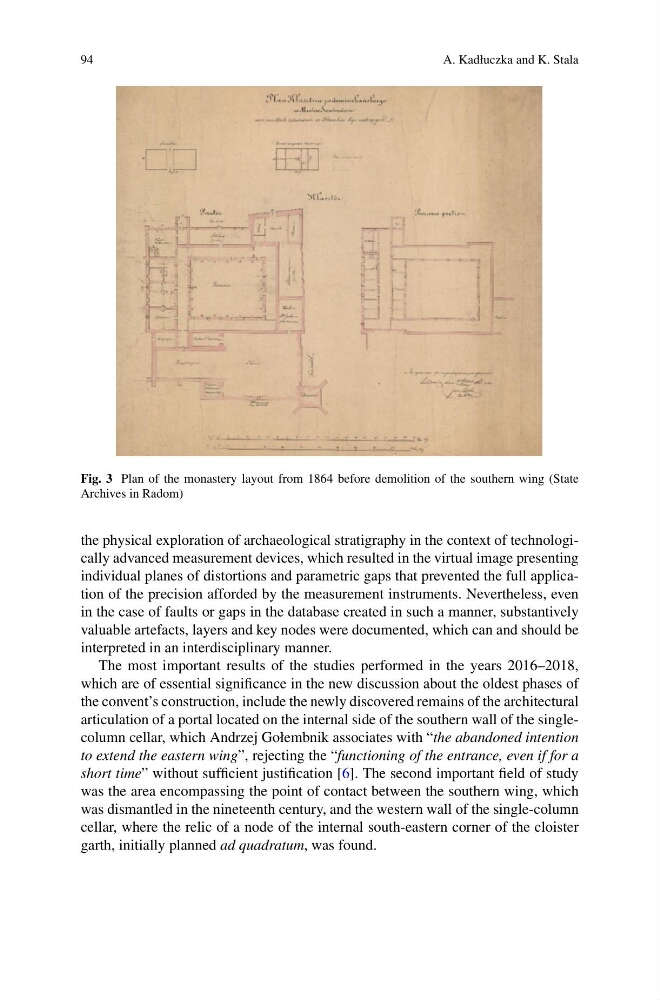
Fig. 3 Plan of the monastery layout from 1864 before demolition of the southern wing (State
Archives in Radom)
the physical exploration of archaeological stratigraphy in the context of technologically advanced measurement devices, which resulted in the virtual image presenting
individual planes of distortions and parametric gaps that prevented the full application of the precision afforded by the measurement instruments. Nevertheless, even
in the case of faults or gaps in the database created in such a manner, substantively
valuable artefacts, layers and key nodes were documented, which can and should be
interpreted in an interdisciplinary manner.
The most important results of the studies performed in the years 2016–2018,
which are of essential significance in the new discussion about the oldest phases of
the convent’s construction, include the newly discovered remains of the architectural
articulation of a portal located on the internal side of the southern wall of the singlecolumn cellar, which Andrzej Gołembnik associates with “the abandoned intention
to extend the eastern wing”, rejecting the “functioning of the entrance, even if for a
short time” without sufficient justification [6]. The second important field of study
was the area encompassing the point of contact between the southern wing, which
was dismantled in the nineteenth century, and the western wall of the single-column
cellar, where the relic of a node of the internal south-eastern corner of the cloister
garth, initially planned ad quadratum, was found.
A. Kadłuczka and K. Stala
Fig. 3 Plan of the monastery layout from 1864 before demolition of the southern wing (State
Archives in Radom)
the physical exploration of archaeological stratigraphy in the context of technologically advanced measurement devices, which resulted in the virtual image presenting
individual planes of distortions and parametric gaps that prevented the full application of the precision afforded by the measurement instruments. Nevertheless, even
in the case of faults or gaps in the database created in such a manner, substantively
valuable artefacts, layers and key nodes were documented, which can and should be
interpreted in an interdisciplinary manner.
The most important results of the studies performed in the years 2016–2018,
which are of essential significance in the new discussion about the oldest phases of
the convent’s construction, include the newly discovered remains of the architectural
articulation of a portal located on the internal side of the southern wall of the singlecolumn cellar, which Andrzej Gołembnik associates with “the abandoned intention
to extend the eastern wing”, rejecting the “functioning of the entrance, even if for a
short time” without sufficient justification [6]. The second important field of study
was the area encompassing the point of contact between the southern wing, which
was dismantled in the nineteenth century, and the western wall of the single-column
cellar, where the relic of a node of the internal south-eastern corner of the cloister
garth, initially planned ad quadratum, was found.