

476
Practical MATLAB
® Applications for Engineers
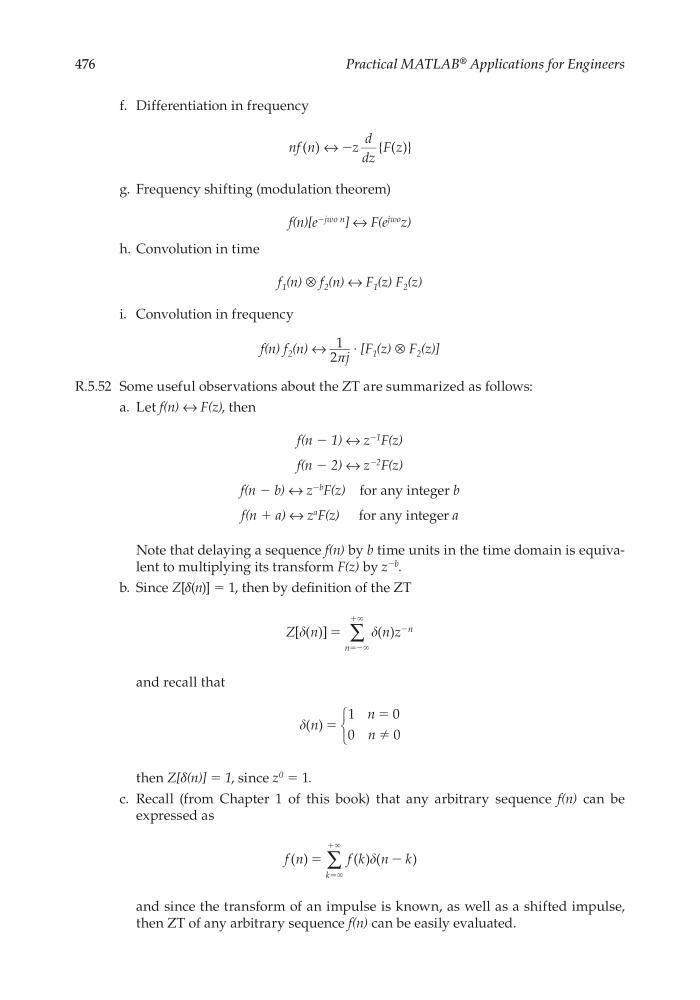
f. Differentiation in frequency
nf n
z
d
dz
F z
( )
{ ( )}
↔ Ϫ
g. Frequency shifting (modulation theorem)
f(n)[e
−jwo n
] ↔ F(e
jwo z)
h. Convolution in time
f 1 (n) ⊗ f 2 (n) ↔ F 1 (z) F 2 (z)
i. Convolution in frequency
f(n) f 2 (n) ↔ 1
___
2πj
. [F 1 (z) ⊗ F 2 (z)]
R.5.52 Some useful observations about the ZT are summarized as follows:
a. Let f(n) ↔ F(z), then
f(n − 1) ↔ z
−1 F(z)
f(n − 2) ↔ z
−2 F(z)
f(n − b) ↔ z
−b F(z) for any integer b
f(n + a) ↔ z
a F(z) for any integer a
Note that delaying a sequence f(n) by b time units in the time domain is equivalent to multiplying its transform F(z) by z
−b
.
b. Since Z[δ(n)] = 1, then by defi nition of the ZT
Z n
n z
n
n
[ ( )]
( )
ϭ
Ϫ
ϭϪϱ
ϩϱ
∑
and recall that
( )
n
n
n
ϭ
ϭ
1
0
0
0
then Z[δ(n)] = 1, since z
0
= 1.
c. Recall (from Chapter 1 of this book) that any arbitrary sequence f(n) can be
expressed as
f n
f k n k
k
( )
( ) (
)
ϭ
Ϫ
ϭϱ
ϩϱ
∑
and since the transform of an impulse is known, as well as a shifted impulse,
then ZT of any arbitrary sequence f(n) can be easily evaluated.
CRC_47760_CH005.indd 476
CRC_47760_CH005.indd 476
7/23/2008 1:47:21 PM
7/23/2008 1:47:21 PM
Practical MATLAB
® Applications for Engineers
f. Differentiation in frequency
nf n
z
d
dz
F z
( )
{ ( )}
↔ Ϫ
g. Frequency shifting (modulation theorem)
f(n)[e
−jwo n
] ↔ F(e
jwo z)
h. Convolution in time
f 1 (n) ⊗ f 2 (n) ↔ F 1 (z) F 2 (z)
i. Convolution in frequency
f(n) f 2 (n) ↔ 1
___
2πj
. [F 1 (z) ⊗ F 2 (z)]
R.5.52 Some useful observations about the ZT are summarized as follows:
a. Let f(n) ↔ F(z), then
f(n − 1) ↔ z
−1 F(z)
f(n − 2) ↔ z
−2 F(z)
f(n − b) ↔ z
−b F(z) for any integer b
f(n + a) ↔ z
a F(z) for any integer a
Note that delaying a sequence f(n) by b time units in the time domain is equivalent to multiplying its transform F(z) by z
−b
.
b. Since Z[δ(n)] = 1, then by defi nition of the ZT
Z n
n z
n
n
[ ( )]
( )
ϭ
Ϫ
ϭϪϱ
ϩϱ
∑
and recall that
( )
n
n
n
ϭ
ϭ
1
0
0
0
then Z[δ(n)] = 1, since z
0
= 1.
c. Recall (from Chapter 1 of this book) that any arbitrary sequence f(n) can be
expressed as
f n
f k n k
k
( )
( ) (
)
ϭ
Ϫ
ϭϱ
ϩϱ
∑
and since the transform of an impulse is known, as well as a shifted impulse,
then ZT of any arbitrary sequence f(n) can be easily evaluated.
CRC_47760_CH005.indd 476
CRC_47760_CH005.indd 476
7/23/2008 1:47:21 PM
7/23/2008 1:47:21 PM