

DTFT, DFT, ZT, and FFT
477
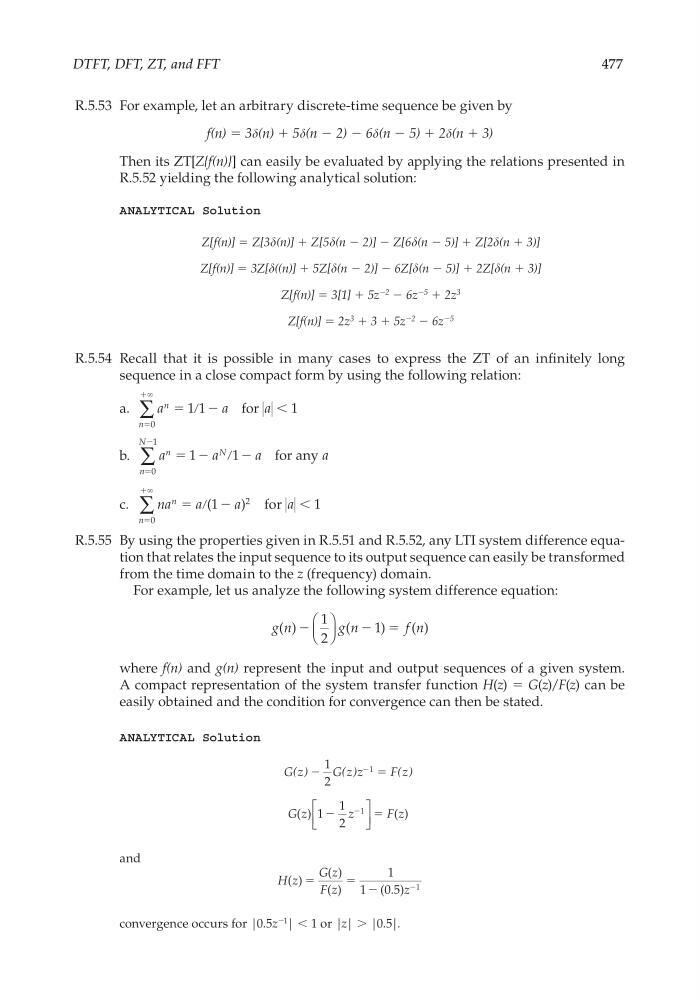
R.5.53 For example, let an arbitrary discrete-time sequence be given by
f(n) = 3(n) + 5(n − 2) − 6(n − 5) + 2(n + 3)
Then its ZT[Z{f(n)}] can easily be evaluated by applying the relations presented in
R.5.52 yielding the following analytical solution:
ANALYTICAL Solution
Z[f(n)] = Z[3(n)] + Z[5(n − 2)] − Z[6(n − 5)] + Z[2(n + 3)]
Z[f(n)] = 3Z[((n)] + 5Z[(n − 2)] − 6Z[(n − 5)] + 2Z[(n + 3)]
Z[f(n)] = 3[1] + 5z
−2
− 6z
−5
+ 2z
3
Z[f(n)] = 2z
3
+ 3 + 5z
−2
− 6z
−5
R.5.54 Recall that it is possible in many cases to express the ZT of an infi nitely long
sequence in a close compact form by using the following relation:
a.
a
a
a
n
nϭ
ϩϱ
ϭ ր Ϫ
0
1 1
1
∑
for Ͻ
b.
a
a
a
a
n
n
N
N
ϭ
Ϫ
ϭ Ϫ ր Ϫ
0
1
1
1
∑
for any
c.
na
a
a
a
n
nϭ
ϩϱ
ϭ ր Ϫ
0
2
1
1
∑
(
) for Ͻ
R.5.55 By using the properties given in R.5.51 and R.5.52, any LTI system difference equation that relates the input sequence to its output sequence can easily be transformed
from the time domain to the z (frequency) domain.
For example, let us analyze the following system difference equation:
g n
g n
f n
( )
(
)
( )
Ϫ
Ϫ ϭ
1
2
1
where f(n) and g(n) represent the input and output sequences of a given system.
A compact representation of the system transfer function H(z) = G(z)/F(z) can be
easily obtained and the condition for convergence can then be stated.
ANALYTICAL Solution
G z
G z z
F z
( )
( )
( )
Ϫ
ϭ
Ϫ
1
2
1
G z
z
F z
( )
( )
1
1
2
1
Ϫ
ϭ
Ϫ
and
H z
G z
F z
z
( )
( )
( )
( . )
ϭ
ϭ Ϫ
Ϫ
1
1 05
1
convergence occurs for |0.5z
−1
| < 1 or |z| > |0.5|.
CRC_47760_CH005.indd 477
CRC_47760_CH005.indd 477
7/23/2008 1:47:21 PM
7/23/2008 1:47:21 PM
477
R.5.53 For example, let an arbitrary discrete-time sequence be given by
f(n) = 3(n) + 5(n − 2) − 6(n − 5) + 2(n + 3)
Then its ZT[Z{f(n)}] can easily be evaluated by applying the relations presented in
R.5.52 yielding the following analytical solution:
ANALYTICAL Solution
Z[f(n)] = Z[3(n)] + Z[5(n − 2)] − Z[6(n − 5)] + Z[2(n + 3)]
Z[f(n)] = 3Z[((n)] + 5Z[(n − 2)] − 6Z[(n − 5)] + 2Z[(n + 3)]
Z[f(n)] = 3[1] + 5z
−2
− 6z
−5
+ 2z
3
Z[f(n)] = 2z
3
+ 3 + 5z
−2
− 6z
−5
R.5.54 Recall that it is possible in many cases to express the ZT of an infi nitely long
sequence in a close compact form by using the following relation:
a.
a
a
a
n
nϭ
ϩϱ
ϭ ր Ϫ
0
1 1
1
∑
for Ͻ
b.
a
a
a
a
n
n
N
N
ϭ
Ϫ
ϭ Ϫ ր Ϫ
0
1
1
1
∑
for any
c.
na
a
a
a
n
nϭ
ϩϱ
ϭ ր Ϫ
0
2
1
1
∑
(
) for Ͻ
R.5.55 By using the properties given in R.5.51 and R.5.52, any LTI system difference equation that relates the input sequence to its output sequence can easily be transformed
from the time domain to the z (frequency) domain.
For example, let us analyze the following system difference equation:
g n
g n
f n
( )
(
)
( )
Ϫ
Ϫ ϭ
1
2
1
where f(n) and g(n) represent the input and output sequences of a given system.
A compact representation of the system transfer function H(z) = G(z)/F(z) can be
easily obtained and the condition for convergence can then be stated.
ANALYTICAL Solution
G z
G z z
F z
( )
( )
( )
Ϫ
ϭ
Ϫ
1
2
1
G z
z
F z
( )
( )
1
1
2
1
Ϫ
ϭ
Ϫ
and
H z
G z
F z
z
( )
( )
( )
( . )
ϭ
ϭ Ϫ
Ϫ
1
1 05
1
convergence occurs for |0.5z
−1
| < 1 or |z| > |0.5|.
CRC_47760_CH005.indd 477
CRC_47760_CH005.indd 477
7/23/2008 1:47:21 PM
7/23/2008 1:47:21 PM