

DTFT, DFT, ZT, and FFT
475
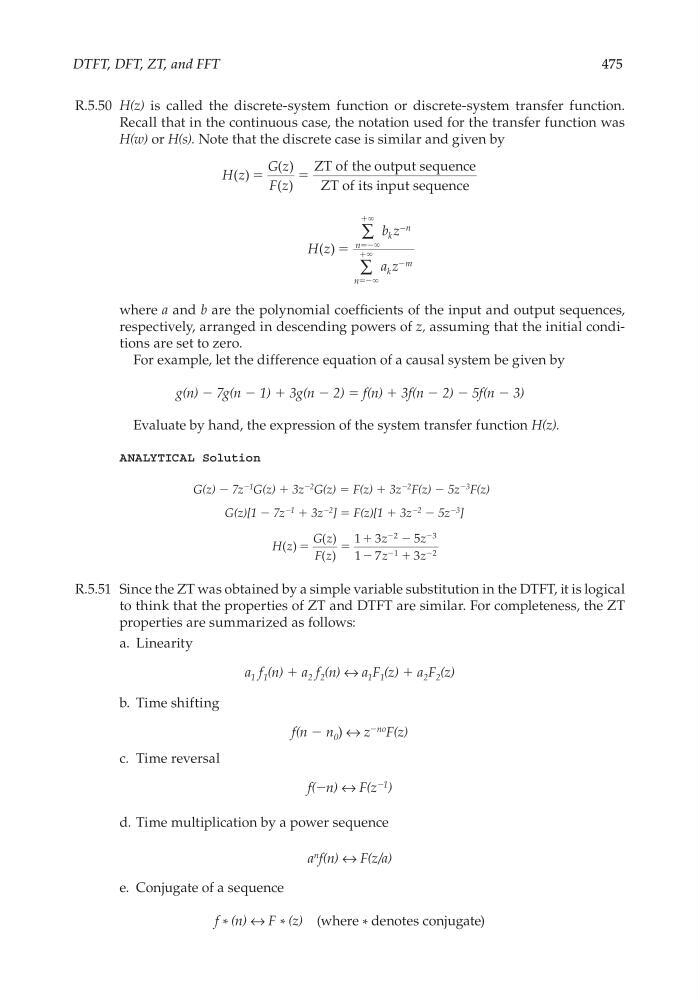
R.5.50 H(z) is called the discrete-system function or discrete-system transfer function.
Recall that in the continuous case, the notation used for the transfer function was
H(w) or H(s). Note that the discrete case is similar and given by
H z
G z
F z
( )
( )
( )
ϭ
ϭ
ZT of the output sequence
ZT of its input sequence
H z
b z
a z
k
n
n
k
m
n
( ) ϭ
ϭϪϱ
ϩϱ
Ϫ
ϭϪϱ
ϩϱ
−
∑
∑
where a and b are the polynomial coeffi cients of the input and output sequences,
respectively, arranged in descending powers of z, assuming that the initial conditions are set to zero.
For example, let the difference equation of a causal system be given by
g(n) − 7g(n − 1) + 3g(n − 2) = f(n) + 3f(n − 2) − 5f(n − 3)
Evaluate by hand, the expression of the system transfer function H(z).
ANALYTICAL Solution
G(z) − 7z
−1
G(z) + 3z
−2
G(z) = F(z) + 3z
−2 F(z) − 5z
−3 F(z)
G(z)[1 − 7z
−1
+ 3z
−2
] = F(z)[1 + 3z
−2
− 5z
−3
]
H z
G z
F z
z
z
z
z
( )
( )
( )
ϭ
ϭ
ϩ
Ϫ
Ϫ
ϩ
Ϫ
Ϫ
Ϫ
Ϫ
1 3
5
1 7
3
2
3
1
2
R.5.51 Since the ZT was obtained by a simple variable substitution in the DTFT, it is logical
to think that the properties of ZT and DTFT are similar. For completeness, the ZT
properties are summarized as follows:
a. Linearity
a 1 f 1 (n) + a 2 f 2 (n) ↔ a 1 F 1 (z) + a 2 F 2 (z)
b. Time shifting
f(n − n 0 ) ↔ z
−no F(z)
c. Time reversal
f(−n) ↔ F(z
−1
)
d. Time multiplication by a power sequence
a
n f(n) ↔ F(z/a)
e. Conjugate of a sequence
f * (n) ↔ F * (z) (where * denotes conjugate)
CRC_47760_CH005.indd 475
CRC_47760_CH005.indd 475
7/23/2008 1:47:20 PM
7/23/2008 1:47:20 PM
475
R.5.50 H(z) is called the discrete-system function or discrete-system transfer function.
Recall that in the continuous case, the notation used for the transfer function was
H(w) or H(s). Note that the discrete case is similar and given by
H z
G z
F z
( )
( )
( )
ϭ
ϭ
ZT of the output sequence
ZT of its input sequence
H z
b z
a z
k
n
n
k
m
n
( ) ϭ
ϭϪϱ
ϩϱ
Ϫ
ϭϪϱ
ϩϱ
−
∑
∑
where a and b are the polynomial coeffi cients of the input and output sequences,
respectively, arranged in descending powers of z, assuming that the initial conditions are set to zero.
For example, let the difference equation of a causal system be given by
g(n) − 7g(n − 1) + 3g(n − 2) = f(n) + 3f(n − 2) − 5f(n − 3)
Evaluate by hand, the expression of the system transfer function H(z).
ANALYTICAL Solution
G(z) − 7z
−1
G(z) + 3z
−2
G(z) = F(z) + 3z
−2 F(z) − 5z
−3 F(z)
G(z)[1 − 7z
−1
+ 3z
−2
] = F(z)[1 + 3z
−2
− 5z
−3
]
H z
G z
F z
z
z
z
z
( )
( )
( )
ϭ
ϭ
ϩ
Ϫ
Ϫ
ϩ
Ϫ
Ϫ
Ϫ
Ϫ
1 3
5
1 7
3
2
3
1
2
R.5.51 Since the ZT was obtained by a simple variable substitution in the DTFT, it is logical
to think that the properties of ZT and DTFT are similar. For completeness, the ZT
properties are summarized as follows:
a. Linearity
a 1 f 1 (n) + a 2 f 2 (n) ↔ a 1 F 1 (z) + a 2 F 2 (z)
b. Time shifting
f(n − n 0 ) ↔ z
−no F(z)
c. Time reversal
f(−n) ↔ F(z
−1
)
d. Time multiplication by a power sequence
a
n f(n) ↔ F(z/a)
e. Conjugate of a sequence
f * (n) ↔ F * (z) (where * denotes conjugate)
CRC_47760_CH005.indd 475
CRC_47760_CH005.indd 475
7/23/2008 1:47:20 PM
7/23/2008 1:47:20 PM