

232
Practical MATLAB
® Applications for Engineers
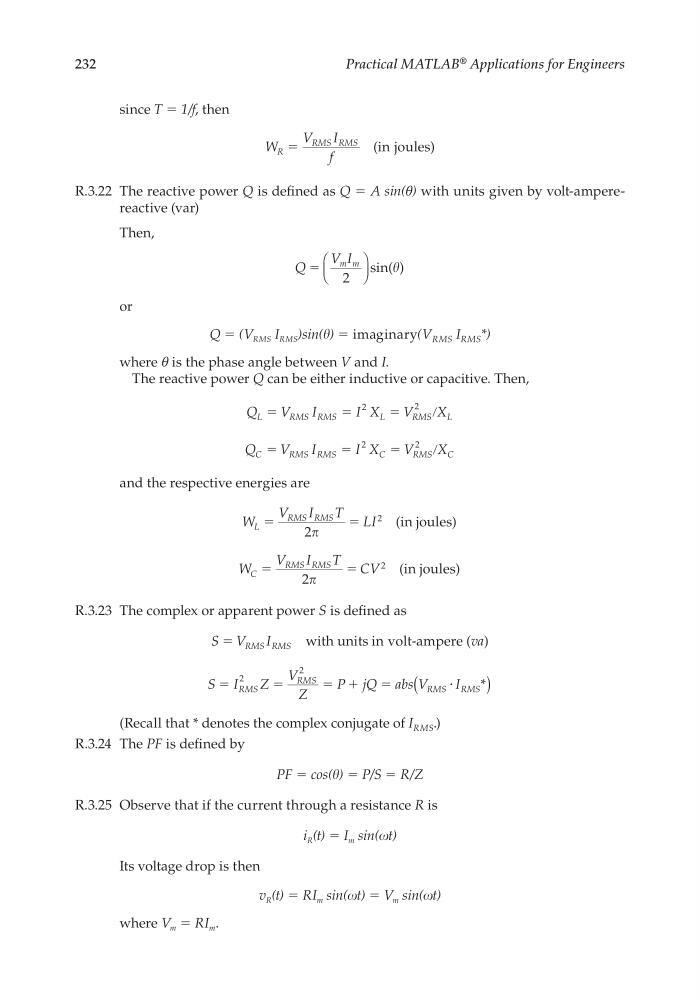
since T = 1/f, then
W
V I
f
R
RMS RMS
ϭ
(in joules)
R.3.22 The reactive power Q is defi ned as Q = A sin(θ) with units given by volt-amperereactive (var)
Then,
Q
V I
m m
ϭ
2
sin( )
or
Q = (V RMS I RMS )sin() = imaginary(V RMS I RMS *)
where θ is the phase angle between V and I.
The reactive power Q can be either inductive or capacitive. Then,
Q
V
I
I X
V
X
L
RMS RMS
L
RMS
L
ϭ
ϭ
ϭ
ր
2
2
Q
V
I
I X
V
X
C
RMS RMS
C
RMS
C
ϭ
ϭ
ϭ
ր
2
2
and the respective energies are
W
V I
T LI
L
RMS RMS
ϭ
ϭ
2
2
(in joules)
W
V I
T CV
C
RMS RMS
ϭ
ϭ
2
2
(in joules)
R.3.23 The complex or apparent power S is defi ned as
S V I
RMS RMS
ϭ
with units in volt-ampere ( )
va
S I
Z
V
Z
P jQ abs V
I
RMS
RMS
RMS
RMS
ϭ
ϭ
ϭ ϩ
ϭ
и
2
2
*
(
)
(Recall that * denotes the complex conjugate of I RMS .)
R.3.24 The PF is defi ned by
PF = cos() = P/S = R/Z
R.3.25 Observe that if the current through a resistance R is
i R (t) = I m sin(t)
Its voltage drop is then
v R (t) = RI m sin(t) = V m sin(t)
where V m = RI m .
CRC_47760_CH003.indd 232
CRC_47760_CH003.indd 232
7/23/2008 1:27:31 PM
7/23/2008 1:27:31 PM
Practical MATLAB
® Applications for Engineers
since T = 1/f, then
W
V I
f
R
RMS RMS
ϭ
(in joules)
R.3.22 The reactive power Q is defi ned as Q = A sin(θ) with units given by volt-amperereactive (var)
Then,
Q
V I
m m
ϭ
2
sin( )
or
Q = (V RMS I RMS )sin() = imaginary(V RMS I RMS *)
where θ is the phase angle between V and I.
The reactive power Q can be either inductive or capacitive. Then,
Q
V
I
I X
V
X
L
RMS RMS
L
RMS
L
ϭ
ϭ
ϭ
ր
2
2
Q
V
I
I X
V
X
C
RMS RMS
C
RMS
C
ϭ
ϭ
ϭ
ր
2
2
and the respective energies are
W
V I
T LI
L
RMS RMS
ϭ
ϭ
2
2
(in joules)
W
V I
T CV
C
RMS RMS
ϭ
ϭ
2
2
(in joules)
R.3.23 The complex or apparent power S is defi ned as
S V I
RMS RMS
ϭ
with units in volt-ampere ( )
va
S I
Z
V
Z
P jQ abs V
I
RMS
RMS
RMS
RMS
ϭ
ϭ
ϭ ϩ
ϭ
и
2
2
*
(
)
(Recall that * denotes the complex conjugate of I RMS .)
R.3.24 The PF is defi ned by
PF = cos() = P/S = R/Z
R.3.25 Observe that if the current through a resistance R is
i R (t) = I m sin(t)
Its voltage drop is then
v R (t) = RI m sin(t) = V m sin(t)
where V m = RI m .
CRC_47760_CH003.indd 232
CRC_47760_CH003.indd 232
7/23/2008 1:27:31 PM
7/23/2008 1:27:31 PM