

Alternating Current Analysis
231
where
V
T
v t dt
RMS
T
ϭ
1
2
0
( )
∫
and
I
T
i t dt
T
p t dt
MS
T
T
R
AVG
P
ϭ
ϭ
1 2
0
0
( )
(
∫
∫
and
1
)
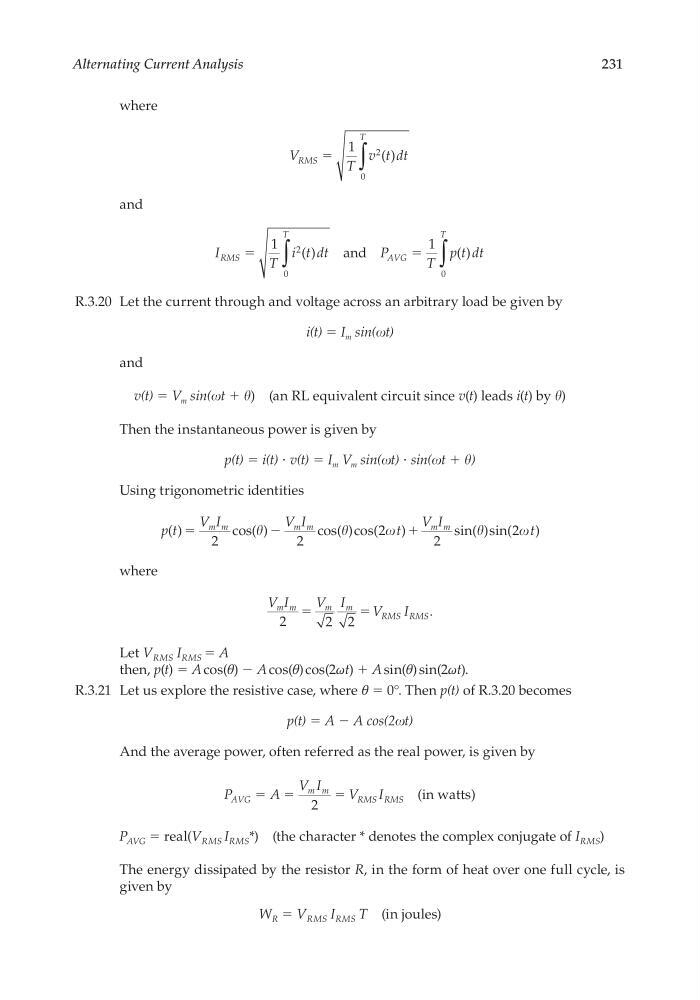
R.3.20 Let the current through and voltage across an arbitrary load be given by
i(t) = I m sin(t)
and
v(t) = V m sin(t + ) (an RL equivalent circuit since v(t) leads i(t) by )
Then the instantaneous power is given by
p(t) = i(t) ⋅ v(t) = I m V m sin(t) ⋅ sin(t + )
Using trigonometric identities
p t
V I
V I
t
V I
t
m m
m m
m m
( )
cos( )
cos( )cos(
)
sin( )sin(
)
ϭ
Ϫ
ϩ
2
2
2
2
2
where
V I
V I
V
I
m m
m
m
RMS RMS
2
2
ϭ
ϭ
2
.
Let V RMS I RMS = A
then, p(t) = A cos(θ) − A cos(θ) cos(2ωt) + A sin(θ) sin(2ωt).
R.3.21 Let us explore the resistive case, where θ = 0°. Then p(t) of R.3.20 becomes
p(t) = A − A cos(2t)
And the average power, often referred as the real power, is given by
P
A
V I
V I
AVG
m m
RMS RMS
ϭ ϭ
ϭ
2
(in watts)
P AVG = real(V RMS I RMS *) (the character * denotes the complex conjugate of I RMS )
The energy dissipated by the resistor R, in the form of heat over one full cycle, is
given by
W R = V RMS I RMS T (in joules)
CRC_47760_CH003.indd 231
CRC_47760_CH003.indd 231
7/23/2008 1:27:30 PM
7/23/2008 1:27:30 PM
231
where
V
T
v t dt
RMS
T
ϭ
1
2
0
( )
∫
and
I
T
i t dt
T
p t dt
MS
T
T
R
AVG
P
ϭ
ϭ
1 2
0
0
( )
(
∫
∫
and
1
)
R.3.20 Let the current through and voltage across an arbitrary load be given by
i(t) = I m sin(t)
and
v(t) = V m sin(t + ) (an RL equivalent circuit since v(t) leads i(t) by )
Then the instantaneous power is given by
p(t) = i(t) ⋅ v(t) = I m V m sin(t) ⋅ sin(t + )
Using trigonometric identities
p t
V I
V I
t
V I
t
m m
m m
m m
( )
cos( )
cos( )cos(
)
sin( )sin(
)
ϭ
Ϫ
ϩ
2
2
2
2
2
where
V I
V I
V
I
m m
m
m
RMS RMS
2
2
ϭ
ϭ
2
.
Let V RMS I RMS = A
then, p(t) = A cos(θ) − A cos(θ) cos(2ωt) + A sin(θ) sin(2ωt).
R.3.21 Let us explore the resistive case, where θ = 0°. Then p(t) of R.3.20 becomes
p(t) = A − A cos(2t)
And the average power, often referred as the real power, is given by
P
A
V I
V I
AVG
m m
RMS RMS
ϭ ϭ
ϭ
2
(in watts)
P AVG = real(V RMS I RMS *) (the character * denotes the complex conjugate of I RMS )
The energy dissipated by the resistor R, in the form of heat over one full cycle, is
given by
W R = V RMS I RMS T (in joules)
CRC_47760_CH003.indd 231
CRC_47760_CH003.indd 231
7/23/2008 1:27:30 PM
7/23/2008 1:27:30 PM