

230
Practical MATLAB
® Applications for Engineers
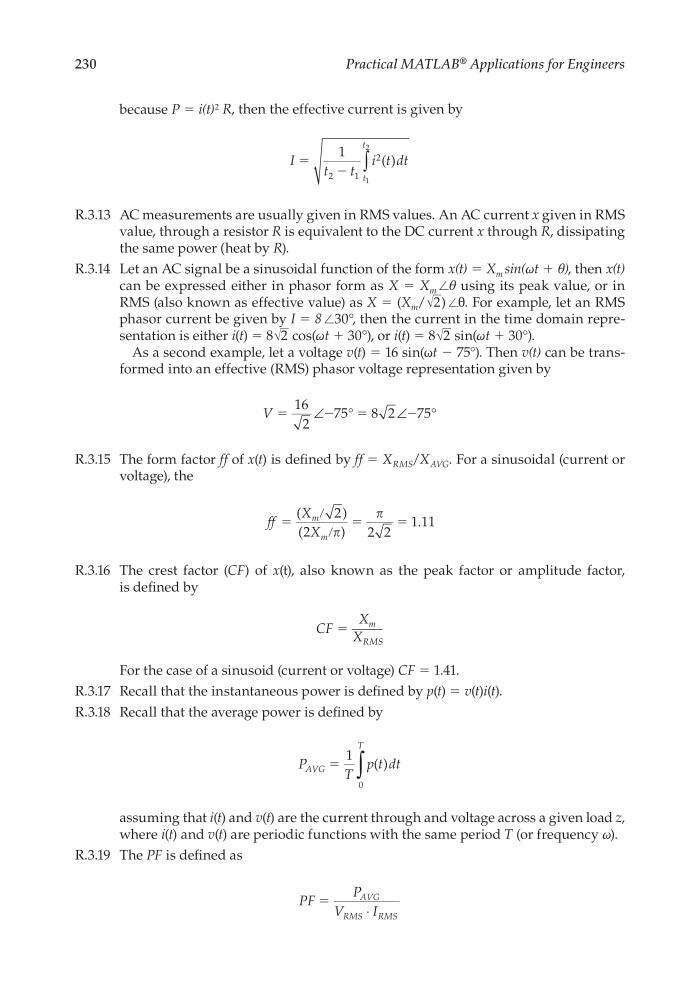
because P = i(t)
2 R, then the effective current is given by
I
t
t
i t dt
t
t
ϭ
Ϫ
1
2
1
2
1
2
( )
∫
R.3.13 AC measurements are usually given in RMS values. An AC current x given in RMS
value, through a resistor R is equivalent to the DC current x through R, dissipating
the same power (heat by R).
R.3.14 Let an AC signal be a sinusoidal function of the form x(t) = X m sin(ωt + θ), then x(t)
can be expressed either in phasor form as X = X m ∠θ using its peak value, or in
RMS (also known as effective value) as X = (X m / √
__
2 ) ∠θ. For example, let an RMS
phasor current be given by I = 8 ∠30°, then the current in the time domain representation is either i(t) = 8 √
__
2 cos(ωt + 30°), or i(t) = 8 √
__
2 sin(ωt + 30°).
As a second example, let a voltage v(t) = 16 sin(ωt − 75°). Then v(t) can be transformed into an effective (RMS) phasor voltage representation given by
V ϭ
Ϫ
ϭ
Ϫ
16
2
75
8 2
75
∠
°
∠
°
R.3.15 The form factor ff of x(t) is defi ned by ff = X RMS /X AVG . For a sinusoidal (current or
voltage), the
ff
X
X
m
m
ϭ
ր
ր
ϭ
ϭ
(
)
(
)
.
2
2
2 2
1 11
R.3.16 The crest factor (CF) of x(t), also known as the peak factor or amplitude factor,
is defi ned by
CF =
X m
_____
X RMS
For the case of a sinusoid (current or voltage) CF = 1.41.
R.3.17 Recall that the instantaneous power is defi ned by p(t) = v(t)i(t).
R.3.18 Recall that the average power is defi ned by
P
T
p t dt
AVG
T
ϭ
1
0
( )
∫
assuming that i(t) and v(t) are the current through and voltage across a given load z,
where i(t) and v(t) are periodic functions with the same period T (or frequency ω).
R.3.19 The PF is defi ned as
PF
P
V
I
AVG
RMS
RMS
ϭ
⋅
CRC_47760_CH003.indd 230
CRC_47760_CH003.indd 230
7/23/2008 1:27:30 PM
7/23/2008 1:27:30 PM
Practical MATLAB
® Applications for Engineers
because P = i(t)
2 R, then the effective current is given by
I
t
t
i t dt
t
t
ϭ
Ϫ
1
2
1
2
1
2
( )
∫
R.3.13 AC measurements are usually given in RMS values. An AC current x given in RMS
value, through a resistor R is equivalent to the DC current x through R, dissipating
the same power (heat by R).
R.3.14 Let an AC signal be a sinusoidal function of the form x(t) = X m sin(ωt + θ), then x(t)
can be expressed either in phasor form as X = X m ∠θ using its peak value, or in
RMS (also known as effective value) as X = (X m / √
__
2 ) ∠θ. For example, let an RMS
phasor current be given by I = 8 ∠30°, then the current in the time domain representation is either i(t) = 8 √
__
2 cos(ωt + 30°), or i(t) = 8 √
__
2 sin(ωt + 30°).
As a second example, let a voltage v(t) = 16 sin(ωt − 75°). Then v(t) can be transformed into an effective (RMS) phasor voltage representation given by
V ϭ
Ϫ
ϭ
Ϫ
16
2
75
8 2
75
∠
°
∠
°
R.3.15 The form factor ff of x(t) is defi ned by ff = X RMS /X AVG . For a sinusoidal (current or
voltage), the
ff
X
X
m
m
ϭ
ր
ր
ϭ
ϭ
(
)
(
)
.
2
2
2 2
1 11
R.3.16 The crest factor (CF) of x(t), also known as the peak factor or amplitude factor,
is defi ned by
CF =
X m
_____
X RMS
For the case of a sinusoid (current or voltage) CF = 1.41.
R.3.17 Recall that the instantaneous power is defi ned by p(t) = v(t)i(t).
R.3.18 Recall that the average power is defi ned by
P
T
p t dt
AVG
T
ϭ
1
0
( )
∫
assuming that i(t) and v(t) are the current through and voltage across a given load z,
where i(t) and v(t) are periodic functions with the same period T (or frequency ω).
R.3.19 The PF is defi ned as
PF
P
V
I
AVG
RMS
RMS
ϭ
⋅
CRC_47760_CH003.indd 230
CRC_47760_CH003.indd 230
7/23/2008 1:27:30 PM
7/23/2008 1:27:30 PM