

Direct Current and Transient Analysis
163
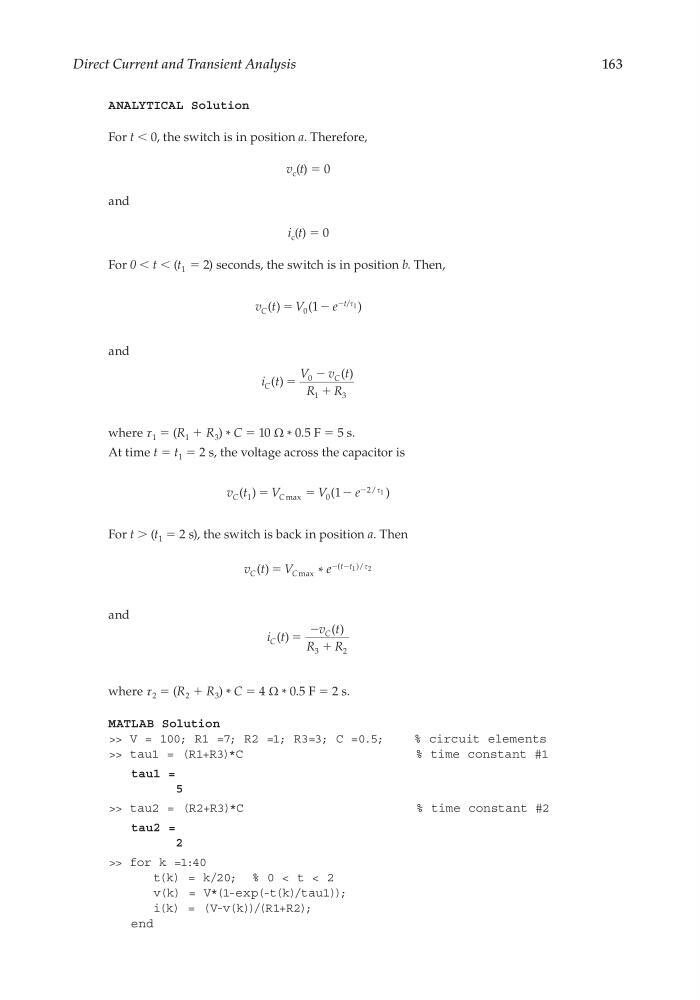
ANALYTICAL Solution
For t < 0, the switch is in position a. Therefore,
v c (t) = 0
and
i c (t) = 0
For 0 < t < (t 1 = 2) seconds, the switch is in position b. Then,
v t
V
e
C
t
( )
(
)
/
ϭ 0 1
1
Ϫ
Ϫ
and
i t
V
v t
R
R
C
C
( )
( )
ϭ
ϩ
0
1
3
Ϫ
where τ 1 = (R 1 + R 3 ) * C = 10 Ω * 0.5 F = 5 s.
At time t = t 1 = 2 s, the voltage across the capacitor is
v t
V
V
e
C
C
( )
(
)
max
/
1
0
2
1
1
ϭ
ϭ
Ϫ
Ϫ
For t > (t 1 = 2 s), the switch is back in position a. Then
v t
V
e
C
C
t t
( )
*
max
(
) /
ϭ
Ϫ Ϫ 1
2
and
i t
v t
R
R
C
C
( )
( )
ϭ
ϩ
Ϫ
3
2
where τ 2 = (R 2 + R 3 ) * C = 4 Ω * 0.5 F = 2 s.
MATLAB Solution
>> V = 100; R1 =7; R2 =1; R3=3; C =0.5;
% circuit elements
>> tau1 = (R1+R3)*C
% time constant #1
tau1 =
5
>> tau2 = (R2+R3)*C
% time constant #2
tau2 =
2
>> for k =1:40
t(k) = k/20; % 0 < t < 2
v(k) = V*(1-exp(-t(k)/tau1));
i(k) = (V-v(k))/(R1+R2);
end
CRC_47760_CH002.indd 163
CRC_47760_CH002.indd 163
7/23/2008 1:38:51 PM
7/23/2008 1:38:51 PM
163
ANALYTICAL Solution
For t < 0, the switch is in position a. Therefore,
v c (t) = 0
and
i c (t) = 0
For 0 < t < (t 1 = 2) seconds, the switch is in position b. Then,
v t
V
e
C
t
( )
(
)
/
ϭ 0 1
1
Ϫ
Ϫ
and
i t
V
v t
R
R
C
C
( )
( )
ϭ
ϩ
0
1
3
Ϫ
where τ 1 = (R 1 + R 3 ) * C = 10 Ω * 0.5 F = 5 s.
At time t = t 1 = 2 s, the voltage across the capacitor is
v t
V
V
e
C
C
( )
(
)
max
/
1
0
2
1
1
ϭ
ϭ
Ϫ
Ϫ
For t > (t 1 = 2 s), the switch is back in position a. Then
v t
V
e
C
C
t t
( )
*
max
(
) /
ϭ
Ϫ Ϫ 1
2
and
i t
v t
R
R
C
C
( )
( )
ϭ
ϩ
Ϫ
3
2
where τ 2 = (R 2 + R 3 ) * C = 4 Ω * 0.5 F = 2 s.
MATLAB Solution
>> V = 100; R1 =7; R2 =1; R3=3; C =0.5;
% circuit elements
>> tau1 = (R1+R3)*C
% time constant #1
tau1 =
5
>> tau2 = (R2+R3)*C
% time constant #2
tau2 =
2
>> for k =1:40
t(k) = k/20; % 0 < t < 2
v(k) = V*(1-exp(-t(k)/tau1));
i(k) = (V-v(k))/(R1+R2);
end
CRC_47760_CH002.indd 163
CRC_47760_CH002.indd 163
7/23/2008 1:38:51 PM
7/23/2008 1:38:51 PM