

Direct Current and Transient Analysis
133
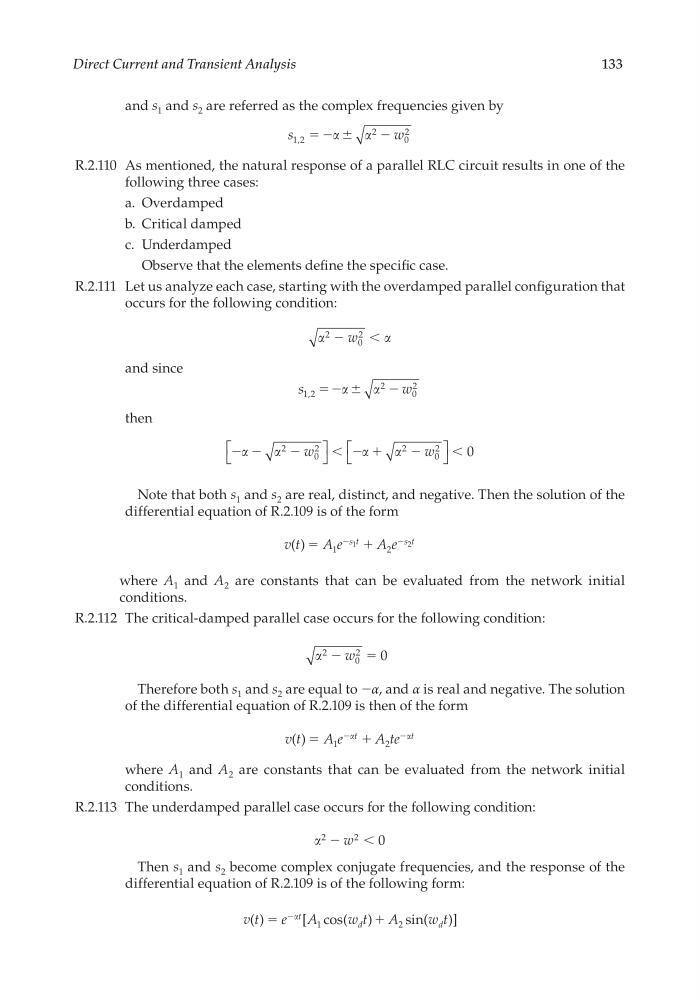
and s 1 and s 2 are referred as the complex frequencies given by
s
w
1 2
2
0
2
, ϭ
Ϯ
Ϫ
Ϫ
R.2.110 As mentioned, the natural response of a parallel RLC circuit results in one of the
following three cases:
a. Overdamped
b. Critical damped
c. Underdamped
Observe that the elements defi ne the specifi c case.
R.2.111 Let us analyze each case, starting with the overdamped parallel confi guration that
occurs for the following condition:
2
2
Ϫ w 0 Ͻ
and since
s
w
1 2
0
2
, ϭϪ Ϯ
Ϫ
2
then
Ϫ Ϫ
Ϫ
Ϫ
Ϫ
2
0
2
2
0
2
0
w
w
Ͻ
ϩ
Ͻ
Note that both s 1 and s 2 are real, distinct, and negative. Then the solution of the
differential equation of R.2.109 is of the form
v t
A e
A e
s t
s t
( ) ϭ
ϩ
1
2
1
2
Ϫ
Ϫ
where A 1 and A 2 are constants that can be evaluated from the network initial
conditions.
R.2.112 The critical-damped parallel case occurs for the following condition:
2
0
2
0
Ϫ w ϭ
Therefore both s 1 and s 2 are equal to −α, and α is real and negative. The solution
of the differential equation of R.2.109 is then of the form
v t
A e
A te
t
t
( ) ϭ
ϩ
1
2
Ϫ
Ϫ
where A 1 and A 2 are constants that can be evaluated from the network initial
conditions.
R.2.113 The underdamped parallel case occurs for the following condition:
2
2
0
Ϫ w Ͻ
Then s 1 and s 2 become complex conjugate frequencies, and the response of the
differential equation of R.2.109 is of the following form:
v t
e A
w t
A
w t
t
d
d
( )
[ cos( )
sin( )]
ϭ
ϩ
Ϫ
1
2
CRC_47760_CH002.indd 133
CRC_47760_CH002.indd 133
7/23/2008 1:38:43 PM
7/23/2008 1:38:43 PM
133
and s 1 and s 2 are referred as the complex frequencies given by
s
w
1 2
2
0
2
, ϭ
Ϯ
Ϫ
Ϫ
R.2.110 As mentioned, the natural response of a parallel RLC circuit results in one of the
following three cases:
a. Overdamped
b. Critical damped
c. Underdamped
Observe that the elements defi ne the specifi c case.
R.2.111 Let us analyze each case, starting with the overdamped parallel confi guration that
occurs for the following condition:
2
2
Ϫ w 0 Ͻ
and since
s
w
1 2
0
2
, ϭϪ Ϯ
Ϫ
2
then
Ϫ Ϫ
Ϫ
Ϫ
Ϫ
2
0
2
2
0
2
0
w
w
Ͻ
ϩ
Ͻ
Note that both s 1 and s 2 are real, distinct, and negative. Then the solution of the
differential equation of R.2.109 is of the form
v t
A e
A e
s t
s t
( ) ϭ
ϩ
1
2
1
2
Ϫ
Ϫ
where A 1 and A 2 are constants that can be evaluated from the network initial
conditions.
R.2.112 The critical-damped parallel case occurs for the following condition:
2
0
2
0
Ϫ w ϭ
Therefore both s 1 and s 2 are equal to −α, and α is real and negative. The solution
of the differential equation of R.2.109 is then of the form
v t
A e
A te
t
t
( ) ϭ
ϩ
1
2
Ϫ
Ϫ
where A 1 and A 2 are constants that can be evaluated from the network initial
conditions.
R.2.113 The underdamped parallel case occurs for the following condition:
2
2
0
Ϫ w Ͻ
Then s 1 and s 2 become complex conjugate frequencies, and the response of the
differential equation of R.2.109 is of the following form:
v t
e A
w t
A
w t
t
d
d
( )
[ cos( )
sin( )]
ϭ
ϩ
Ϫ
1
2
CRC_47760_CH002.indd 133
CRC_47760_CH002.indd 133
7/23/2008 1:38:43 PM
7/23/2008 1:38:43 PM