

132
Practical MATLAB
® Applications for Engineers
R.2.108 Systems higher than the second order are not considered in this section, but in
general, the solution follows the same steps outlined for the second-order system.
Higher-order systems arise when there are more than two independent energystoring elements. The transient response is obtained by solving for the roots of
the network characteristic equation that consist of either real numbers, in which
case the response consists of exponentials, or complex conjugate, in which case the
response consists of sinusoids (decaying or growing).
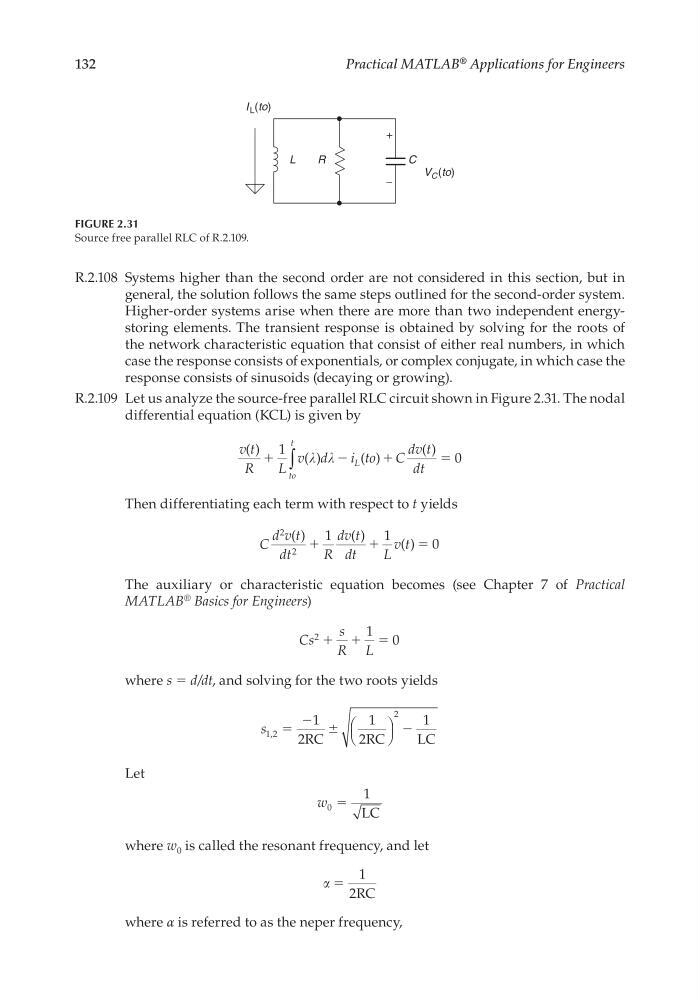
R.2.109 Let us analyze the source-free parallel RLC circuit shown in Figure 2.31. The nodal
differential equation (KCL) is given by
v t
R
L
v d
i to C
dv t
dt
L
to
t
( )
( )
( )
( )
ϩ
ϩ
ϭ
1
0
Ϫ
∫
Then differentiating each term with respect to t yields
C
d v t
dt
R
dv t
dt
L
v t
2
2
1
1
0
( )
( )
( )
ϩ
ϩ
ϭ
The auxiliary or characteristic equation becomes (see Chapter 7 of Practical
MATLAB
® Basics for Engineers)
Cs
s
R L
2
1 0
ϩ ϩ ϭ
where s = d/dt, and solving for the two roots yields
s 1 2
2
1
2
1
2
1
, ϭ
Ϯ
Ϫ
Ϫ
RC
RC
LC
Let
w 0
1
ϭ
LC
where w 0 is called the resonant frequency, and let
ϭ
1
2RC
where α is referred to as the neper frequency,
FIGURE 2.31
Source free parallel RLC of R.2.109.
R
L
C
I L (to)
V C (to)
+
−
CRC_47760_CH002.indd 132
CRC_47760_CH002.indd 132
7/23/2008 1:38:43 PM
7/23/2008 1:38:43 PM
Practical MATLAB
® Applications for Engineers
R.2.108 Systems higher than the second order are not considered in this section, but in
general, the solution follows the same steps outlined for the second-order system.
Higher-order systems arise when there are more than two independent energystoring elements. The transient response is obtained by solving for the roots of
the network characteristic equation that consist of either real numbers, in which
case the response consists of exponentials, or complex conjugate, in which case the
response consists of sinusoids (decaying or growing).
R.2.109 Let us analyze the source-free parallel RLC circuit shown in Figure 2.31. The nodal
differential equation (KCL) is given by
v t
R
L
v d
i to C
dv t
dt
L
to
t
( )
( )
( )
( )
ϩ
ϩ
ϭ
1
0
Ϫ
∫
Then differentiating each term with respect to t yields
C
d v t
dt
R
dv t
dt
L
v t
2
2
1
1
0
( )
( )
( )
ϩ
ϩ
ϭ
The auxiliary or characteristic equation becomes (see Chapter 7 of Practical
MATLAB
® Basics for Engineers)
Cs
s
R L
2
1 0
ϩ ϩ ϭ
where s = d/dt, and solving for the two roots yields
s 1 2
2
1
2
1
2
1
, ϭ
Ϯ
Ϫ
Ϫ
RC
RC
LC
Let
w 0
1
ϭ
LC
where w 0 is called the resonant frequency, and let
ϭ
1
2RC
where α is referred to as the neper frequency,
FIGURE 2.31
Source free parallel RLC of R.2.109.
R
L
C
I L (to)
V C (to)
+
−
CRC_47760_CH002.indd 132
CRC_47760_CH002.indd 132
7/23/2008 1:38:43 PM
7/23/2008 1:38:43 PM